Tariff A
Tariff B
Tariff C
Tariff D
This energy tariff comparison calculator uses the prices you enter. Bar shows the cheapest tariff’s cost as a share of the dearest. Enter prices as quoted, including VAT. Ofgem cap rates checked 22 October 2026: electricity has no VAT from 1 October 2026 to 31 March 2027 and gas includes 5 % VAT. Standing charges vary by region.
Formula and breakdown
n/a
n/a
n/a
n/a
n/a
This energy tariff comparison calculator prices up to four electricity and gas tariffs against your own yearly use, using each tariff’s unit rates, standing charges and any exit fee, and shows which one is cheapest for you. It is built for households in Great Britain and starts with the Ofgem price cap for 1 October to 31 December 2026 as the baseline to beat.
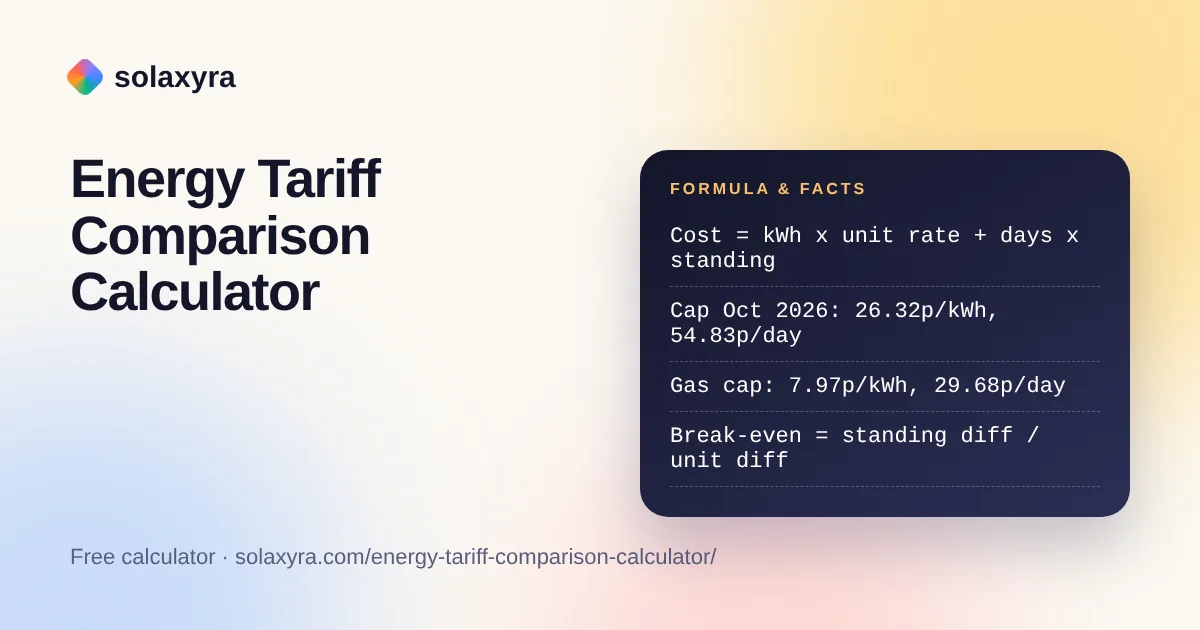
Quick answer: An energy tariff comparison calculator multiplies your yearly kWh by each tariff’s unit rate, adds the daily standing charge times 365, and adds any exit fee. At the October 2026 Ofgem cap of 26.32p per kWh and 54.83p a day, 2,700 kWh of electricity costs £910.77 a year.
What Is an Energy Tariff Comparison Calculator?
An energy tariff comparison calculator is a tool that works out the full cost of several tariffs for the same amount of energy, so you compare total bills instead of headline unit rates. In plain words: cost equals kWh used times unit rate, plus days times standing charge, plus any fee to leave your current deal, worked out separately for electricity and gas and then added together.
Unit rates are quoted in pence per kWh and standing charges in pence per day. A tariff with a low unit rate can still cost more if its standing charge is high and you use little energy, which is why the energy tariff comparison calculator also shows the break-even use between Tariff A and Tariff B.
How Do You Use the Energy Tariff Comparison Calculator?
- Enter your yearly electricity and gas use in kWh from your annual statement or online account. Set gas to 0 if you only have electricity.
- Leave Tariff A at the Ofgem price cap figures, or replace them with your current tariff.
- Type the unit rates and standing charges of a quote into Tariff B, including VAT, and add any exit fee your current supplier would charge.
- Fill in Tariffs C and D if you have more quotes, or leave them blank.
- Read the cheapest tariff, the saving against Tariff A and the break-even use, then open the breakdown to check each sum.
What Are the Price Cap Rates From 1 October 2026?
For 1 October to 31 December 2026, Ofgem’s GB average price cap for direct debit is 26.32p per kWh with a 54.83p daily standing charge for electricity, and 7.97p per kWh with a 29.68p daily standing charge for gas. Ofgem says gas prices include 5 per cent VAT, while the government has removed VAT from electricity bills from 1 October 2026 to 31 March 2027.
The cap limits the unit rate and standing charge a supplier can charge on a default tariff; it is not a limit on the total bill. Standing charges differ by region, and Ofgem publishes regional tables on its unit rates and standing charges page. Ofgem also notes in its October 2026 price cap announcement that customers on a fixed tariff are not affected by cap changes.
Why Can a Lower Unit Rate Cost You More?
A lower unit rate only saves money once your use is above the break-even point, where the extra standing charge is paid back. Break-even use equals the difference in yearly standing charges divided by the difference in unit rates.
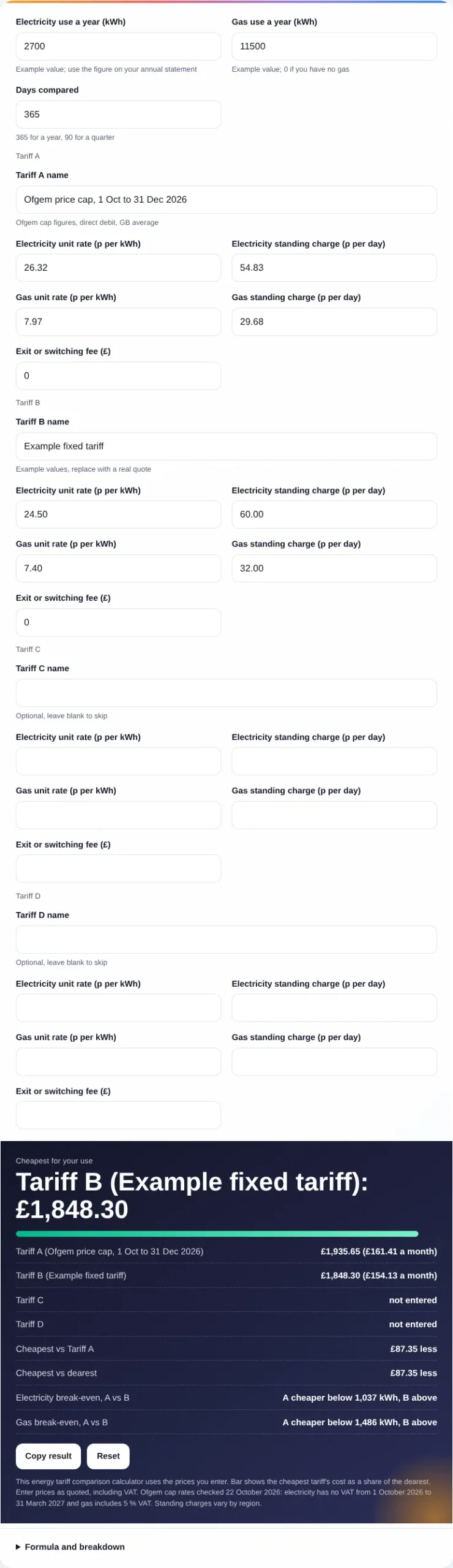
Example: the example fixed tariff in the tool charges 24.50p per kWh and 60.00p a day for electricity, against the cap’s 26.32p and 54.83p. The extra standing charge is 5.17p x 365 = £18.87 a year, and each kWh is 1.82p cheaper, so break-even is £18.87 / 1.82p = about 1,037 kWh. A one-person flat using 1,000 kWh a year would pay slightly more on the fixed tariff, while a home using more than 1,037 kWh would pay less. Our guide to how standing charges work explains why they vary.
How Much Do Standing Charges Add to a Year’s Bill?
At the October 2026 cap, the electricity standing charge adds £200.13 a year and the gas standing charge adds £108.33, a total of £308.46 before you use any energy. That fixed part is a large share of the bill for low users and a small share for high users, which is why the cheapest tariff depends on how much you use.
| Example yearly use | Ofgem cap, Oct to Dec 2026 | Example fixed tariff | Difference |
|---|---|---|---|
| 1,000 kWh electricity, no gas | £463.33 | £464.00 | Cap £0.67 cheaper |
| 1,800 kWh electricity, 5,000 kWh gas | £1,180.72 | £1,146.80 | Fixed £33.92 cheaper |
| 2,700 kWh electricity, 11,500 kWh gas | £1,935.65 | £1,848.30 | Fixed £87.35 cheaper |
| 4,200 kWh electricity, 17,000 kWh gas | £2,768.80 | £2,622.80 | Fixed £146.00 cheaper |
The fixed tariff figures are example values to show the method, not a real offer. Cap figures are Ofgem’s GB average direct debit rates, so your regional rates may differ by a few pence.
What Else Should You Compare Besides Price?
Check the contract length, any exit fee, whether the price is fixed or moves with the cap, and whether the deal needs a smart meter or a specific payment method. An exit fee belongs in the comparison, which is why the energy tariff comparison calculator adds it to the first year’s cost of the tariff you would move to or leave.
If you are weighing a fixed deal against staying on the cap, the price cap calculator shows your bill at the current cap. To find your yearly kWh when you do not have a statement, the energy consumption calculator adds up your appliances, and the electricity cost calculator prices a single appliance on any tariff.
Worked Example: Comparing Three Quotes for a 3-Bed Semi
Example: a 3-bedroom semi in Leeds uses 2,700 kWh of electricity and 11,500 kWh of gas a year. On the price cap it pays £910.77 for electricity and £1,024.88 for gas, a total of £1,935.65. An example fixed quote at 24.50p and 60.00p for electricity and 7.40p and 32.00p for gas comes to £880.50 plus £967.80 = £1,848.30, which is £87.35 less.
A third quote with a £75 exit fee from the current deal would need to be at least £75 cheaper over the year just to break even. The energy tariff comparison calculator adds that fee to the tariff’s cost, so the ranking you see already includes it. Remember that cap rates can change every quarter, while a fixed tariff stays the same for its term.
Frequently Asked Questions
How do I compare two energy tariffs?
Multiply your yearly kWh by each tariff’s unit rate, add the daily standing charge times 365, and add any exit fee. Do this separately for electricity and gas, then add them. The tariff with the lowest total is cheapest for your use, whatever its headline unit rate.
What is the price cap unit rate from October 2026?
For 1 October to 31 December 2026, Ofgem’s GB average direct debit cap is 26.32p per kWh and 54.83p a day for electricity, and 7.97p per kWh and 29.68p a day for gas. Regional rates differ, and gas includes 5 per cent VAT.
Is a lower standing charge or a lower unit rate better?
Low users usually save more with a lower standing charge, and high users with a lower unit rate. The break-even point is the standing charge difference over a year divided by the unit rate difference. The calculator works this out for electricity and gas.
Should I include VAT when comparing tariffs?
Yes. Compare prices as you will pay them. Ofgem’s cap figures for gas include 5 per cent VAT, and electricity has no VAT on household bills from 1 October 2026 to 31 March 2027, so enter quotes on the same basis.
Does the price cap affect fixed tariffs?
No. Ofgem says customers who have moved to a fixed rate tariff are not affected by changes to the price cap. Your unit rates and standing charges stay as agreed until the fixed term ends, so check what your supplier will move you to after that date.
Where do I find my yearly energy use in kWh?
Your annual statement, online account or app usually shows the last twelve months of use in kWh. If you are new to a home, ask the supplier for an estimate or build one from your appliances, then update the comparison once you have real readings.
Checked October 2026 by the Solaxyra Editorial Team. Sources: Ofgem: Energy price cap unit rates and standing charges, Ofgem: Changes to energy price cap between 1 October and 31 December 2026.