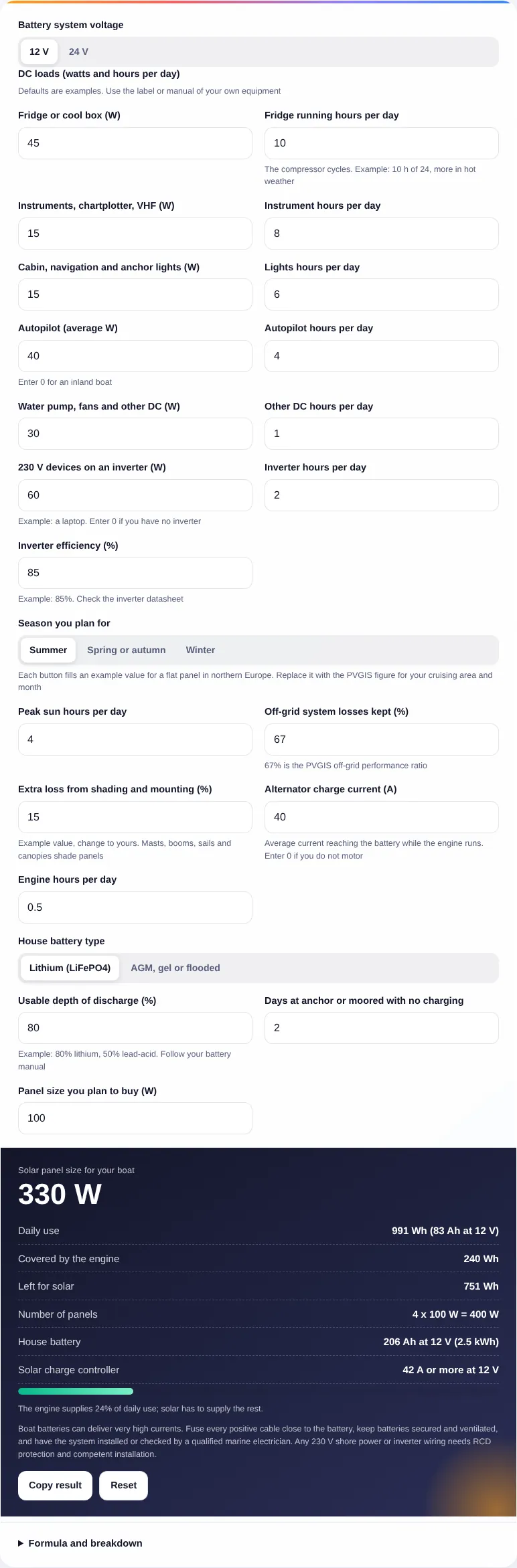
Boat batteries can deliver very high currents. Fuse every positive cable close to the battery, keep batteries secured and ventilated, and have the system installed or checked by a qualified marine electrician. Any 230 V shore power or inverter wiring needs RCD protection and competent installation.
Formula and breakdown
n/a
n/a
n/a
n/a
This boat solar calculator works out the solar panel wattage, house battery size and charge controller rating for a sailing yacht, motor cruiser or narrowboat, from your own list of 12 V or 24 V loads, the sun you can expect where you cruise, shading from the rig or canopy, and the charge your engine adds while motoring.
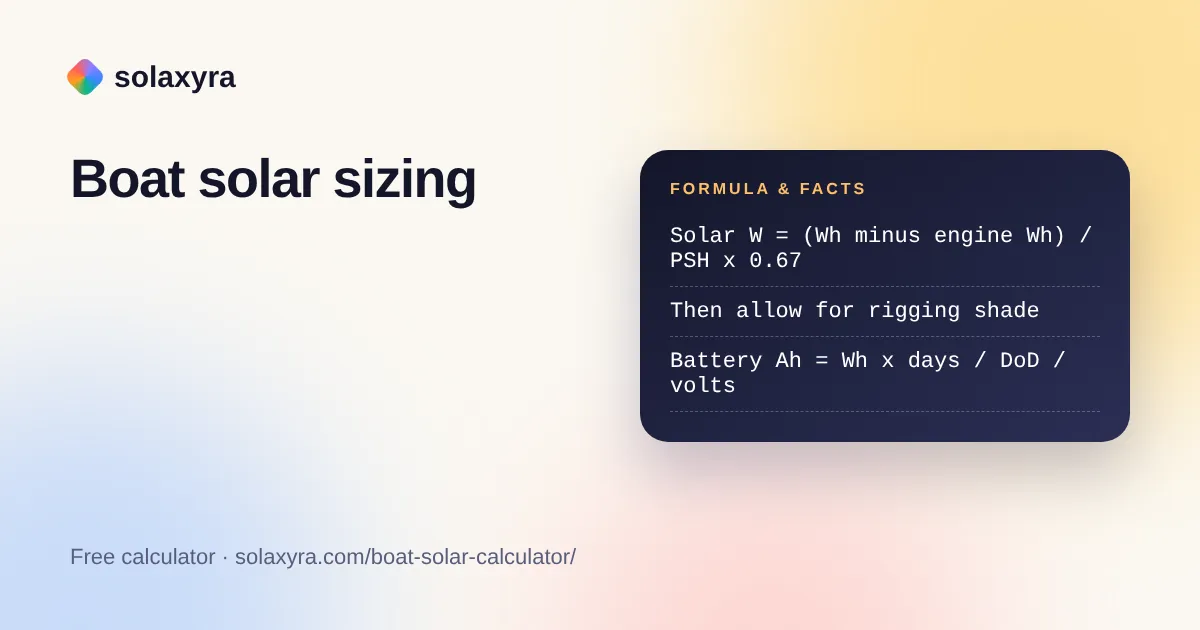
Quick answer: A boat solar calculator adds up the watt-hours your boat uses each day, subtracts engine charging, and divides the rest by peak sun hours times the 0.67 PVGIS off-grid ratio and a shading allowance. With no engine charging, 1,000 Wh a day needs about 440 W of panels at 4 sun hours with 15% shading.
What Is a Boat Solar Calculator?
A boat solar calculator is a sizing tool that turns a boat’s daily electrical use into the panel watts, battery amp-hours and controller current needed to stay charged away from shore power. The formula in plain words: daily energy is each load’s watts times its hours, with inverter loads divided by the inverter efficiency; solar watts equal the energy left after engine charging, divided by peak sun hours, the off-grid performance ratio and the share of light that is not shaded; battery amp-hours equal daily energy times the days you want to last, divided by usable depth of discharge and system voltage.
Boats differ from vans and cabins in two ways that change the answer. Masts, booms, sails, radar arches and canopies cast moving shadows over the panels, and many boats motor for part of the day, which puts energy back through the alternator. The boat solar calculator treats both as separate inputs so you can see their effect.
How Do You Use the Boat Solar Calculator?
- Choose a 12 V or 24 V battery system.
- Enter the watts and daily hours of each DC load. For a fridge, enter the hours the compressor actually runs.
- Add any 230 V devices that run on an inverter and set its efficiency.
- Pick a season, then replace the example sun hours with a figure for your cruising area and month.
- Set the extra loss for shading and mounting, the alternator current reaching the battery and your engine hours per day.
- Choose lithium or lead-acid, the days you want to last with no charging, and the panel size you plan to buy.
- Read the panel watts, panel count, battery size and controller rating, and open the breakdown to check each step.
How Many Watts of Solar Do You Need on a Boat?
A boat using 1,000 Wh a day with no engine charging needs about 440 W of panels at 4 peak sun hours, after a 0.67 off-grid performance ratio and 15% shading. The 0.67 figure comes from the PVGIS user manual for off-grid systems, which uses it to cover losses in the battery, the inverter and ageing components. The table shows how strongly the season changes the answer.
| Daily use | Summer (4 sun hours) | Spring or autumn (2) | Winter (0.7) | Battery for 2 days, lithium |
|---|---|---|---|---|
| 500 Wh | 219 W | 439 W | 1,254 W | 104 Ah at 12 V or 52 Ah at 24 V |
| 1,000 Wh | 439 W | 878 W | 2,508 W | 208 Ah at 12 V or 104 Ah at 24 V |
| 1,500 Wh | 658 W | 1,317 W | 3,763 W | 312 Ah at 12 V or 156 Ah at 24 V |
Sun hours are examples for a flat panel in northern Europe; panel watts assume a 0.67 ratio, 15% shading and no engine charging, and the battery assumes 80% usable depth. Winter figures show why most boats rely on shore power or the engine from late autumn. For a real figure, open PVGIS, choose the off-grid tool, set a horizontal panel at your mooring or cruising area and read the monthly results.
How Big Should a Boat’s House Battery Be?
A house battery should hold your daily use times the days you want to stay at anchor or on a mooring without charging, divided by the usable depth of discharge and the system voltage. For 1,000 Wh a day over 2 days with lithium at an example 80% usable depth, that is 1,000 x 2 / 0.8 / 12 = 208 Ah at 12 V, or 104 Ah at 24 V. Lead-acid banks are usually run to about half their capacity to protect their life, so the same need doubles to about 333 Ah at 12 V; check the figure in your battery manual. Our battery bank size calculator shows how to wire several batteries in series and parallel to reach the result.
How Much Does Engine Charging Reduce the Solar You Need?
Each hour of motoring adds roughly the alternator current times the system voltage in watt-hours, so 40 A for half an hour at 12 V puts back 240 Wh and cuts the solar needed by about a quarter for a 1,000 Wh day. Use the average current that reaches the battery, not the alternator’s label rating, because the regulator and a battery near full limit what it accepts. On days spent at anchor the engine adds nothing, which is why battery size is worked out from the days with no charging rather than from an average day.
Should a Boat Use 12 V or 24 V?
A 24 V system halves the current for the same power, which means smaller cables, fuses and charge controllers and lower voltage drop on long runs to the bow or mast. Many smaller yachts and narrowboats stay at 12 V because most marine instruments, pumps and lights are made for it. The boat solar calculator shows battery size in amp-hours and controller current at the voltage you choose; for the controller itself, the MPPT charge controller calculator also checks the cold open circuit voltage of your panels.
What Safety Rules Apply to Boat Solar and Batteries?
Every positive cable from a battery needs a correctly rated fuse or circuit breaker as close to the battery as practical, and batteries must be secured and ventilated. The Boat Safety Scheme electrical standards require batteries to be stowed so they cannot move and in a ventilated space, because charging can give off hydrogen, a highly flammable gas, and they require fuses and breakers to suit the circuits they protect.
- Have the system designed or checked by a qualified marine electrician.
- Use marine grade tinned cable sized for the current and length; the solar cable size calculator helps with the DC runs from the panels.
- Fit a battery isolator and keep 230 V shore power and inverter circuits on RCD protection.
- Follow the charging limits in your battery and controller manuals, especially for lithium batteries.
Worked Example: A 24 V Yacht Cruising in Summer
Example: a 10 metre yacht with a 24 V lithium bank plans summer coastal cruising with the default loads in the boat solar calculator.
- DC loads: fridge 45 W x 10 h = 450 Wh, instruments 15 W x 8 h = 120 Wh, lights 15 W x 6 h = 90 Wh, autopilot 40 W x 4 h = 160 Wh, pump and fans 30 W x 1 h = 30 Wh. Total 850 Wh.
- Inverter: 60 W x 2 h = 120 Wh, divided by 0.85 = 141 Wh. Daily use: 991 Wh.
- Engine: 40 A x 24 V x 0.5 h = 480 Wh, leaving 511 Wh for solar.
- Solar: 511 / (4 x 0.67 x 0.85 = 2.28) = 224 W. With 175 W panels, fit 2, giving 350 W.
- Battery for 2 days at anchor: 991 x 2 / 0.8 / 24 = 103 Ah at 24 V.
- Controller: 350 W / 24 V x 1.25 = 18 A or more.
On days at anchor with no motoring, 350 W supplies about 350 x 4 x 0.67 x 0.85 = 797 Wh, a little short of 991 Wh, so the battery covers the gap and the next passage tops it up. The same loads on a 12 V system would need a 206 Ah bank, and because half an hour of motoring then adds only 240 Wh, about 330 W of panels; four 100 W panels would need a controller of 42 A or more.
Frequently Asked Questions
How many watts of solar do I need for a sailing yacht?
It depends on daily use, not boat length. A yacht using 1,000 Wh a day needs about 440 W at an example 4 summer sun hours after off-grid losses and 15% shading from the rig. Use the boat solar calculator with your own loads and cruising area.
Is 200 W of solar enough for a narrowboat?
In summer, 200 W can supply roughly 450 Wh a day at 4 sun hours after losses and some shading, enough for lights, a pump and phone charging. A compressor fridge or inverter use usually needs more panels, engine running or shore power, especially from October to March.
Should a boat use a 12 V or 24 V battery system?
Both work. At 24 V the current for the same power is halved, so cables, fuses and charge controllers can be smaller over long runs. Smaller boats often stay at 12 V because most marine electronics and accessories are made for it.
How much does shading from the mast and boom reduce solar output?
Even a thin shadow across one cell can cut a panel’s output sharply, because cells in a string share the same current. Losses vary with sail plan, heading and time of day, so the boat solar calculator lets you set your own extra shading allowance.
Do I need an MPPT controller on a boat?
An MPPT controller converts higher panel voltage into extra charging current, which helps with long cable runs and panels wired in series. Size it for the panel watts divided by battery voltage with a margin, and check its maximum input voltage against the panels’ cold open circuit voltage.
Who should fit solar panels and batteries on a boat?
A qualified marine electrician should install or check the system. Batteries must be secured and ventilated, every circuit needs a correctly rated fuse or breaker, and 230 V shore power or inverter wiring needs RCD protection. Boats under the Boat Safety Scheme are examined against its standards.
Checked October 2026 by the Solaxyra Editorial Team. Sources: PVGIS user manual, EU JRC, Boat Safety Scheme Part 3 electrical installations, Boat Safety Scheme electrical safety.