This guide compares an air source vs ground source heat pump for UK homes: how each works, the typical installation costs and efficiencies, the space and planning each needs, and which tends to suit different properties.
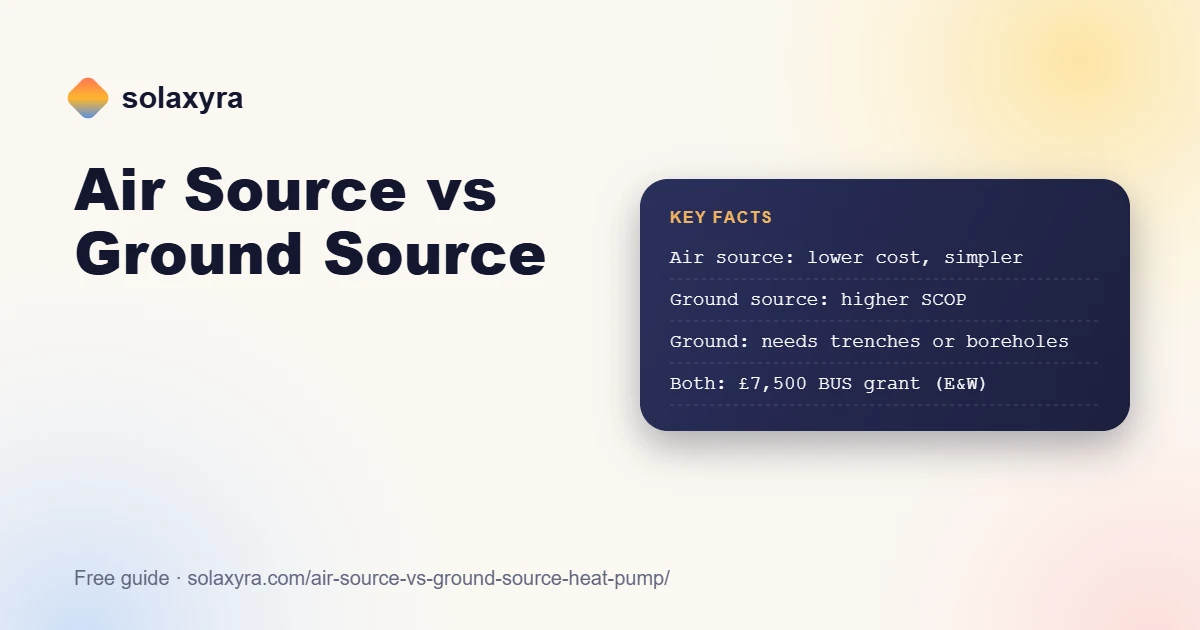
Quick answer: Air source heat pumps are cheaper and easier to install and suit most homes. Ground source heat pumps cost far more to install because of trenches or boreholes, but they are usually more efficient and quieter, because the ground stays at a steadier temperature than the air. Both qualify for the £7,500 Boiler Upgrade Scheme grant in England and Wales.
How do they differ?
Both use the same refrigerant cycle. The difference is where the heat comes from.
- Air source heat pumps use a fan unit outside to take heat from the outdoor air.
- Ground source heat pumps circulate fluid through pipes buried in horizontal trenches or deep vertical boreholes, collecting heat from the ground, which stays at roughly 10 to 12°C below a metre or two all year in the UK.
Side-by-side comparison
| Factor | Air source | Ground source |
|---|---|---|
| Typical seasonal efficiency (SCOP) | about 3 to 3.5 | about 3.5 to 4.5 |
| Installation cost | lower | much higher, mainly ground works |
| Space needed | space for an outdoor unit | large garden for trenches, or drilling access for boreholes |
| Noise | outdoor fan, usually quiet but audible | very quiet, no outdoor fan |
| Disruption | a day or two of work plus plumbing | major ground works |
| Lifespan | often around 15 to 20 years | heat pump unit similar; ground loop can last 50 years or more |
Running costs
Higher efficiency means lower bills. For a home needing 12,000 kWh of heat a year, at the October to December 2026 cap of 26.32p per kWh:
| System | SCOP | Electricity used | Yearly cost |
|---|---|---|---|
| Air source | 3.2 | 3,750 kWh | £987 |
| Ground source | 4.0 | 3,000 kWh | £790 |
The difference of around £200 a year rarely pays back the extra installation cost on its own, but ground source can make sense for large homes with high heat demand and plenty of land.
Which is right for your home?
- Air source suits most homes, including terraces and semis, where there is a suitable outside wall or space for the unit.
- Ground source suits larger rural homes with big gardens, high heat demand, or where outdoor noise is a concern. Shared ground loops for terraces and flats are also growing.
Grants and planning
The Boiler Upgrade Scheme in England and Wales currently offers £7,500 towards either type. Air source units are often permitted development in England, subject to conditions on size, position and noise. Boreholes may need checks with the local authority and consideration of ground conditions.
Frequently Asked Questions
Is ground source more efficient than air source?
Usually yes, because the ground is warmer than winter air, giving a higher seasonal efficiency.
Which is cheaper to install?
Air source, by a wide margin, because no ground works are needed.
Can I get a grant for a ground source heat pump?
Yes, the Boiler Upgrade Scheme offers £7,500 in England and Wales.
Do ground source heat pumps need a lot of land?
Horizontal trenches need a large garden; vertical boreholes need much less surface area.
Checked November 2026 by the Solaxyra Editorial Team. Sources: Energy Saving Trust: Ground source heat pumps, Energy Saving Trust: Air source heat pumps, GOV.UK: Boiler Upgrade Scheme.