A planning estimate only. Ground loops must be designed by an MCS certified installer to MIS 3005 and drilled by a competent drilling contractor.
Formula and breakdown
n/a
n/a
n/a
This ground source heat pump borehole size calculator estimates the total length of vertical borehole a home heat pump needs, how many holes that means at a given depth, and which MCS 022 look-up table and column apply, for homeowners, self-builders and specifiers in the UK planning a closed-loop system. It works from the heat pump’s output, the seasonal efficiency and the heat extraction rate per metre for your ground, and shows every step so the figure can be checked against an installer’s design.
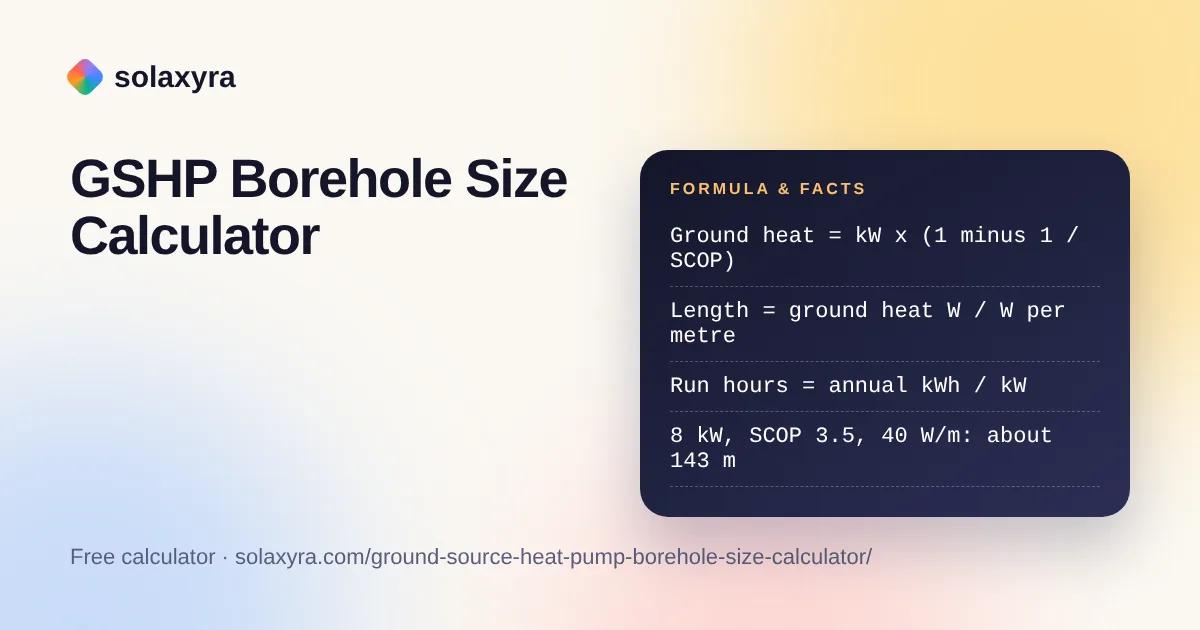
Quick answer: A ground source heat pump borehole size calculator divides ground heat by the extraction rate per metre. Example: an 8 kW heat pump at a seasonal efficiency of 3.5 draws 5.71 kW from the ground, so at an example 40 W per metre it needs about 143 m of borehole, or two holes of about 71 m.
What Is a Ground Source Heat Pump Borehole Size Calculator?
A ground source heat pump borehole size calculator is a tool that converts a heat pump’s output into the length of vertical ground loop needed to supply it without over-cooling the ground. In plain words: the ground supplies the share of the heat that the electricity does not, which is the output times 1 minus 1 divided by the seasonal efficiency. Divide that heat in watts by the safe extraction rate in watts per metre and you have the borehole length.
The check works on published figures. In a 2011 MCS design seminar paper on the borehole charts, a heat pump giving 4.37 kW at a COP of 3.05 extracts 2.93 kW from the ground; 4.37 x (1 minus 1 / 3.05) gives 2.94 kW, the same answer within rounding.
How Do You Use the Ground Source Heat Pump Borehole Size Calculator?
- Enter the heat pump’s heating output in kW from your room-by-room heat loss design, and the annual heat demand for heating and hot water in kWh.
- Enter the seasonal efficiency (SCOP or seasonal performance factor) from the design.
- Pick the ground type, or enter a measured thermal conductivity from a thermal response test.
- Read the run hours and the MCS 022 table it points to, then enter the extraction rate in W per metre from that table for your ground conductivity and mean ground temperature.
- Enter the maximum depth the driller can reach and the spacing between holes, then read the total length, number of holes and the per metre energy check.
How Deep Does a Ground Source Heat Pump Borehole Need to Be?
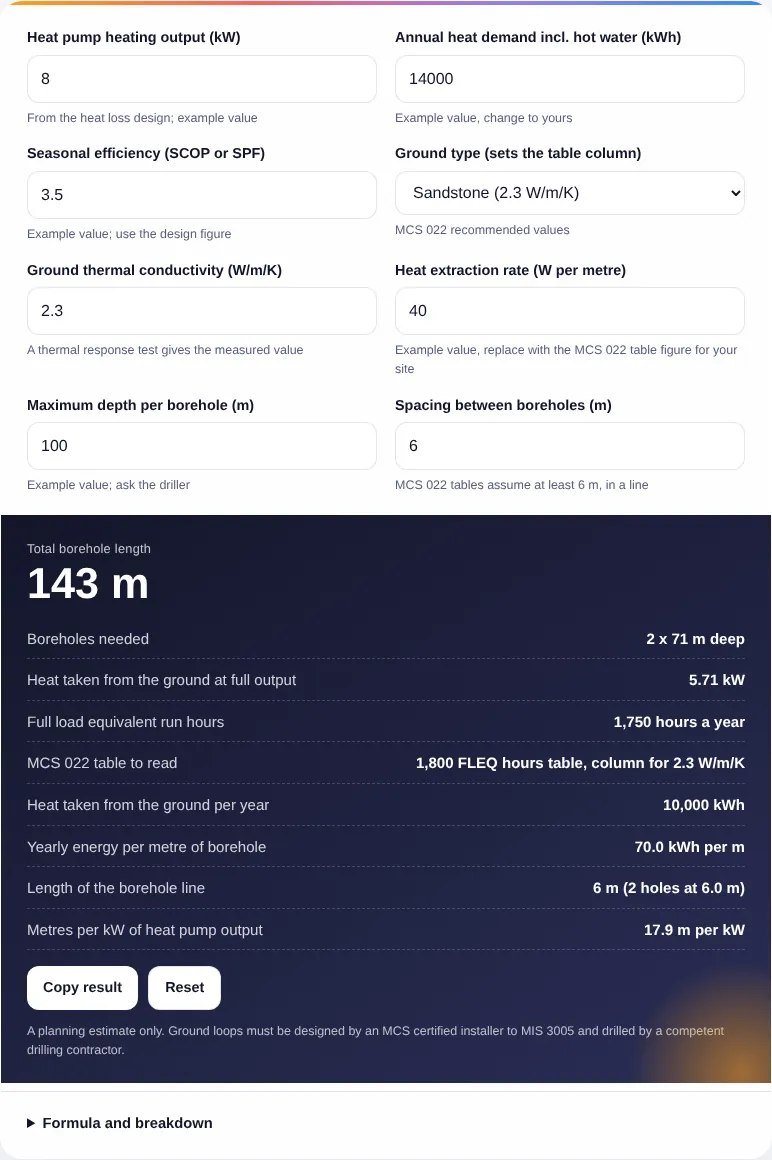
There is no fixed depth: total length equals the heat taken from the ground divided by the extraction rate per metre, and the ground source heat pump borehole size calculator then splits that length between one or more holes. An 8 kW heat pump with a seasonal efficiency of 3.5 needs about 143 m at 40 W per metre, which could be two holes of about 71 m or one of 143 m.
The Wikipedia article on ground source heat pumps describes vertical boreholes from about 15 to 122 m deep and gives an example of a 10 kW home needing three boreholes of 80 to 110 m. Real designs vary widely because ground conductivity, ground temperature and run hours all change the safe extraction rate, which is why an example rate is shown here rather than a single rule of thumb.
What Are the MCS 022 Look-Up Tables?
MCS 022 is a set of ground heat exchanger look-up tables, supplementary to the MCS heat pump standard MIS 3005, that give the maximum heat in watts that may be taken from each metre of borehole. The borehole tables are arranged by average ground thermal conductivity in W/m/K and mean ground temperature, with a separate table for 1,200, 1,800, 2,400, 3,000 and 3,600 full load equivalent run hours a year.
Run hours are the annual heat demand divided by the heat pump’s output, so the ground source heat pump borehole size calculator tells you which table to read. The tables assume heat extraction only, a 130 mm borehole with a single U-tube of 32 mm PE100 pipe, 25% glycol antifreeze, thermally enhanced grout of 2.4 W/m/K and holes at least 6 m apart in a line. The published design seminar paper adds that the charts aim to keep the fluid returning from the ground above 0 °C after 20 years.
| Ground type in MCS 022 | Recommended thermal conductivity |
|---|---|
| Clay or silt, water-saturated | 1.7 W/m/K |
| Sandstone | 2.3 W/m/K |
| Granite | 3.4 W/m/K |
Higher conductivity lets heat flow back to the borehole faster, so the same heat pump needs fewer metres in granite than in clay. A thermal response test on a trial borehole replaces these book values with a measured figure.
How Does the Extraction Rate Change Borehole Length?
Borehole length is inversely proportional to the extraction rate, so halving the rate from 40 to 20 W per metre doubles the length from about 143 m to about 286 m for the same 8 kW heat pump. The table below runs the default example through the ground source heat pump borehole size calculator at a range of example rates.
| Extraction rate (example) | Total length | Holes at 100 m maximum | Energy per metre per year |
|---|---|---|---|
| 20 W/m | 286 m | 3 x 95 m | 35.0 kWh |
| 30 W/m | 190 m | 2 x 95 m | 52.5 kWh |
| 40 W/m | 143 m | 2 x 71 m | 70.0 kWh |
| 50 W/m | 114 m | 2 x 57 m | 87.5 kWh |
| 60 W/m | 95 m | 1 x 95 m | 105.0 kWh |
All rows assume 8 kW output, 14,000 kWh a year and a seasonal efficiency of 3.5, which gives 1,750 run hours and points to the 1,800 hour table. The yearly energy per metre column is a sense check: the same annual heat spread over fewer metres means each metre has to give up more energy every winter.
Does Seasonal Efficiency Change the Borehole Size?
Yes: a more efficient heat pump takes a larger share of its heat from the ground, so at the same output a seasonal efficiency of 4 needs 150 m at 40 W per metre where 3 needs about 133 m. This surprises many people, but the electricity supplies less of the heat when efficiency rises, so the ground has to supply more.
That extra borehole is usually worth it, because running costs fall as efficiency rises. To see the effect on bills, put the same heat demand and efficiency into the heat pump running cost calculator, and check the heat pump’s electricity use per hour with the electricity cost calculator. Our heat pump size calculator and ground source heat pump cost calculator cover the steps before and after this one.
Who Must Design and Drill the Boreholes?
An MCS certified installer working to MIS 3005 should design the ground loop, and a competent drilling contractor should drill it. For the Boiler Upgrade Scheme, GOV.UK tells homeowners to get quotes from MCS certified installers, and the installer applies for the grant. This ground source heat pump borehole size calculator is a planning check, not a design. The installer will use the full method, your measured heat loss and site data, and may commission a thermal response test.
The electrical supply to the heat pump and its circulation pumps must be installed by a qualified electrician to BS 7671; in England and Wales this is notifiable work under Part P of the Building Regulations.
Worked Example: Detached House on Sandstone
Example: a detached house in Shropshire on sandstone has a designed heat loss that calls for an 8 kW ground source heat pump, an annual heat demand of 14,000 kWh including hot water and a design seasonal efficiency of 3.5. The driller can reach 100 m, and the installer’s table gives an example rate of 40 W per metre. The steps below are what the ground source heat pump borehole size calculator shows for these inputs.
- Ground share: 1 minus 1 / 3.5 = 0.714, so 71.4% of the heat comes from the ground.
- Heat taken from the ground at full output: 8 x 0.714 = 5.71 kW, or 5,714 W.
- Borehole length: 5,714 / 40 = 142.9 m, about 143 m.
- Holes: 142.9 / 100 rounded up = 2 holes of about 71 m, at least 6 m apart.
- Run hours: 14,000 / 8 = 1,750 hours, so the installer reads the 1,800 hour MCS 022 table in the 2.3 W/m/K sandstone column.
- Check: 14,000 x 0.714 = 10,000 kWh a year from the ground, or 70 kWh per metre.
Frequently Asked Questions
How many metres of borehole per kW does a ground source heat pump need?
It depends on the extraction rate for your ground and the seasonal efficiency. Example: with a seasonal efficiency of 3.5, each kW of heat pump output needs about 17.9 m at 40 W per metre and about 35.7 m at 20 W per metre. The calculator shows the metres per kW for your inputs.
How do I find the W per metre extraction rate for my ground?
Read it from the MCS 022 borehole table for your run hours, ground thermal conductivity and mean ground temperature, or ask your MCS certified installer. A thermal response test on a trial borehole gives a measured conductivity, which is more reliable than a book value for the rock type.
What are full load equivalent run hours?
They are the annual heat demand divided by the heat pump’s output, as if it ran flat out. Example: 14,000 kWh a year from an 8 kW heat pump is 1,750 hours. MCS 022 has separate borehole tables for 1,200, 1,800, 2,400, 3,000 and 3,600 hours.
How far apart should ground source boreholes be?
The MCS 022 borehole tables assume holes at least 6 m apart, arranged in a line, and say the values do not apply to many systems packed into a small area. Closer or clustered holes need a full design, because neighbouring holes cool the same ground.
Why does a more efficient heat pump need a longer borehole?
Because the ground supplies the heat that the electricity does not. At a seasonal efficiency of 3, the ground gives two thirds of the heat; at 4, it gives three quarters. The same output therefore draws more from the ground, so the ground loop must be slightly longer.
Can I use this ground source heat pump borehole size calculator for my final design?
No. It is a planning estimate. Under MCS, the ground loop is designed by a certified installer to MIS 3005 using the full method and site data, and the boreholes are drilled by a competent contractor. Use the result to sense check quotes and site space.
Checked October 2026 by the Solaxyra Editorial Team. Sources: GOV.UK: Boiler Upgrade Scheme, how to apply, MCS 022 Ground heat exchanger look-up tables, Issue 1.0 (GSHPA copy), GSHPA Cambridge seminar 2011: MCS borehole design charts, Wikipedia: Ground source heat pump.