Bar shows the ground coverage ratio. Level ground, identical rows; times are local solar time. Southern sites use the June solstice and north-facing rows.
Formula and breakdown
n/a
n/a
n/a
This solar row spacing calculator works out the clear gap and front-to-front pitch between rows of tilted solar panels so that one row does not shade the next on the winter solstice, for flat roofs, garden arrays and field installations in the UK, Ireland, Europe and worldwide. It uses the full sun position formula for a time window you choose, not just solar noon.
Quick answer: A solar row spacing calculator divides the back-edge rise of a tilted row by the tangent of the lowest winter sun angle you design for. In London, a 1.72 m panel at 30 degrees rises 0.86 m and needs a 3.20 m gap for noon on the winter solstice, or 4.08 m for 10:00 to 14:00.
What Is a Solar Row Spacing Calculator?
A solar row spacing calculator is a tool that finds the minimum distance between the back edge of one row of tilted panels and the front edge of the next so that the first row's shadow does not reach the second during a chosen period. In plain words: the gap equals the height the back edge rises above the front edge divided by the tangent of the sun's elevation, corrected for the sun's direction.
The sun's elevation comes from the standard relation in the solar zenith angle article: the sine of the elevation equals sin(latitude) x sin(declination) + cos(latitude) x cos(declination) x cos(hour angle). On the December solstice the declination is minus 23.44 degrees, as given in the position of the Sun article, and the hour angle moves 15 degrees for each hour from solar noon.
How Do You Use the Solar Row Spacing Calculator?
- Choose how long each winter day the rows must stay unshaded: solar noon only, 10:00 to 14:00, or 9:00 to 15:00 local solar time.
- Pick a city or type your latitude; use a negative value south of the equator.
- Enter the length of the panel or mounting table up the slope, in metres or feet, and the tilt angle.
- If the rows do not face due south (or due north in the southern hemisphere), enter the azimuth offset, west positive.
- Enter the number of rows to see the total depth the array needs.
- Read the gap, pitch, ground coverage ratio and the noon-only gap for comparison, and open the breakdown to check the angles.

How Do You Calculate the Spacing Between Solar Panel Rows?
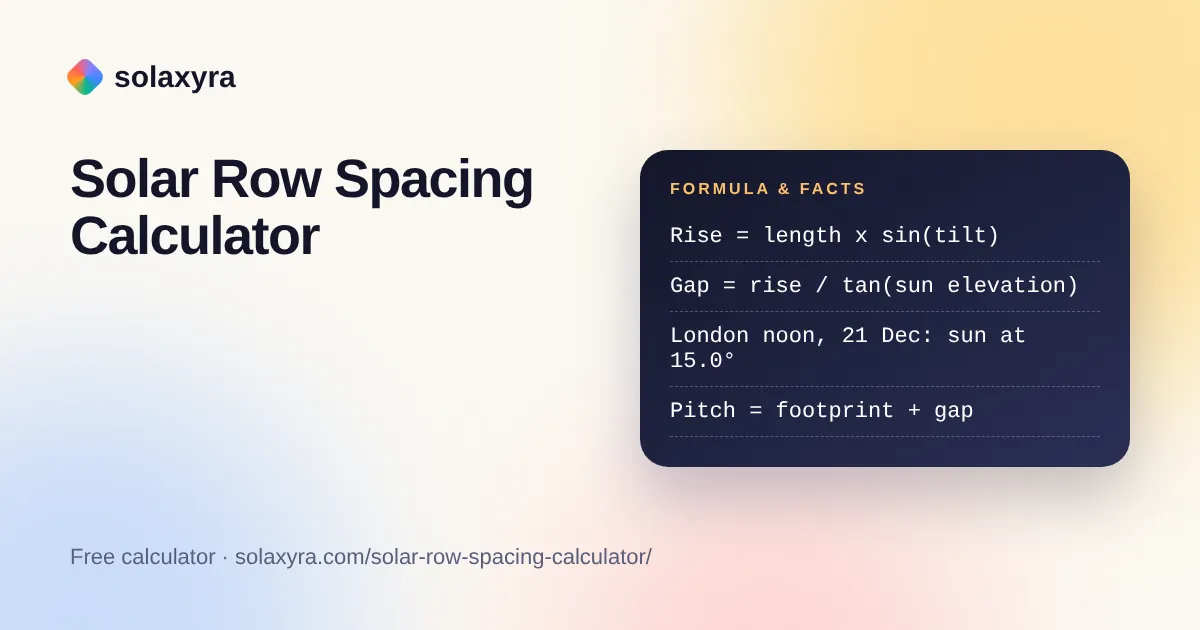
Multiply the panel length up the slope by the sine of the tilt to get the rise, then divide the rise by the tangent of the lowest sun elevation you design for. At London's winter solstice noon the sun is 15.0 degrees high, so a 0.86 m rise needs 0.86 / tan 15.0 = 3.20 m of clear gap. Add the row footprint, length times cosine of tilt, to get the pitch: 1.49 + 3.20 = 4.69 m.
Away from noon the sun sits to the east or west, so its shadow falls at an angle across the rows rather than straight back. The solar row spacing calculator works out the sun's azimuth with the standard position formula and multiplies the shadow length by the cosine of the angle between the sun and the direction the rows face. This is the azimuth correction that many guides ask you to look up from a sun chart.
How Much Gap Do Solar Rows Need in the UK and Europe?
At UK latitudes, rows due south need roughly 3.4 to 6 times their rise as a clear gap for noon on the winter solstice, rising to 4.3 to 9 times for 10:00 to 14:00. The table gives the gap per 1 m of rise for rows facing due south, calculated with this solar row spacing calculator. Multiply by your own rise.
| City (latitude) | Sun at noon, 21 Dec | Gap per 1 m rise, noon | Lowest sun 10:00 to 14:00 | Gap per 1 m rise, 10:00 to 14:00 | Gap per 1 m rise, 9:00 to 15:00 |
|---|---|---|---|---|---|
| Madrid (40.42°) | 26.1° | 2.04 m | 20.3° | 2.36 m | 3.07 m |
| Rome (41.90°) | 24.7° | 2.18 m | 19.0° | 2.54 m | 3.36 m |
| Paris (48.86°) | 17.7° | 3.13 m | 12.9° | 3.85 m | 5.90 m |
| Plymouth (50.37°) | 16.2° | 3.44 m | 11.6° | 4.32 m | 7.01 m |
| London (51.51°) | 15.0° | 3.72 m | 10.6° | 4.75 m | 8.17 m |
| Berlin (52.52°) | 14.0° | 4.00 m | 9.7° | 5.20 m | 9.57 m |
| Dublin (53.35°) | 13.2° | 4.26 m | 8.9° | 5.64 m | 11.13 m |
| Manchester (53.48°) | 13.1° | 4.30 m | 8.8° | 5.71 m | 11.42 m |
| Edinburgh (55.95°) | 10.6° | 5.34 m | 6.6° | 7.64 m | 22.59 m |
| Aberdeen (57.15°) | 9.4° | 6.03 m | 5.6° | 9.12 m | 42.91 m |
The last column shows why a full 9:00 to 15:00 shade-free rule rarely makes sense in Scotland: the sun is only one or two degrees above the horizon at the edges of the window, and very little energy arrives then anyway.
Why Is the Winter Solstice Used for Row Spacing?
The winter solstice is the day the noon sun is lowest, so a gap that clears shadows then clears them at the same time of day for the whole year. In the northern hemisphere this is around 21 December; south of the equator it is around 21 June, and the solar row spacing calculator switches automatically when you enter a negative latitude.
You may choose to accept some winter shading to fit more panels, because at high latitudes the low winter sun delivers a small share of yearly sunlight. The noon-only result is the tightest gap that avoids shading at midday; the window results trade more space for more winter hours.
What Is Ground Coverage Ratio?
Ground coverage ratio (GCR) is the panel length up the slope divided by the row pitch: a 1.72 m panel on a 5.57 m pitch has a GCR of 31%. A higher GCR means more panels on the same roof or field but more inter-row shading, especially in winter. Lowering the tilt is the most effective way to raise GCR without extra shading, because the rise falls with the sine of the tilt. Our solar panel angle calculator shows how much yield a lower tilt gives up, and the solar panel roof area calculator helps count how many panels fit across the width.
Worked Example: Two Rows on a Flat Roof in Manchester
Example: a flat garage roof in Manchester (latitude 53.48 degrees) will hold rows of panels 1.134 m long up the slope, mounted landscape on frames tilted at 15 degrees, facing due south. The owner wants no row-to-row shading from 10:00 to 14:00 on the winter solstice.
- Rise: 1.134 x sin 15 = 0.293 m. Footprint: 1.134 x cos 15 = 1.095 m.
- Sun at 10:00 solar time on 21 December (hour angle minus 30 degrees): elevation 8.8 degrees, azimuth 28 degrees east of south.
- Gap: 0.293 / tan 8.8 x cos 28 = about 1.68 m, matching 0.293 x 5.71 from the table.
- Pitch: 1.095 + 1.68 = 2.77 m, so two rows need about 2.77 + 1.10 = 3.87 m of roof depth.
- For noon only, the gap would be 0.293 x 4.30 = 1.26 m.
Before fitting, the roof's capacity for the frames, ballast and wind uplift should be checked by a structural engineer, and the wiring installed by a qualified electrician to BS 7671. Our solar panel orientation calculator helps if the roof forces the rows away from due south.
Frequently Asked Questions
What is the formula for solar panel row spacing?
Gap equals rise divided by the tangent of the sun's elevation, where rise is panel length up the slope times the sine of the tilt. If the sun is not straight in front of the rows, multiply by the cosine of the angle between sun azimuth and array azimuth.
Why use the winter solstice for row spacing?
The sun is at its lowest on the winter solstice, around 21 December in the northern hemisphere, so shadows are longest. Rows spaced to be shade-free then will be shade-free at the same time of day for the rest of the year.
Should I design for solar noon or a wider window?
Solar noon gives the smallest gap but leaves rows shading each other for most of the winter day. A 10:00 to 14:00 window is a middle option; 9:00 to 15:00 at UK latitudes gives very large gaps because the sun is only a few degrees high.
What is a good ground coverage ratio?
Ground coverage ratio is panel length up the slope divided by row pitch. A higher ratio fits more panels in the space but increases winter shading. The right value depends on land or roof cost and how much winter output matters, so compare options with the calculator.
Does lower tilt reduce row spacing?
Yes. Rise is panel length times the sine of the tilt, so dropping from 30 to 15 degrees roughly halves the rise and the gap. Lower tilt slightly changes yearly yield and self-cleaning, so check both with an angle tool before deciding.
Do I need a structural engineer for flat roof solar rows?
Often, yes. Tilted frames add dead load and ballast, and wind uplift on rows can be high. Have the roof's capacity and the fixing or ballast design checked by a structural engineer, and use a qualified electrician for the wiring, which in the UK must meet BS 7671.
Checked October 2026 by the Solaxyra Editorial Team. Sources: Wikipedia: Solar zenith angle, Wikipedia: Position of the Sun, Wikipedia: Solar azimuth angle.