This guide explains how smart EV tariffs work for UK households with an electric car and a smart meter, how they differ from fixed overnight EV tariffs, Economy 7 and dynamic tariffs, and how to check with your own numbers whether switching will actually lower your bill. It includes a simple break-even rule that comparison pages leave out.
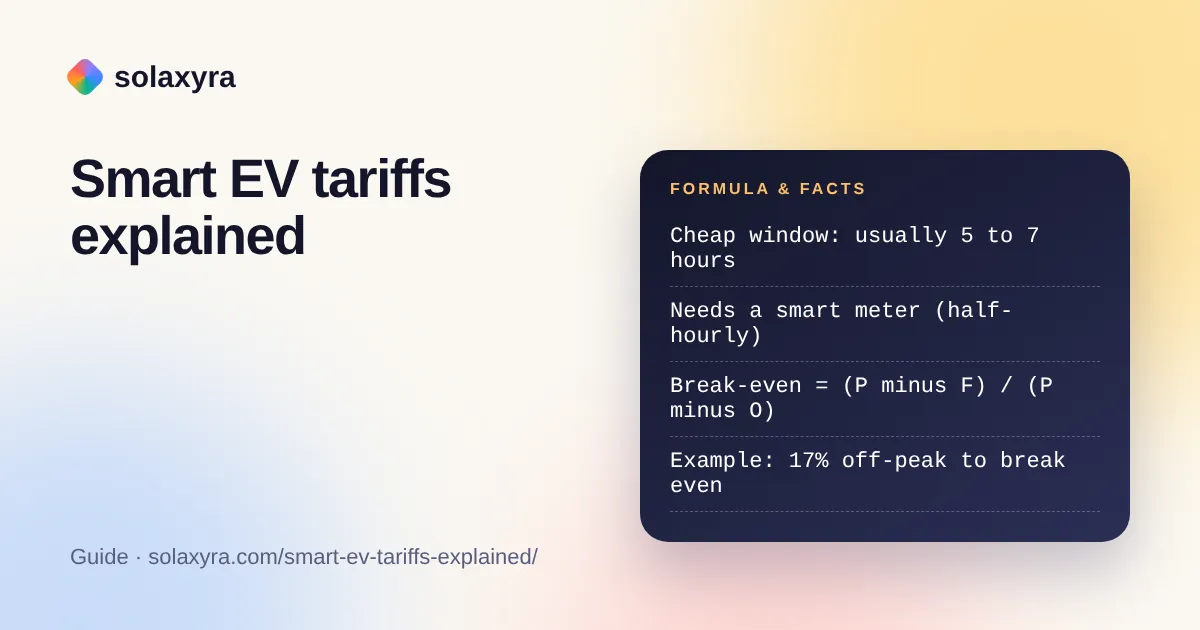
Quick answer: Smart EV tariffs are time of use electricity tariffs that charge much less per kWh for a few hours, usually overnight, and let your supplier or charger schedule car charging into those cheap periods. You need a smart meter and often a compatible charger or car. Daytime units usually cost more than a standard tariff.
What is a smart EV tariff?
A smart EV tariff is an electricity tariff with at least two unit rates, a low off-peak rate for a set number of hours and a higher rate at other times, designed so an electric car does most of its charging at the low rate. The word “smart” refers to two things: the smart meter, which records your use in half-hour blocks so the supplier can bill each block at the right price, and in many cases a link between the supplier and your charger or car so charging can be scheduled automatically.
The UK government’s smart meter guidance for households describes this directly: smart meters can record half-hourly price and consumption data, and smart tariffs let consumers save money by using energy away from peak times or when there is spare clean electricity. Without that half-hourly data a supplier cannot offer a tariff that changes price through the day, which is why almost all smart EV tariffs require a working smart meter.
What types of EV tariff are there?
There are four main types, and the difference is who decides when your car charges and how predictable the price is. The table compares them; product names and exact hours vary by supplier and change often, so check the current terms before switching.
| Tariff type | How the cheap rate works | Who controls charging time | Main thing to watch |
|---|---|---|---|
| Fixed-window EV tariff | Same cheap window every night, often 5 to 7 hours | You, using the charger or car timer | Higher daytime rate for the whole house |
| Smart (dispatched) EV tariff | Core cheap window plus extra slots the supplier schedules | Supplier, through a compatible charger or car | Only works with supported hardware; rules on extra slots differ |
| Dynamic half-hourly tariff | Price changes every half hour, published in advance | You or an automation app | Evening peaks can be very expensive |
| Economy 7 | 7 cheaper hours overnight on an older two-rate meter or smart meter | Meter timings set by the supplier | Off-peak rate usually less generous than EV tariffs |
Ofgem confirms that Economy 7 customers are covered by the energy price cap. Specialist EV tariffs are fixed or variable products priced by each supplier, so their peak rate can sit above the cap rate. For tariffs where the price changes every half hour, see our guide to dynamic electricity tariffs.
How do you know if a smart EV tariff will save you money?
A two-rate tariff beats a flat rate once the share of your electricity used at the off-peak rate is higher than the break-even share: (peak rate minus flat rate) divided by (peak rate minus off-peak rate). Everything you use below that share costs you more than staying on a standard tariff.
Example: the flat rate is the October to December 2026 cap average of 26.32p per kWh. An EV tariff charges 30p per kWh at peak and 8p per kWh off-peak; both are example values, so change them to the tariff you are considering. The break-even share is (30 minus 26.32) divided by (30 minus 8), which is 3.68 divided by 22, or about 17%. If more than 17% of all your kWh land in the cheap window, the EV tariff wins on unit costs.
With an electric car the break-even test for smart EV tariffs is easy to pass, because the car’s charging often makes up a large part of a household’s total use. Without a car, a household that moves only 15% of its use overnight would pay slightly more on this example tariff than on the cap rate.
| Example household (example rates: peak 30p, off-peak 8p, flat 26.32p) | Yearly kWh | Share off-peak | Flat tariff cost | EV tariff cost | Difference |
|---|---|---|---|---|---|
| House only, 15% moved overnight | 2,700 | 15% | £711 | £721 | £10 more |
| House 2,700 kWh plus EV 2,000 kWh, all car charging off-peak, 10% of house use off-peak | 4,700 | about 48% | £1,237 | £911 | £326 less |
| Same, 30% of house use off-peak (dishwasher, washing on timers) | 4,700 | about 60% | £1,237 | £792 | £445 less |
These are unit costs only. Standing charges on smart EV tariffs need a separate comparison: a tariff with a standing charge 5p a day higher costs an extra 5 × 365 = 1,825p, about £18, a year. Your own yearly kWh figure is on your bill or in your supplier app; the energy consumption calculator helps you estimate it if you do not have a full year of data, and the electricity cost calculator prices any single appliance at either rate.
How do smart chargers and the GB charging rules fit with tariffs?
Every private chargepoint sold in Great Britain since 30 June 2022 must have pre-set default charging hours outside peak hours, which the Smart Charge Points Regulations 2021 define as 8am to 11am and 4pm to 10pm on weekdays. That default stops a car starting to charge in the evening peak, but it does not by itself match your tariff’s cheapest hours. Set the charger schedule to your tariff window, or let the supplier control it on a dispatched tariff.
The same regulations require a randomised delay of up to 600 seconds when charging starts, which spreads the moment thousands of cars switch on. On smart EV tariffs with a fixed window starting at midnight, expect charging to begin within ten minutes of the window opening rather than on the dot; you can cancel the delay in the app. The hardware side, including installation and grants, is covered in our guide to charging an EV at home in the UK.
What do you need before switching to an EV tariff?
Smart EV tariffs need a working smart meter sending half-hourly readings to your supplier, and smart dispatched tariffs also need a charger or car model on the supplier’s compatibility list. Follow these steps in order:
- Check your meter: it must be a smart meter in smart mode. Older first generation meters may need an upgrade before a time of use tariff can be billed.
- Find your yearly kWh and estimate how much of it, including car charging, you can move into the cheap hours.
- Run the break-even test above with the tariff’s real peak, off-peak and standing charge figures.
- Check compatibility of your charger or car if the tariff schedules charging for you.
- Check exit fees on your current fixed tariff and on the new one.
- Switch, then set timers on the car, the charger and any big appliances to the new cheap window.
- After one or two bills, compare your actual off-peak share with your estimate.
Do smart EV tariffs work with a home battery or solar panels?
Yes, and they often make a home battery more valuable: the battery can fill at the off-peak rate overnight and power the house through the expensive daytime and evening hours. The saving per kWh is roughly the peak rate minus the off-peak rate, reduced by the battery’s round trip losses. The home battery savings calculator models exactly that, using your own rates.
With solar panels, daytime generation can charge the car directly at weekends or when it is at home, and smart EV tariffs cover the winter months when solar output is low. The solar EV charging calculator shows how much of your mileage solar could cover. Any battery or solar installation is fixed electrical work and must be installed by a qualified electrician to BS 7671.
Does VAT change the comparison in 2026?
From 1 October 2026 to 31 March 2027 VAT is removed from domestic electricity bills in Great Britain, so both your current tariff and any EV tariff are billed without VAT in that period. Ofgem confirms that the 26.32p cap rate for October to December 2026 already excludes VAT. When you compare rates for smart EV tariffs on an older comparison page with today’s prices, check whether they included 5% VAT, otherwise you are not comparing like with like. Public charging points remain standard rated at 20% VAT under HMRC Notice 701/19, which widens the gap between home and public charging.
Frequently Asked Questions
Do I need a smart meter for an EV tariff?
Yes, almost always. The supplier needs half-hourly readings to bill the cheap and expensive periods separately. A smart meter working in smart mode provides them. Some older meters must be upgraded first, which your supplier arranges before the tariff starts.
Does the cheap rate apply to the whole house?
On most fixed-window EV tariffs the whole house pays the off-peak rate during the cheap hours, so timed dishwashers and washing machines benefit too. On smart dispatched tariffs, how extra scheduled slots are billed depends on each supplier’s terms, so read them before switching.
Is an EV tariff worth it without an electric car?
Usually only if you can move a large share of your use into the cheap hours, for example with a home battery or storage heaters. Using the example rates in this guide, you need more than about 17% of all your kWh in the off-peak window to break even.
Can I charge my car outside the off-peak window?
Yes, but you pay the higher peak rate for those kWh, which on many EV tariffs is above the standard cap rate. Occasional daytime top-ups are fine; regular peak charging can wipe out the savings that made the tariff worthwhile.
Are EV tariffs covered by the price cap?
The Ofgem price cap applies to standard variable tariffs, including Economy 7. Specialist EV tariffs are priced by each supplier, so their peak rate can be higher than the cap rate. Always compare the full set of rates and the standing charge.
Checked October 2026 by the Solaxyra Editorial Team. Sources: GOV.UK: smart meters, a guide for households, Ofgem: price cap October to December 2026, legislation.gov.uk: Smart Charge Points Regulations 2021, regulation 10, regulation 11, HMRC VAT Notice 701/19.