This guide explains what boiler flow temperature is, what to set it to for a combi boiler or a boiler with a hot water cylinder, and what a lower setting does to your radiators and your gas bill, for households in the UK with a gas or oil condensing boiler. Turning the boiler flow temperature down is one of the few free changes that can cut gas use, but it only works if you understand the trade-off with radiator output.
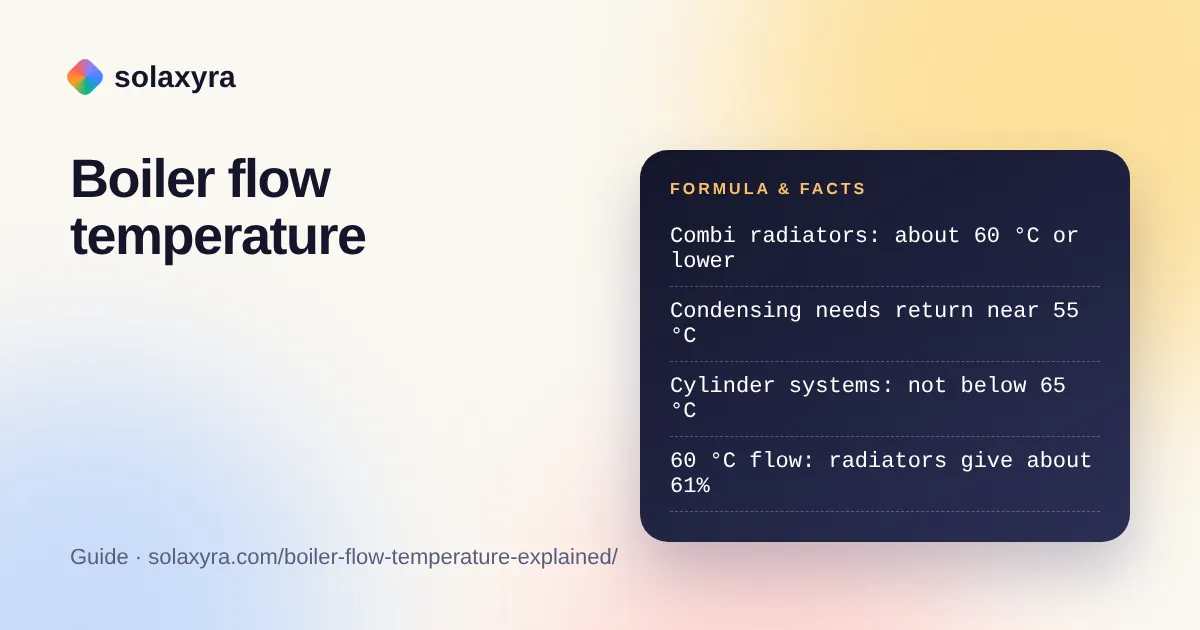
Quick answer: Boiler flow temperature is how hot the water leaving the boiler for your radiators is. For a condensing combi boiler, about 60 °C or lower lets the returning water fall to roughly 55 °C or below, so the boiler condenses and wastes less heat. With a hot water cylinder, do not set it below 65 °C.
What is boiler flow temperature?
Flow temperature is the temperature of the water the boiler sends out to the radiators, usually set on a dial or display marked with a radiator symbol, and it is separate from the room thermostat. The thermostat decides when the heating is on by measuring the room; the flow temperature decides how hot the water in the radiators is while it runs.
The water cools as it gives heat to the rooms and comes back to the boiler as the return. Two numbers matter:
- Flow temperature: the water leaving the boiler, which you set.
- Return temperature: the water coming back, which depends on the flow setting, radiator size and how much heat the rooms take.
Many boilers are left on a high factory or installer setting. Lowering the boiler flow temperature means the radiators run cooler for longer, rather than hot in short bursts.
Why does a lower flow temperature save gas?
A condensing boiler recovers extra heat from its flue gases only when the return water is cool enough, around 55 °C or below, for water vapour in the exhaust to condense. That is the threshold given in the condensing boiler entry, which also puts the typical efficiency gain from condensing at as much as 10 to 12%.
If the flow is set at 75 °C or 80 °C, the return is often too hot to condense, so the boiler works like an older non-condensing model and sends usable heat out of the flue. Lower the flow and the return drops into the condensing range. The Energy Saving Trust’s flow temperature advice says research shows turning the flow down to 60 °C improves boiler efficiency by nearly 4%, and that claims of savings as high as 9% on gas bills should be treated with caution.
What does each flow setting do to your radiators?
At 60 °C flow and 50 °C return, a radiator gives about 61% of its catalogue output, so a lower setting saves gas but heats rooms more slowly. Radiator outputs are rated under EN 442 at a delta T of 50 °C, and the radiator maker Zehnder defines delta T as (flow + return) ÷ 2 minus room temperature, with an exponent of 1.3 representing most radiators. Output at any setting is then rated output × (delta T ÷ 50) to the power 1.3.
The table assumes a room at 21 °C and a 10 °C drop across the radiators. Both are example values; your real return depends on your system.
| Flow setting | Example return | Delta T | Share of rated radiator output | Return at or below 55 °C? |
|---|---|---|---|---|
| 75 °C | 65 °C | 49 °C | about 97% | No |
| 70 °C | 60 °C | 44 °C | about 85% | No |
| 65 °C | 55 °C | 39 °C | about 72% | Borderline |
| 60 °C | 50 °C | 34 °C | about 61% | Yes |
| 55 °C | 45 °C | 29 °C | about 49% | Yes |
| 50 °C | 40 °C | 24 °C | about 39% | Yes |
Example: a living room radiator rated 1,500 W at delta T 50 gives about 1,461 W at 75 °C flow but about 909 W at 60 °C flow. If the room needs more than 909 W on a cold day it will warm slowly or not reach the thermostat setting, which is the main reason to lower the boiler flow temperature in steps rather than all at once. Rooms with generously sized radiators cope well; rooms with small radiators are the ones to watch.
What flow temperature should you set for your system?
For a combi boiler try 60 °C or lower on the radiator setting; for a system or regular boiler with a hot water cylinder, the Energy Saving Trust says not to go below 65 °C. The difference is hot water: a combi heats tap water separately, while a cylinder is heated by the same flow.
| System | Suggested radiator flow setting | Why |
|---|---|---|
| Combi boiler (no cylinder) | About 60 °C, or 50 to 60 °C depending on the weather | Separate hot water setting, so lowering the radiator flow does not affect taps |
| System or regular boiler with a hot water cylinder | Not below 65 °C | The cylinder must stay hot enough to control legionella bacteria |
| Boiler with weather compensation | Let the curve set it; lower the curve slightly if rooms overheat | The boiler already lowers the flow in mild weather |
| Heat pump | Set by the installer’s design, usually well below boiler settings | Heat pumps are most efficient at low flow temperatures |
| Communal or district heating | Not usually adjustable by residents | Ask the building manager or heat supplier |
The Nesta Money Saving Boiler Challenge recommends 60 °C or below for combi boilers and says its guidance does not cover systems with a hot water tank, which matches the Energy Saving Trust’s caution.
How do you lower your boiler flow temperature?
Use only the boiler’s front controls or its app: find the radiator (central heating) setting, not the tap symbol, and turn it down to about 60 °C on a combi. Every model is different, so keep the user manual to hand.
- Note or photograph the current setting so you can return to it.
- Find the central heating control, usually marked with a radiator symbol. On a combi, the tap symbol is hot water and should be left alone.
- Turn the heating setting down to about 60 °C. On a dial without numbers, the manual will show which mark matches which temperature.
- Leave the room thermostat where it was, and allow the heating to run for longer periods, as rooms take longer to warm.
- Live with it for a few days. If every room is comfortable, try 55 °C in mild weather.
- If a room stays cold, raise the setting by 5 °C. Check that room’s radiator valve is fully open before blaming the setting.
- If you have a cylinder, do not go below 65 °C, and raise it back if hot water is not hot enough.
If someone at home is elderly, unwell or the home is already hard to heat, the Energy Saving Trust warns that a colder home is a health risk, so prioritise comfort and change the setting gradually.
How much can lowering the flow temperature save?
The Energy Saving Trust points to research showing nearly 4% better boiler efficiency at 60 °C, while some campaigns quote up to 9%; actual savings depend on your previous setting and your home. Using Ofgem’s 2026 typical gas use of 9,500 kWh a year and the October 2026 cap gas rate of 7.97p per kWh, a typical gas bill for energy is £757.15 before the standing charge.
- At a 4% reduction: 380 kWh less gas, about £30.29 a year.
- At a 9% reduction: 855 kWh less gas, about £68.14 a year.
That is a modest but free saving. Do not wipe it out by topping up a cold room with a plug-in heater; at cap rates each kWh of electricity costs 26.32p against 7.97p for gas, more than three times as much, which you can check with the electric heater running cost calculator.
Is lower flow temperature the same as a heat pump setting?
No, but the idea is the same: heat pumps work far better at low flow temperatures, so a home that stays comfortable on a low boiler flow setting is a good sign for a future heat pump. If your radiators keep the house warm at 50 to 55 °C on cold days, they are closer to what a heat pump needs. The flow temperature a heat pump runs at sets its seasonal efficiency (SCOP), which is the biggest factor in the heat pump running cost calculator. For the wider choice, see our heat pump vs gas boiler guide.
When do you need a Gas Safe registered engineer?
You can safely change the flow temperature using the boiler’s user controls, but any work inside the boiler casing, on the gas supply or the flue must be done by a Gas Safe registered engineer. The HSE says anyone employed to work on gas appliances in homes must be Gas Safe registered and competent for that work, and strongly advises that boilers, flues and pipework are serviced at least once a year. Ask the engineer at your next service to check the boiler’s maximum heating output, any weather compensation settings and whether the radiators are balanced, all of which help a lower flow temperature work well.
Frequently Asked Questions
What is the best boiler flow temperature for a combi boiler?
About 60 °C or lower on the radiator setting. That lets the water returning to a condensing combi boiler fall to around 55 °C or below so it condenses and wastes less heat. In mild weather 50 to 55 °C often keeps rooms warm. Hot water is set separately.
Can I lower the flow temperature if I have a hot water cylinder?
Only to 65 °C, according to the Energy Saving Trust. The same flow heats the cylinder, which must stay hot enough to control legionella bacteria. Nesta’s boiler challenge does not cover cylinder systems, so do not follow combi advice for these boilers.
Will a lower flow temperature make my house cold?
It makes radiators cooler, so rooms warm more slowly. At 60 °C flow a radiator gives roughly 61% of its catalogue output. Most homes stay comfortable if the heating runs longer; if a room stays cold, raise the setting by 5 °C.
How much money does lowering boiler flow temperature save?
For a home using Ofgem’s typical 9,500 kWh of gas a year at 7.97p per kWh, a 4% saving is about £30 a year and a 9% saving about £68. The Energy Saving Trust says the higher claims should be treated with caution.
Is flow temperature the same as the thermostat setting?
No. The room thermostat measures the air and switches heating on or off. Flow temperature is how hot the water leaving the boiler is while the heating runs. You can lower the flow without changing the thermostat.
Is it safe to change my boiler flow temperature myself?
Yes, using the boiler’s normal front controls or app, and it can be changed back at any time. Never remove the boiler casing or touch the gas supply or flue; that work must be done by a Gas Safe registered engineer.
Checked October 2026 by the Solaxyra Editorial Team. Sources: Energy Saving Trust: should I turn my boiler’s flow temperature down, Nesta: Money Saving Boiler Challenge, Wikipedia: condensing boiler, Zehnder: delta T correction factors, HSE: domestic gas FAQs, Ofgem: price cap October to December 2026, Ofgem: 2026 typical consumption values.