This guide explains, for UK homeowners, how much of a heat pump’s electricity rooftop solar panels can really supply across the year, what that is worth in pounds, and how to set up the system so more solar goes into heating and hot water. Running a heat pump with solar panels works well in spring, summer and autumn, but the winter gap is large, so the numbers here use government generation data rather than annual averages.
Quick answer: A heat pump with solar panels can run on solar electricity whenever the panels generate, but in the UK solar covers only a small part of winter heating. Government data show October to December output is about a third of April to June. Solar helps most with hot water and mild-season heating; the grid supplies the rest.
Can solar panels power a heat pump?
Yes: a heat pump is an electrical appliance, so any solar electricity generated while it runs is used by it first, before anything is exported. Running a heat pump with solar panels needs no special connection; the solar inverter feeds the home’s wiring and the heat pump draws from the same supply.
The limit is timing. A heat pump uses most of its electricity on cold winter days, mornings and evenings, while solar panels produce most of their energy in long summer days around midday. So the realistic question for a heat pump with solar panels is not whether solar can power it, but what share of its yearly electricity the panels can cover in your home.
This is different from a solar-assisted heat pump, a less common integrated system in which solar collectors feed heat directly into the heat pump’s evaporator. This guide covers the usual UK set-up: ordinary solar PV panels on the roof and a separate air source or ground source heat pump.
How much of a heat pump’s winter use can solar cover?
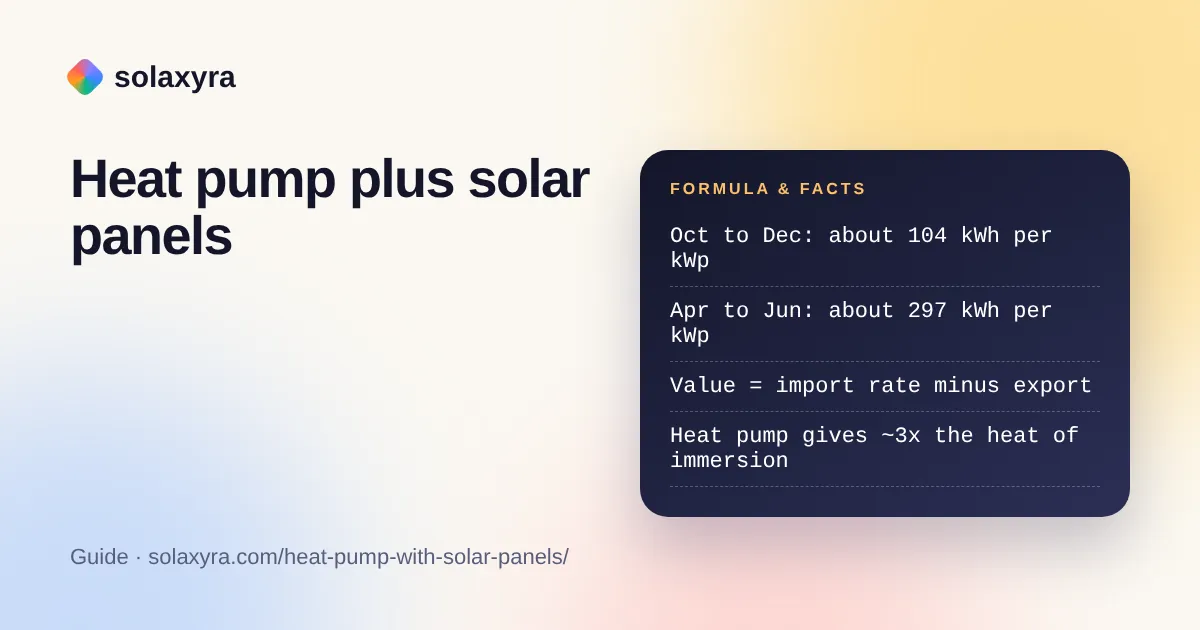
From October to December a UK solar system produces only about 104 kWh for each kWp of panels, roughly a third of the 297 kWh per kWp it makes from April to June. These figures come from the DESNZ Feed-in Tariff load factor analysis for 2024/25, based on 282,047 solar installations: a load factor of 4.7% in October to December and 13.6% in April to June, with a median of 9.2% over the year.
The table sets that against an example heat pump with solar panels. The solar size is the Energy Saving Trust’s average domestic system of 4.5 kWp. The heat pump’s yearly use of 4,000 kWh and its split across the quarters are example values only; change them to your installer’s estimate.
| Period | Solar per kWp (DESNZ) | Example 4.5 kWp system | Example heat pump use | Most solar could cover |
|---|---|---|---|---|
| October to December | about 104 kWh | 468 kWh | 1,320 kWh (33% of 4,000) | 35%, if every kWh reached the heat pump |
| April to June | about 297 kWh | 1,337 kWh | 480 kWh (12% of 4,000) | All of it in principle; surplus is exported |
| Whole year (median) | about 806 kWh | 3,627 kWh | 4,000 kWh | Annual totals look close, but timing makes real cover much lower |
The calculation is load factor × hours in the period × kWp. For October to December: 0.047 × 2,208 hours = 104 kWh per kWp, and 104 × 4.5 = 468 kWh. Even that 35% ceiling assumes all of the winter solar arrives while the heat pump is running, which it will not, because some goes to the fridge, lighting and other daytime loads, and some arrives when the heat pump is idle.
How much is solar electricity worth when a heat pump uses it?
Each solar kWh your heat pump uses is worth the import rate you avoid minus the export payment you give up, not the full import rate. Under the Ofgem price cap for October to December 2026 the average import rate is 26.32p per kWh. The Energy Saving Trust gives roughly 12p per kWh as a typical export payment, so treat 12p as an example and use your own Smart Export Guarantee rate.
Example: a heat pump with solar panels uses 4,000 kWh a year, and 25% of that (an example share), 1,000 kWh, comes directly from the panels.
- Import avoided: 1,000 × 26.32p = £263.20.
- Export given up: 1,000 × 12p = £120.00.
- Extra value from using solar in the heat pump rather than exporting it: £143.20 a year.
That is a real but modest gain, which is why adding a heat pump does not on its own justify a bigger solar system. Check your own figures with the solar self-consumption calculator and the solar panel savings calculator. The heat pump’s total running cost, including the grid share, is easiest to estimate with the heat pump running cost calculator.
Is it better to send surplus solar to an immersion heater or the heat pump?
If you run a heat pump with solar panels, using surplus solar to heat hot water through the heat pump gives about three times as much heat as sending it to an immersion heater. An immersion heater turns 1 kWh of electricity into 1 kWh of heat, while the Energy Saving Trust describes heat pumps as more than three times as efficient as a gas or oil boiler.
Example: on a sunny afternoon there is 2 kWh of surplus solar. Through a solar diverter and immersion heater it makes 2 kWh of hot water heat. Through a heat pump running at an example COP of 3 it makes about 6 kWh of heat, if the cylinder has room for it. In practice the cylinder’s size and starting temperature cap how much you can store, so a diverter can still mop up surplus after the heat pump has finished its cycle. Our solar diverter calculator shows what a diverter alone is worth.
How do you use more solar in a heat pump?
Move the heat pump’s flexible jobs, mainly heating the hot water cylinder, into the sunniest hours, and keep space heating steady rather than switching it off and on. These steps work with most heat pump controllers.
- Set the main hot water heating period to late morning or early afternoon, for example 11:00 to 14:00, when solar output is highest.
- Keep a second, shorter hot water period on a cheap overnight or off-peak time for dull days.
- In spring and autumn, let the heating run steadily during the day at a low flow temperature rather than heating hard in the evening.
- If your heat pump or solar inverter supports it, use a surplus or “smart grid ready” input so the heat pump raises its target slightly when there is spare solar. Ask your installer whether your models support this.
- Look at your solar app and in-home display together for a few sunny days to check that the heat pump runs while the panels generate.
A home battery added to a heat pump with solar panels can store midday solar for evening heating, but in winter there is little surplus to store. The Energy Saving Trust notes that switching to a heat pump time-of-use tariff can reduce running costs significantly, and for many homes that does more in winter than a battery.
How many solar panels do you need for a heat pump?
To match a heat pump’s yearly use on paper, divide its annual kWh by about 806 kWh per kWp, the median UK yield from the DESNZ data. For the example heat pump using 4,000 kWh, that is 4,000 ÷ 806 = about 5 kWp on top of what the rest of the house needs. Because of the winter gap, that size will not make the heat pump run on solar in winter; it only balances the year through export in summer.
A better approach when planning a heat pump with solar panels is to size the solar for the whole home’s daytime use, roof space and budget, then treat the heat pump as a useful extra load. Start with the solar panel calculator using your total yearly electricity including the heat pump, and check how many panels fit with the roof area calculator.
What does a heat pump with solar panels cost?
The Energy Saving Trust puts a typical air source heat pump at around £12,000 and an average 4.5 kWp solar system at about £7,600, before grants. In England and Wales the Boiler Upgrade Scheme takes £7,500 off an air source or ground source heat pump, or £9,000 for homes replacing oil or LPG until March 2027. Heat pumps, solar panels and home batteries are all zero-rated for VAT in Great Britain until 31 March 2027, with a 5% rate from 1 April 2027. Our Boiler Upgrade Scheme guide covers eligibility, and the heat pump vs gas boiler guide compares running costs without solar.
| Item | Typical cost (Energy Saving Trust) | Grant or relief |
|---|---|---|
| Air source heat pump | around £12,000 | £7,500 BUS grant (£9,000 replacing oil or LPG until March 2027), 0% VAT to 31 March 2027 |
| Solar PV, 4.5 kWp | about £7,600 | 0% VAT to 31 March 2027; no BUS grant |
| Home battery | £5,000 to £8,000 | 0% VAT to 31 March 2027 |
Who must install a heat pump and solar panels?
For a heat pump with solar panels, both should be fitted by MCS certified installers: MCS certification is required for the Boiler Upgrade Scheme grant and GOV.UK says the solar installation and installer must be MCS certified, or certified under an accredited equivalent scheme, to receive Smart Export Guarantee payments. All electrical work, including the heat pump supply, solar inverter and any battery, must be carried out by a qualified electrician and meet BS 7671.
Removing a gas boiler must be done by a Gas Safe registered engineer, as the HSE requires for any work on gas appliances in homes. If your roof is old, altered or you are unsure it can carry the panels, ask for a structural check by a qualified surveyor or structural engineer before installation.
Frequently Asked Questions
Can a heat pump run only on solar panels in winter?
No, not in a typical UK home. Government data show solar systems produce about 104 kWh per kWp from October to December, roughly a third of their spring output, while heat pumps use most electricity in winter. The grid, ideally on a cheaper heat pump tariff, supplies most winter heating.
Do I need a battery to use solar with a heat pump?
No. The heat pump uses solar electricity directly whenever it runs while the panels generate. A battery can shift midday surplus into the evening, but in winter there is little surplus to store, so a time-of-use tariff often saves more in the cold months.
Is a heat pump better than an immersion diverter for spare solar?
For heating hot water, yes. An immersion heater turns 1 kWh of solar into 1 kWh of heat, while a heat pump with a coefficient of performance of about 3 turns it into about 3 kWh. A diverter can still use surplus left once the heat pump cycle has finished.
How much do solar panels save on heat pump running costs?
Each solar kWh the heat pump uses saves the import rate minus the export payment you give up. At 26.32p import and an example 12p export, that is about 14p per kWh, so 1,000 kWh of solar used by the heat pump is worth about £143 a year.
Does the Boiler Upgrade Scheme pay for solar panels?
No. The Boiler Upgrade Scheme grant covers heat pumps and biomass boilers in England and Wales, not solar panels. Solar panels and home batteries are zero-rated for VAT in Great Britain until 31 March 2027, which lowers their price.
Checked October 2026 by the Solaxyra Editorial Team. Sources: DESNZ: Feed-in Tariff load factor analysis 2024/25, Energy Saving Trust: air source heat pumps, Energy Saving Trust: solar panels, GOV.UK: Boiler Upgrade Scheme, what you can get, HMRC: VAT Notice 708/6, Ofgem: price cap October to December 2026, GOV.UK: Smart Export Guarantee, HSE: domestic gas FAQs, Wikipedia: solar-assisted heat pump.