This guide explains the Boiler Upgrade Scheme for homeowners, landlords and small businesses in England and Wales: how much it pays in October 2026, who qualifies, how the installer-led application works, and what a heat pump costs you after the grant and to run. It also flags several outdated claims still found on other websites.
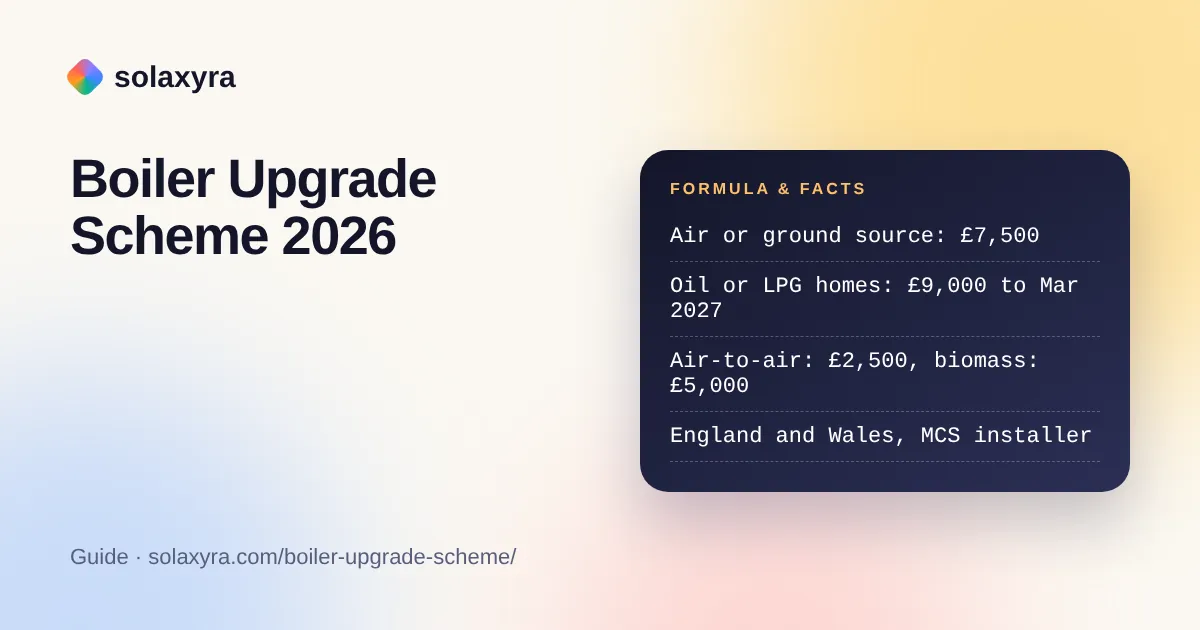
Quick answer: The Boiler Upgrade Scheme in England and Wales gives £7,500 towards an air source or ground source heat pump, £5,000 towards a biomass boiler and £2,500 towards an air-to-air heat pump. Homes replacing oil or LPG heating get an extra £1,500 until March 2027. An MCS certified installer applies and deducts the grant.
How much does the Boiler Upgrade Scheme pay?
The grant is £7,500 for an air source or ground source heat pump, £5,000 for a biomass boiler and £2,500 for an air-to-air heat pump, according to GOV.UK’s Boiler Upgrade Scheme page, last updated on 1 October 2026. Ground source includes water source heat pumps and heat pumps on shared ground loops.
| System | Standard grant | If replacing oil or LPG (until March 2027) | Notes |
|---|---|---|---|
| Air source (air-to-water) heat pump | £7,500 | £9,000 | Heats radiators or underfloor heating and hot water |
| Ground source or water source heat pump | £7,500 | £9,000 | Includes shared ground loops |
| Biomass boiler | £5,000 | No uplift listed | Rural, off the gas grid, with an emissions certificate; not for self-builds |
| Air-to-air heat pump | £2,500 | No uplift listed | Warms air in rooms; does not heat hot water |
| Hybrid (heat pump plus gas boiler) | Not eligible | Not eligible | GOV.UK excludes hybrid systems |
The extra £1,500 applies where the property is heated by oil or LPG and has no mains gas. Ofgem, which runs the scheme for the Department for Energy Security and Net Zero, describes this as a £9,000 grant for off-gas-grid homes available until 31 March 2027. Only one grant is allowed per property.
Who is eligible for the Boiler Upgrade Scheme?
You are eligible if you own the property in England or Wales and are replacing fossil fuel heating such as gas, oil, LPG or direct electric heating. Owner includes a business, a second home or a property you let to tenants, so private landlords can apply.
GOV.UK lists these exclusions and limits:
- Most new build properties are excluded. Self-builds can qualify if you or the original owner built it, or paid a builder to, and it has never been owned by a business or organisation.
- Social housing is excluded.
- A property that has already had government funding for a heat pump or biomass boiler is excluded.
- You cannot get a grant to replace an existing low carbon heating system.
- Capacity limits: 45 kWth for a single system, 70 kWth when several heat pumps are installed together, and 300 kWth for shared ground loops. Most homes need far less than 45 kWth, so this rarely affects a house.
- The installer must install and commission the system within 120 days of applying, or it will not be eligible.
The Energy Saving Trust states that you are not required to have home insulation to qualify, although your installer may recommend improvements. Some older pages still describe an EPC with no outstanding loft or cavity wall insulation recommendations as a condition; the current GOV.UK eligibility page does not list it, but ask your installer what paperwork they need.
What if you live in Scotland or Northern Ireland?
The Boiler Upgrade Scheme is open only to properties in England and Wales. In Scotland, the Energy Saving Trust lists the Home Energy Scotland Grant and Loan, offering up to £7,500 grant plus an optional £7,500 loan for a heat pump, with an extra £1,500 grant for qualifying rural homes. In Northern Ireland, the Energy Saving Trust directs residents to NI Energy Advice for current support.
How do you apply for the Boiler Upgrade Scheme?
You do not apply yourself: an MCS certified installer applies to Ofgem on your behalf and the grant is taken off the price you pay. These are the steps from a homeowner’s side.
- Check suitability. A heat pump works best in a home with reasonable insulation and radiators sized for lower flow temperatures. A Energy Saving Trust guide to the scheme covers the basics.
- Get quotes from at least two or three MCS certified installers. Each should survey the home, work out its heat loss and say which radiators, if any, need changing.
- Compare quotes on the price after the grant, the heat pump size in kW, the design flow temperature and the expected seasonal efficiency (SCOP).
- Agree a quote. The installer confirms you are eligible and applies on the Ofgem website.
- Respond when Ofgem contacts you to confirm the installer is acting for you. Ofgem may phone or visit, and MCS may carry out its own checks.
- The installer fits and commissions the system within 120 days of applying, and you pay the quoted price minus the grant.
- Keep the MCS certificate and commissioning paperwork with your property documents.
Be wary of anyone who asks you to pay the grant amount upfront and claim it back yourself. Under the scheme the grant goes to the installer and is deducted from your bill.
What does a heat pump cost after the grant?
Your cost is the installer’s quoted price minus the grant, and heat pumps are zero-rated for VAT in Great Britain until 31 March 2027. The quotes below are example values only, so change them to the quotes you receive; the grant figures are the current GOV.UK amounts.
| Example home and system | Example quote | Grant | You pay |
|---|---|---|---|
| Gas-heated semi, air source heat pump | £12,000 | £7,500 | £4,500 |
| Oil-heated detached house, air source heat pump | £14,000 | £9,000 | £5,000 |
| LPG-heated bungalow, ground source heat pump | £25,000 | £9,000 | £16,000 |
| Flat with electric panel heaters, air-to-air heat pump | £5,000 | £2,500 | £2,500 |
Under HMRC’s VAT notice on energy-saving materials, air source, ground source and water source heat pumps installed in homes are zero-rated from 1 May 2023 to 31 March 2027, and a 5% reduced rate applies from 1 April 2027. Check whether a quote is shown with VAT at 0% so you compare like with like.
Will a heat pump cost more or less to run than a gas boiler?
At October 2026 cap rates a well-installed heat pump with a SCOP of about 3 or more usually costs a little less to run than a gas boiler, and dropping the gas supply saves the gas standing charge too. The result depends heavily on SCOP, so treat any single figure as an example.
Example: a home needs 12,000 kWh of heat a year (example value). A gas boiler at an example 90% seasonal efficiency burns 13,333 kWh of gas; at the Ofgem cap rate of 7.97p per kWh that is £1,062.67. A heat pump with an example SCOP of 3.2 uses 3,750 kWh of electricity; at 26.32p per kWh that is £987.00. If the gas meter is removed, the 29.68p daily gas standing charge, £108.33 a year, also goes.
That saving shrinks quickly if the system is designed for hot flow temperatures and runs at a SCOP nearer 2.5. Put your own heat demand, SCOP and prices into the heat pump running cost calculator, and use the electricity cost calculator for a quick check at a different unit rate. Our heat pump vs gas boiler guide covers the wider comparison, and if you also have or plan solar panels, see how a heat pump works with solar panels.
Which Boiler Upgrade Scheme claims online are out of date?
Several ranking pages still repeat older rules, so check any figure against GOV.UK. These are the common ones we found in October 2026.
| Claim seen online | What GOV.UK and Ofgem say in October 2026 |
|---|---|
| Ground source heat pumps get £6,000 | £7,500, the same as air source |
| You need an EPC with no outstanding insulation recommendations | Not listed on the current GOV.UK eligibility page; the Energy Saving Trust says insulation is not required |
| The extra £1,500 for oil and LPG homes runs to the end of 2027 | GOV.UK says until March 2027; Ofgem gives 31 March 2027 |
| The scheme closes in 2027 | The government grants finder lists a closing date of 30 December 2029 for the scheme itself |
| Installers have 3 months, or 6 for ground source | GOV.UK says install and commission within 120 days of applying |
If you are replacing oil or LPG close to March 2027, ask the installer in writing whether the higher £9,000 rate is secured when they apply or depends on when the work is finished. Neither GOV.UK nor Ofgem spells this out, so do not assume it.
What safety and certification rules apply to the installation?
The heat pump installer must be MCS certified for the grant, and any work on the old gas boiler, such as disconnecting it and capping the supply, must be done by a Gas Safe registered engineer. The HSE states that anyone employed to work on gas appliances in homes must be Gas Safe registered and competent in that work, and there is no DIY exemption. The heat pump’s electrical supply and controls must be installed by a qualified electrician to BS 7671, Before any gas work starts, check the engineer’s Gas Safe ID card, which lists the appliances they are qualified to work on.
Frequently Asked Questions
Is the Boiler Upgrade Scheme a loan?
No. It is a grant that does not have to be repaid. Your MCS certified installer applies for it and takes the value off the price you pay, so you only pay the difference. In Scotland the separate Home Energy Scotland scheme combines a grant with an optional loan.
Can landlords use the Boiler Upgrade Scheme?
Yes. GOV.UK says you must own the property, and that includes a property you rent out to tenants, a second home or a business property. Social housing is excluded, and each property can receive only one grant.
Can I get the grant for a hybrid heat pump?
No. GOV.UK says you cannot get a grant for a hybrid system, such as a gas boiler combined with an air source heat pump. The heat pump has to replace the fossil fuel heating system rather than work alongside it.
Do I need insulation to get the Boiler Upgrade Scheme grant?
The Energy Saving Trust says insulation is not required to qualify. Good insulation still lowers the heat pump size you need and the running cost, so ask the installer whether loft or cavity wall insulation would pay off before fitting.
How long does the installer have to fit the heat pump?
GOV.UK says the installer must install and commission the heat pump within 120 days of applying for the grant, or it will not be eligible. Agree a realistic installation date in the quote before the installer applies.
Is the Boiler Upgrade Scheme available in Scotland?
No. The scheme covers England and Wales only. In Scotland the Home Energy Scotland Grant and Loan offers up to £7,500 grant plus an optional £7,500 loan for a heat pump, with extra grant for qualifying rural homes.
Checked October 2026 by the Solaxyra Editorial Team. Sources: GOV.UK: Boiler Upgrade Scheme, GOV.UK: what you can get, GOV.UK: check if you’re eligible, GOV.UK: how to apply, Ofgem: Boiler Upgrade Scheme, Find a grant: Boiler Upgrade Scheme, Energy Saving Trust: Boiler Upgrade Scheme, HMRC: VAT Notice 708/6, HSE: domestic gas FAQs, Ofgem: price cap October to December 2026.