This guide explains which grid connection route applies when you add solar panels, a home battery or both to a home in Great Britain, how the 16 A per phase line works in kilowatts, and what each route means for your installation timetable. Understanding G98 vs G99 before you sign a quote tells you whether the job can go ahead straight away or must wait for the network operator to say yes.
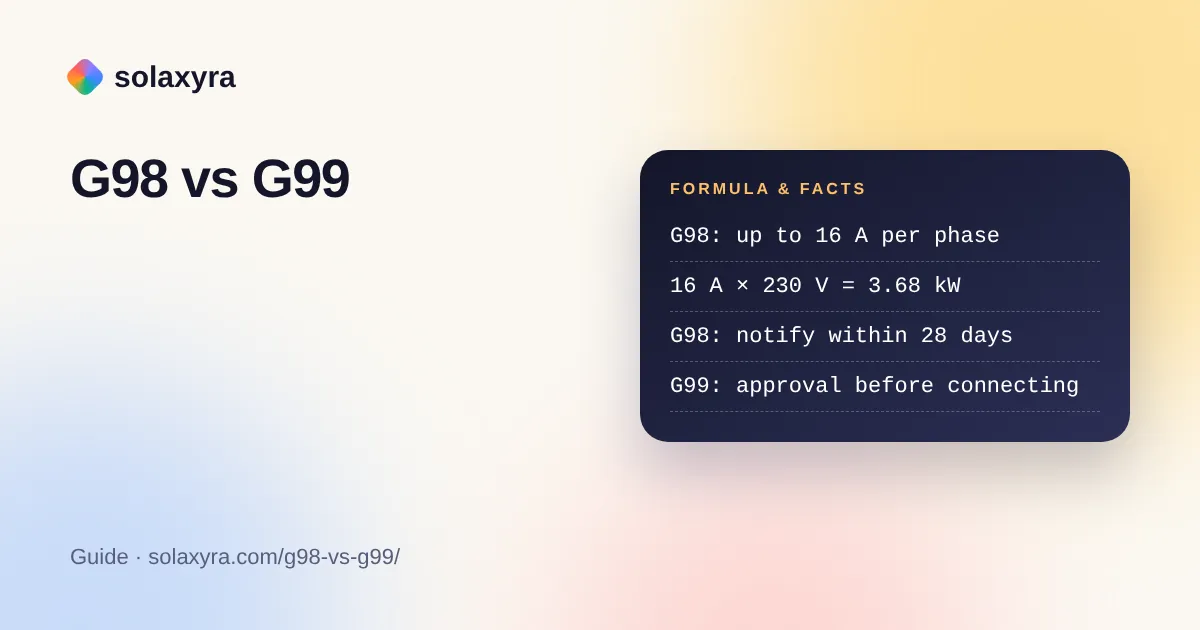
Quick answer: In G98 vs G99, G98 covers type tested micro-generation up to 16 A per phase, about 3.68 kW on a single-phase supply, and the installer notifies the network operator within 28 days of commissioning. G99 covers anything larger and needs the network operator’s approval before the system is connected.
What is the difference between G98 and G99?
G98 and G99 are Engineering Recommendations that set how generating equipment connects to the electricity distribution network: G98 is the notify-after route for small type tested systems up to 16 A per phase, and G99 is the apply-first route for everything above that. Both are published by the Energy Networks Association, and your local distribution network operator (DNO) applies them.
The MCS guidance on notifying DNOs describes G98 as covering fully type tested micro-generators up to and including 16 A per phase, with the DNO notified within 28 days of commissioning. For G99, prior permission to connect must be granted before installation. MCS also notes that for storage under G99 the installer completes Form A1.1 and submits it to the DNO before installation.
The practical difference in G98 vs G99 is time and certainty. A G98 job can be fitted and switched on in one visit. A G99 job cannot be energised until the DNO has assessed whether the local network can take the extra power, and the answer can be yes, yes with an export limit, or yes only after network works.
How many kW is 16 A per phase?
16 A per phase is about 3.68 kW on a single-phase 230 V supply, because 230 V × 16 A = 3,680 W, and about 11.04 kW on a three-phase supply, because the same 16 A applies to each of the three phases. Most UK homes have a single-phase supply, so 3.68 kW is the figure that matters for most households.
The G98 vs G99 limit is set in amps, not in panel watts. What counts is the rated output of the inverter or inverters that feed the grid, not the total wattage of the panels on the roof. A 4.5 kWp array on a 3.68 kW inverter is still a 16 A system, because the inverter cannot push more than its rating onto the network. You can check any rating in amps with the kW to amps calculator, and three-phase figures with the three-phase power calculator.
Which common solar and battery set-ups fall under G98 or G99?
Any set-up whose combined inverter output on a phase is at or below 16 A is normally G98; anything above is G99 unless the DNO accepts an export limit. The table converts typical UK ratings to amps at 230 V so you can see which side of G98 vs G99 each one lands on. The ratings are example values; the inverter datasheet and your installer’s design are what count.
| Example set-up (single-phase unless stated) | Combined inverter output | Current at 230 V | Likely route |
|---|---|---|---|
| Plug-in solar kit at the 800 W legal maximum | 0.8 kW | 3.5 A | Within the G98 range; the device must be on the type test register |
| Solar with a 3.68 kW inverter | 3.68 kW | 16.0 A | G98 |
| Hybrid inverter rated 3.6 kW with battery on its DC side | 3.6 kW | 15.7 A | G98 |
| Solar inverter 3.6 kW plus separate AC battery inverter 3 kW | 6.6 kW | 28.7 A | G99, unless export is limited and the DNO accepts it |
| Single 5 kW hybrid inverter | 5 kW | 21.7 A | G99, or G98 style notification if export limited and accepted |
| Three-phase home, 10 kW inverter balanced across phases | 3.33 kW per phase | 14.5 A per phase | G98 |
| Three-phase home, 12 kW inverter | 4 kW per phase | 17.4 A per phase | G99 |
The G98 vs G99 case that catches people out is the retrofit battery. A household with an existing 3.6 kW solar inverter that adds an AC coupled battery with its own 3 kW inverter has two sources that can feed the grid at once. The combined figure is what the installer has to consider, which is why many retrofit batteries go through a G99 application or are set up with export limitation.
Can export limiting keep a larger system on the G98 route?
Yes, often: if a larger inverter is set up so it can never export more than 16 A per phase, many DNOs will accept a simpler notification or a fast track application instead of a full G99 study, but the DNO decides. Export limitation uses a current sensor at the meter position and inverter settings to cap what leaves the property, while letting the system run your own appliances at full power.
This matters when you want a 5 kW or 6 kW hybrid inverter for faster battery charging or bigger evening loads but have no reason to export more than 3.68 kW. Export limitation schemes have their own ENA recommendation (G100), and the installer must still tell the DNO how the limit works and which equipment enforces it. Do not assume a setting in an app is enough on its own; the scheme has to be documented and accepted.
Before you rely on export limiting, check what you lose. If the inverter could produce 5 kW on a bright day but export is capped at 3.68 kW, any surplus above your own use and battery charging is clipped. Estimate how much of your generation you use on site with the solar self-consumption calculator.
How do the G98 and G99 processes work step by step?
Under G98 the installer fits, commissions and then notifies within 28 days; under G99 the installer applies, waits for approval and only then connects. Your installer handles the G98 vs G99 paperwork either way, but you should know which route your quote assumes.
G98 route:
- The installer confirms that every inverter is fully type tested and listed on the ENA type test register.
- The installer checks that the combined output is no more than 16 A per phase.
- The system is installed and commissioned, with electrical work meeting BS 7671.
- The installer submits the G98 notification to the DNO within 28 days of commissioning.
G99 route:
- The installer prepares the application with inverter details, protection settings, any export limitation scheme and, for storage, Form A1.1.
- The application goes to the DNO before installation.
- The DNO studies the local network and replies with approval, approval with conditions such as an export cap, or a requirement for network works.
- Only after approval is the system installed, commissioned and the commissioning confirmation sent to the DNO.
Example: a semi-detached house with a single-phase supply is quoted 4.4 kWp of panels on a 3.6 kW hybrid inverter with a 9.5 kWh battery. The inverter is the only grid-connected source, 3.6 kW is 15.7 A, so the job goes the G98 route and can be fitted in one visit. If the same house chose a 5 kW hybrid inverter, it would need a G99 application or an accepted export limit, and the start date would depend on the DNO’s reply.
What should you ask your installer about G98 vs G99?
Ask which route the quote assumes, what the combined inverter output is per phase, and whether an export limit is part of the design; the answers tell you the likely timetable and whether you will lose any export. Useful questions:
- Is every inverter on the ENA type test register?
- What is the combined inverter output in amps per phase, including any battery inverter and any existing solar?
- If the system is over 16 A, will you apply under G99 before fitting, and who waits for the reply?
- Is export limited, by what equipment, and has the DNO accepted the scheme?
- Will I receive copies of the DNO notification or approval and the commissioning paperwork?
Whichever side of G98 vs G99 your system falls on, keep copies of the notification or approval. Export payment suppliers under the Smart Export Guarantee and future buyers of your home may ask for them, and an MCS installer will include the connection evidence in the handover pack.
Who is allowed to do the work and the application?
Any grid-connected solar or battery system wired into your consumer unit must be installed by a competent, qualified electrician working to BS 7671, and the DNO notification or application is normally made by the installer. The 16 A threshold is a network rule, not a safety rating: a G98 system still involves mains voltage, DC cabling at high voltage and protective devices that need correct design. Fitting a fixed inverter or battery yourself is not a safe or lawful shortcut around these rules.
The one household-installed exception is plug-in solar, legal in Great Britain from 27 August 2026 with a maximum of 800 W output into a standard socket, as announced by GOV.UK. Compliant devices are listed on the G98 type test register. To estimate what such a kit would produce, try the plug-in solar calculator.
Frequently Asked Questions
Does a home battery count towards the G98 limit?
Yes, if it can feed power into the grid. A battery on the DC side of a hybrid inverter adds nothing extra because the inverter rating sets the limit. A separate AC coupled battery inverter adds its rating to the existing solar inverter, which can push the total above 16 A per phase.
How long does a G99 application take?
Timescales vary by DNO and by how much study the local network needs. Fast track applications for smaller systems are usually quicker than a full assessment, which can take several weeks. Your installer should give you an expected date and must not connect the system before approval.
Is the 3.68 kW limit based on panel watts or inverter output?
It is based on the rated output of the inverter or inverters that can export to the grid, measured as 16 A per phase. Panels rated above 3.68 kWp can sit on a 3.68 kW inverter and the system remains within the G98 range.
Can I install a bigger inverter and just limit export myself?
No. Export limitation has to be designed, documented and accepted by the DNO, and fixed inverters must be installed by a qualified electrician working to BS 7671. A setting changed in an app without DNO acceptance does not change which route applies.
Do I need G99 for a three-phase home with 10 kW of solar?
Not necessarily. On three phases the 16 A limit applies to each phase, about 11.04 kW in total if balanced. A 10 kW inverter spread evenly across three phases is about 14.5 A per phase, within the G98 range.
Checked October 2026 by the Solaxyra Editorial Team. Sources: MCS: notifying DNOs (G98 and G99), GOV.UK: plug-in solar panels come to market.