This guide explains how long a solar inverter lasts in a UK home, why it usually wears out before the panels, what affects its life, how to spot a failing unit and how to budget for a replacement over the life of your system. The solar inverter lifespan is the single most common gap in solar payback estimates, because most quotes model 25 years of panel output but only one inverter.
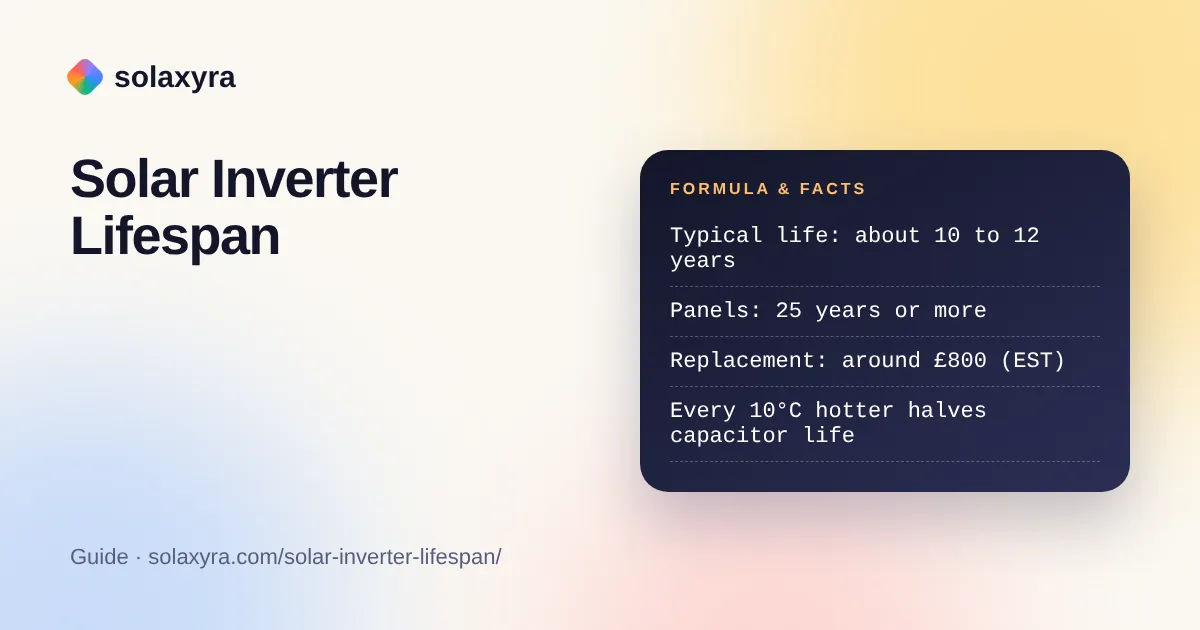
Quick answer: The Energy Saving Trust says a solar inverter typically needs replacing after about 10 to 12 years, while panels last 25 years or more, so most systems need one or two replacements. The trust puts the cost at around £800. Warranties start at five years and can often be extended to 15.
How long does a solar inverter last?
A home solar inverter usually lasts about 10 to 12 years, according to the Energy Saving Trust, which says on its solar panels advice page that you will need to replace the inverter after around 12 years. Its solar fact check gives the solar inverter lifespan as about 10 to 12 years. By comparison the trust expects the panels themselves to last 25 years or more.
That gap exists because an inverter is a piece of power electronics that works hard every sunny day: it converts the panels’ DC into mains-quality AC, tracks the maximum power point, monitors the grid and switches off when the grid fails. It contains fans in some models, relays, and electrolytic capacitors, which age with heat and time. A panel, by contrast, has no moving parts and very few components that wear.
Solar inverter lifespan figures quoted by manufacturers and installers vary by type. String and hybrid inverters are usually treated as the shortest-lived part of a system. Microinverters, which sit behind each panel, have warranty terms that vary widely between manufacturers, so read the warranty document rather than relying on a general figure. Treat any lifespan claim as an expectation, not a promise, and look at the warranty length as the figure the manufacturer will actually stand behind.
What shortens solar inverter lifespan?
Heat is the main enemy: electrolytic capacitors, a common wear part in inverters, follow a rule of thumb that every 10°C rise in temperature roughly halves their useful life. The Wikipedia article on aluminium electrolytic capacitors describes this as the Arrhenius rule: the liquid electrolyte slowly evaporates, and the evaporation rate doubles with each 10°C of extra heat.
The table shows what that rule means for the capacitors alone when an inverter sits in different places. The temperatures are example values for the air around the unit during generation, not measurements, and the result is a relative figure for one component, not a prediction for the whole inverter.
| Inverter location (example air temperature) | Capacitor life relative to 20°C | What it means in practice |
|---|---|---|
| Cool garage or utility room wall, 20°C | 1.0 (reference) | Good location if ventilation clearances are kept |
| Warm cupboard, 25°C | about 0.7 | Capacitors age about 40% faster |
| Poorly ventilated space, 30°C | about 0.5 | Capacitors age about twice as fast |
| Loft under a roof in summer, 40°C | about 0.25 | Capacitors age about four times as fast |
Other common causes of a short solar inverter lifespan include dust blocking fans or heat sinks, damp or condensation, repeated grid voltage disturbances that cause the unit to trip, and an inverter that is sized too small for the array so it runs at its limit for long periods. The solar inverter size calculator shows the usual ratio between array size and inverter rating.
How much will inverter replacements cost over the life of your panels?
Over a 25-year panel life, an inverter that lasts 10 to 12 years will need two replacements, and one that lasts 15 years or more will need one; at the Energy Saving Trust’s figure of around £800 each, that is £800 to £1,600 in total. The trust notes that the price depends on the size and make of your system, so treat £800 as an example and ask your installer for a quote.
| Solar inverter lifespan (example) | Replacements within 25 years | Total at £800 each (example) | Average cost per year |
|---|---|---|---|
| 10 years | 2 (years 10 and 20) | £1,600 | £64 |
| 12 years | 2 (years 12 and 24) | £1,600 | £64 |
| 15 years | 1 (year 15) | £800 | £32 |
| 20 years | 1 (year 20) | £800 | £32 |
The yearly figure is the useful one: subtract it from your expected annual savings before working out payback. Example: a system saving £450 a year with two inverter replacements is really saving about £386 a year on average (£450 minus £64), which adds noticeably to the payback time. Enter that net figure in the solar payback calculator, or model the replacement as a cost in a specific year with the solar ROI calculator.
Is an extended inverter warranty worth it?
An extended warranty is worth it only if it costs clearly less than a replacement inverter; the Energy Saving Trust notes that a 15-year warranty can cost almost as much as a new inverter. Most inverters come with at least five years of cover, and the trust says this can often be extended to as much as 15 years.
Points to check before paying for an extension:
- Whether it covers labour and the installer’s visit, or only a replacement unit sent by post.
- Whether it requires the inverter to stay connected to the manufacturer’s monitoring service.
- Whether it transfers to a new owner if you sell the house.
- Whether the manufacturer has a UK presence that will still be trading in ten years.
Setting aside the yearly amount from the table above in a savings account is a reasonable alternative, and leaves you free to choose a newer, more capable model when the time comes.
What are the signs that an inverter is failing?
The clearest sign is a sunny day with little or no generation: if your generation meter or monitoring app shows zero output in good light, the inverter is the first thing to check. Other signs that the solar inverter lifespan is running out:
- A red or orange fault light, or an error code on the display.
- Generation that is consistently well below the same month in previous years.
- The inverter switching off and on repeatedly during the day.
- Unusual buzzing, a fan running constantly, or the case becoming very hot.
- The monitoring connection dropping out, which can hide a fault for weeks.
To judge whether output is genuinely low, compare your annual generation with what the system should produce. The kWh per kWp calculator turns your meter readings into a yield figure you can compare year on year, which separates an inverter problem from an unusually dull summer.
What should you check when replacing a solar inverter?
Have the replacement fitted by a qualified installer, because it involves both high-voltage DC from the panels and mains AC wiring; in the UK the electrical work must meet BS 7671. These steps keep a replacement straightforward:
- Read the fault code and the warranty terms, and contact the installer or manufacturer before paying for anything.
- Note the old inverter’s rating, its number of MPPT inputs and its maximum DC input voltage, so the new unit matches your panel strings.
- Decide whether you want a hybrid inverter that can run a battery now or later.
- Get at least two quotes, including the removal of the old unit.
- Ask the installer to confirm the network operator notification. Under the G98 rules, which Electricity North West explains, generation up to 16 A per phase (3.68 kW on a single-phase supply) is notified, and anything larger needs a G99 application.
- Keep the new commissioning paperwork with your MCS certificate and export tariff records.
Should you switch to a hybrid inverter when the old one fails?
Often yes, if a battery is likely in the next few years: a hybrid inverter can charge and discharge a battery as well as convert solar power, and replacing a failed string inverter is the cheapest moment to make that switch. The Energy Saving Trust gives home batteries a typical life of about 10 to 12 years, close to its solar inverter lifespan figure, so a hybrid fitted at year 12 can carry a battery through to the end of the panels’ life.
A home battery must be installed in a suitable location: the BSI fire safety specification PAS 63100:2024 rules out bedrooms, escape routes such as landings and stairs, and lofts or roof spaces. Our guide to whether a home battery is worth it explains the numbers.
Frequently Asked Questions
How often do solar inverters need replacing?
The Energy Saving Trust says about every 10 to 12 years. Because panels last 25 years or more, most home systems need one or two inverter replacements over their life. Microinverter warranty terms vary by manufacturer, so check yours.
How much does a replacement solar inverter cost in the UK?
The Energy Saving Trust puts the cost of replacing a home solar inverter at around £800, depending on the size and make of your system. Hybrid inverters that can run a battery usually cost more. Ask for a quote that includes fitting and removal of the old unit.
Do solar panels still work if the inverter fails?
The panels keep producing DC power in daylight, but without a working inverter it cannot be used in your home or exported, so generation drops to zero. The panels remain live in daylight, so never disconnect them yourself; call a qualified installer.
Where is the best place to install a solar inverter?
A cool, dry, well-ventilated spot with the clearances given in the manual, such as a garage or utility room wall. Heat shortens the life of electrolytic capacitors, roughly halving it for every 10°C rise, so avoid hot lofts and enclosed cupboards.
Is an inverter covered by the solar panel warranty?
Usually not. Inverters have their own manufacturer warranty, typically starting at five years and often extendable to 15. Check the inverter’s warranty document separately from the panel warranty, and register the product if the manufacturer requires it.
Checked October 2026 by the Solaxyra Editorial Team. Sources: Energy Saving Trust: solar panels, Energy Saving Trust: solar power facts, Energy Saving Trust: battery storage, Wikipedia: aluminium electrolytic capacitor, Electricity North West: G98 connections, BSI: PAS 63100:2024.