This guide explains what an MCS certificate is for a home solar PV system in Great Britain, what it proves, when you will be asked for it and how to check, copy or correct one, written for homeowners, buyers and sellers. The MCS certificate solar installers issue is a small document, but it decides whether you can sign up for an export tariff and it answers one of the first questions a buyer’s conveyancer will ask.
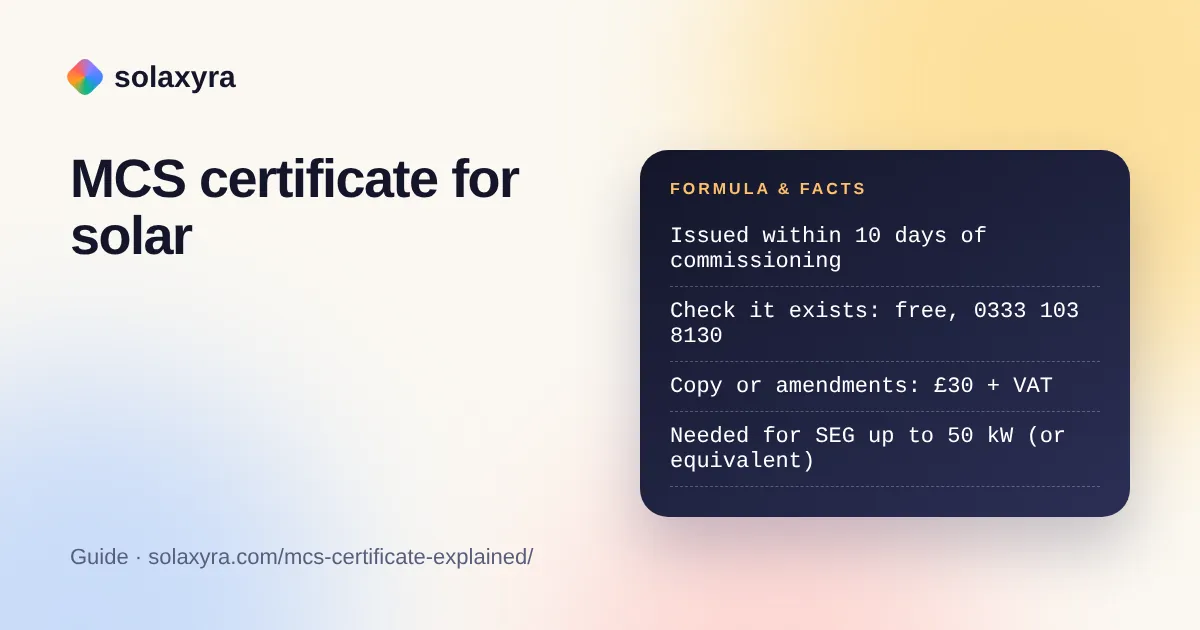
Quick answer: An MCS certificate solar installers issue confirms your PV system was designed, installed and commissioned to MCS standards, using MCS certified products, by an MCS certified installer. The installer must give it to you within 10 days of commissioning. You can check one exists for free, and a copy from MCS costs £30 plus VAT.
What is an MCS certificate for solar panels?
An MCS certificate is the record, generated on the MCS Installation Database, that a specific solar PV installation at a specific address meets the standards of the Microgeneration Certification Scheme. MCS describes it as proof that the system was designed, installed and commissioned to industry recognised standards, using only MCS certified products, by an MCS certified installer. For solar PV, the installation standard behind the certificate is MIS 3002.
Three ideas are easy to mix up, so it helps to keep them apart:
- MCS certified installer: the company holds MCS certification for the technology it fits, checked by a certification body.
- MCS certified product: the panel or inverter model has been tested and certified under the scheme. Manufacturers hold these product certificates, not homeowners.
- MCS installation certificate: the document for your home, tying a certified installer and certified products to your address and commissioning date.
Only the third is “your MCS certificate”. A product certificate from a panel manufacturer, even one stapled into a planning file, does not prove that your particular installation was registered.
Who issues the certificate and how quickly?
Your MCS certified installer registers the installation and must provide the certificate within 10 days of the system being commissioned, according to MCS certificate guidance for consumers. You do not apply for it yourself; the installer generates it on the MCS Installation Database.
Only installations with a commissioning date after 15 July 2009 can hold an MCS certificate. If your installer is not MCS certified for solar PV, MCS cannot issue a certificate later, so this is something to confirm before you sign a contract rather than after the scaffolding comes down.
- Before you sign, check the company on the MCS installer search and note its certification number.
- Confirm in writing that the quote includes MCS registration of the installation.
- On commissioning day, note the date; the 10 day clock runs from it.
- When the certificate arrives, check every field against the table below.
- Store a PDF and a paper copy with the house deeds, the electrician’s certificate and the network operator notification.
What information is on an MCS certificate and what can be corrected?
The certificate records the technology type and product details, the installation company, the address and commissioning date, and confirmation that the work complies with MCS standards. Typing errors such as a wrong MPAN or postcode do happen, and MCS lists which fields it can amend. The table brings the fields, the reason each matters and the correction route together.
| Field to check | Why it matters | Can MCS amend it? |
|---|---|---|
| Installation address and postcode | Must match your property for SEG applications and a sale | Yes |
| MPAN (meter point administration number) | Export tariff providers match payments to this number | Yes |
| Commissioning date | Starts the 10 day issue period and identifies the installation | Yes |
| Product details (panels, inverter) | Must match the certified products actually fitted | Yes |
| Meter make, model and serial number | Needed when a supplier checks generation or export metering | Yes |
| DNC, EAG and TIC figures (capacity and generation values) | Show system size and expected output | Yes |
| Meter readings | Readings are a fixed record at the time | No |
| Installer company and certification number | Proves the installer was certified for that technology | Contact MCS; not on the listed amendments |
A single paid request covers one copy certificate and unlimited amendments, so if you need a correction, list every error in one go.
Do you need an MCS certificate for the Smart Export Guarantee?
For a system up to 50 kW, which covers almost every home, the Smart Export Guarantee rules say the installation must be certified under MCS or an equivalent scheme, and an MCS certificate is the usual evidence. Ofgem’s SEG guidance for generators says the scheme also recognises that other schemes may be equivalent: without MCS, both the installation and the installer should be accredited in line with EN 45011 or EN ISO/IEC 17065:2012. Above 50 kW, up to the 5 MW SEG ceiling, installer certification is not required and suppliers decide what proof they accept.
In practice the MCS certificate is the simplest evidence, because an alternative accreditation has to be proved to the licensee’s satisfaction. Ask your chosen SEG licensee what it needs before you apply. Once you have the certificate, you can estimate what exports could pay with the SEG earnings calculator, and our guide to how SEG works covers tied and untied tariffs.
Example: a 4 kWp system exports 1,500 kWh a year. At an example rate of 5p per kWh (change to your tariff), that is £75 a year; at 15p it is £225. Over 10 years that is £750 to £2,250 of export income riding on valid certification, far more than the £36 a copy certificate costs.
How do you check an MCS certificate exists?
Checking is free: phone the MCS Customer Support Helpdesk on 0333 103 8130 with the technology type and the full address including postcode. MCS asks for proof that you live at the installation address, and accepts documents such as:
- a utility bill or bank statement dated within the last 3 months;
- a mortgage statement dated within the last 3 months;
- a Council Tax letter or financial statement dated within the last 12 months;
- a P45 or P60 dated within the last 12 months, or a photo driving licence.
If you are buying a house with panels, ask the seller for the certificate number early. A missing certificate does not stop a sale, but it raises questions about SEG eligibility, workmanship and whether the panels were installed by a certified firm, and it takes time to resolve.
What if you have lost your MCS certificate?
MCS can send a copy for £30 plus VAT (£36), applied for with an online form, proof of address and payment, and it says copies arrive within 10 working days. The same fee covers amendments. Before paying, ask your original installer, who should have the PDF and may send it free.
There is one important limit. MCS can produce copies, including where the installer is no longer MCS certified or has stopped trading, but it cannot issue a new certificate for an installation that was never registered. If the database has no record, the system was either installed by a non certified firm or never registered, and the fix is to talk to the installer, not to MCS.
Which other documents should come with a solar installation?
An MCS certificate is one document in a handover pack, not the whole pack. The others prove different things and are kept by different bodies, which is why a buyer’s solicitor may ask for several of them.
- Network operator notification: the installer must tell the distribution network operator about every installation. MCS guidance says systems under 16 A per phase are notified within 28 days under G98, while larger systems need permission before connection under G99. Our G98 vs G99 guide explains the difference.
- Electrical installation certificate: issued by the electrician for the new AC circuit. All mains wiring must be carried out by a qualified electrician and meet BS 7671.
- Planning evidence: most roof systems on houses are permitted development, but listed buildings and some locations need consent. See planning permission for solar panels.
- Warranties and the design summary: panel and inverter warranties, the array layout and the system size in kWp. You can sanity check the inverter rating with the inverter sizing calculator and the yearly output figure with the solar output calculator.
A heat pump also comes with an MCS compliance certificate, a checklist confirming the heating system was installed to MCS standards. Solar PV does not use that document, so do not be concerned if your pack lacks one.
Frequently Asked Questions
How long does it take to get an MCS certificate after installation?
Your installer must provide the MCS certificate within 10 days of the system being commissioned. If it has not arrived after that, ask the installer first, then call the MCS helpdesk on 0333 103 8130 to check whether the installation has been registered at all.
How much does a replacement MCS certificate cost?
A copy from MCS costs £30 plus VAT, which is £36, paid online with a form and proof of address. The fee covers one copy and unlimited amendments, and MCS says copies arrive within 10 working days. Checking that a certificate exists is free.
Can I get SEG payments without an MCS certificate?
For systems up to 50 kW, Ofgem’s SEG guidance says the installation must be MCS certified or meet an equivalent scheme, with installation and installer accredited to EN 45011 or EN ISO/IEC 17065:2012. Without either, a SEG licensee can refuse your application, so ask the licensee before you apply.
Can MCS issue a certificate if my installer never registered the system?
No. MCS can issue copies when the installer has stopped trading or is no longer certified, but it cannot create a new certificate for an installation that was never registered. Raise it with the installer, and check certification before signing any future contract.
Is a panel manufacturer’s MCS certificate the same as mine?
No. A manufacturer’s certificate shows a panel or inverter model is MCS certified. Your installation certificate links certified products and a certified installer to your address and commissioning date. Only the installation certificate supports a SEG application or answers a buyer’s questions.
Checked October 2026 by the Solaxyra Editorial Team. Sources: MCS: certificate queries, MCS: notifying DNOs, Ofgem: SEG guidance for generators, Ofgem: Smart Export Guarantee.