Gas fires must be serviced by a Gas Safe registered engineer. Fit a carbon monoxide alarm in the room.
Formula and breakdown
n/a
n/a
n/a
This gas fire running cost calculator works out what a gas fire costs per hour, day and year from its gas input rating and the setting you use. Prices default to the UK gas cap, so it shows the cost of the gas you burn, not just the heat that reaches the room.
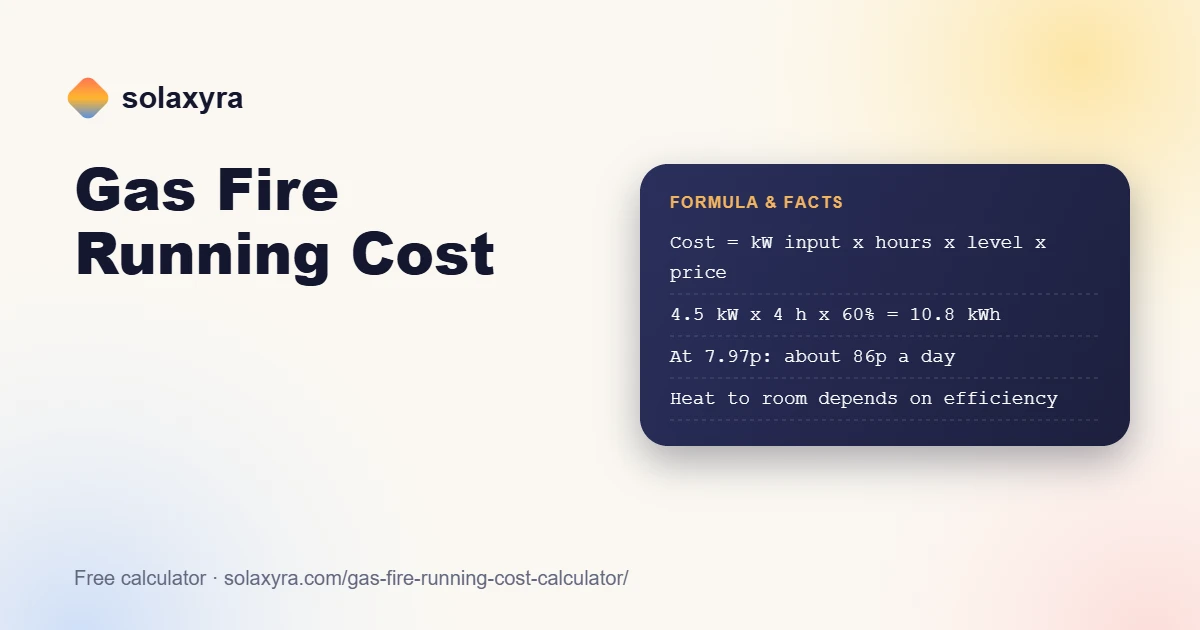
Quick answer: A gas fire costs its gas input in kW times the hours times the setting times the gas price. A 4.5 kW fire on 60% for 4 hours burns 10.8 kWh of gas, about 86p a day at the October to December 2026 cap of 7.97p per kWh.
What Is a Gas Fire Running Cost Calculator?
A gas fire running cost calculator converts the gas input rating into a cost. Gas fires are rated by the gas they burn, the input, and by the heat they put into the room, the output. The input is what you pay for. The output depends on the fire’s efficiency, which varies widely between types.
How Do You Use the Gas Fire Running Cost Calculator?
- Find the input rating on the data plate or in the manual, usually in kW. Enter it in watts, so 4.5 kW is 4,500 W.
- Enter the hours the fire is on each day.
- Set the average setting: 100% on high, around 50 to 60% on a mid setting, lower on pilot or low.
- Check the gas price per kWh and change it to your tariff if you know it.

How Much Does a Gas Fire Cost per Hour?
At the October to December 2026 gas cap of 7.97p per kWh:
| Fire input | On high, per hour | On 60%, per hour | 4 hours on 60% |
|---|---|---|---|
| 3 kW | 23.9p | 14.3p | 57p |
| 4.5 kW | 35.9p | 21.5p | 86p |
| 6 kW | 47.8p | 28.7p | £1.15 |
| 7 kW | 55.8p | 33.5p | £1.34 |
How Efficient Are Gas Fires?
- Glass-fronted and balanced flue fires often reach around 80 to 90% efficiency.
- Radiant and convector fires in an open chimney are often around 50 to 75%.
- Decorative fuel-effect fires that burn open in a fireplace can be far lower, with much of the heat going up the chimney.
If your fire is 60% efficient, a cost of 86p buys about 6.5 kWh of heat in the room, so each kWh of useful heat costs about 13.3p.
Is a Gas Fire Cheaper Than Central Heating?
For heating one room for an evening, a gas fire can cost less than running the whole central heating system. Per kWh of heat, a modern condensing boiler is usually more efficient than most gas fires, so for the whole house central heating is normally cheaper.
Safety
Gas fires can produce carbon monoxide if poorly maintained or if the flue is blocked. Have the fire serviced every year by a Gas Safe registered engineer, keep vents clear and fit a carbon monoxide alarm.
Worked Example: An Older Living Room Fire
Example: a couple in Swansea use a 5.5 kW radiant fire for 3 hours on winter evenings.
- They use the middle setting, about 60%.
- Gas burned = 5.5 kW × 3 h × 60% = 9.9 kWh.
- Cost = 9.9 × 7.97p = 78.9p an evening.
- Over 120 evenings = £94.68.
Frequently Asked Questions
How much does a gas fire cost per hour?
Typically 15p to 55p an hour at 7.97p per kWh, depending on size and setting.
Is it cheaper to run a gas fire or an electric heater?
Usually the gas fire, because gas is about a third of the price of electricity, unless the fire is very inefficient.
Do gas fires use a lot of gas?
A 4.5 kW fire on high burns 4.5 kWh of gas an hour, similar to a boiler heating a few radiators.
How much does the pilot light cost?
A standing pilot can burn a small amount of gas all day; turning the fire off fully when not in use saves that.
Checked November 2026 by the Solaxyra Editorial Team. Sources: Ofgem: Energy price cap, 1 October to 31 December 2026, Gas Safe Register: Gas safety advice.