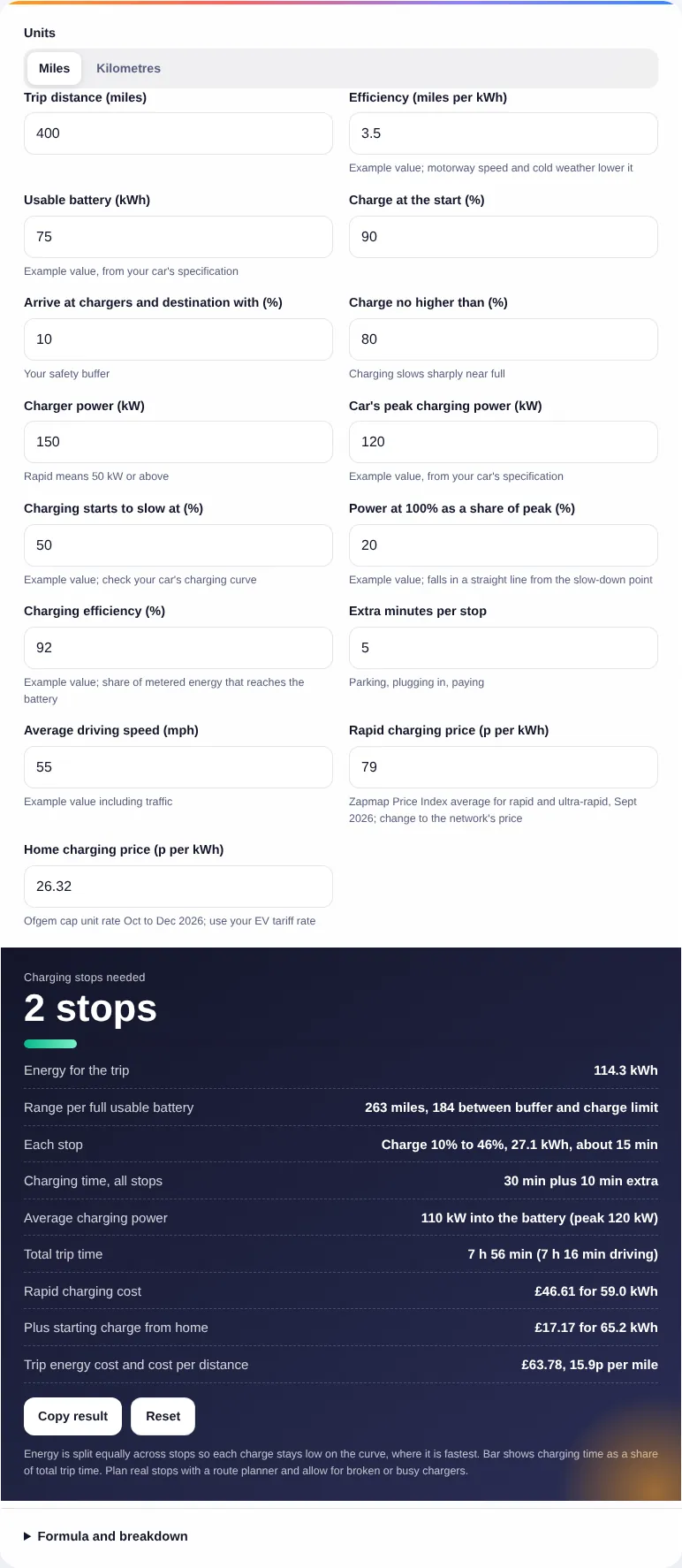
Energy is split equally across stops so each charge stays low on the curve, where it is fastest. Bar shows charging time as a share of total trip time. Plan real stops with a route planner and allow for broken or busy chargers.
Formula and breakdown
n/a
n/a
n/a
n/a
This EV road trip charging calculator works out how many rapid charging stops a long journey in an electric car needs, how long each stop takes once the charging curve slows down, and what the trip costs in public and home electricity. It is built for UK and European drivers planning a holiday, a visit to family or a business trip, in miles or kilometres, and it shows every step so you can test a different car, charger or price.
Quick answer: An EV road trip charging calculator divides trip energy by what the battery can supply between your start charge, safety buffer and charge limit. Example: 400 miles at 3.5 miles per kWh needs 114 kWh; a 75 kWh car leaving at 90% needs two short stops of about 15 minutes each.
What Is an EV Road Trip Charging Calculator?
An EV road trip charging calculator is a tool that estimates the number, length and cost of charging stops for a journey longer than one battery’s range. In plain words: trip energy equals distance divided by efficiency. The battery supplies the energy between your starting charge and the buffer you want to arrive with; the rest must come from chargers. Each stop can add, at most, the energy between your buffer and your charge limit, so the number of stops is the shortfall divided by that, rounded up.
Time is the harder part. A car charges at close to its peak power when the battery is low, then slows as it fills. The EV road trip charging calculator models that with a flat section up to a slow-down point and a straight-line fall afterwards, adds charging losses, and sums the time in small steps.
How Do You Use the EV Road Trip Charging Calculator?
- Choose miles or kilometres, then enter the trip distance and your car’s efficiency in miles per kWh or kWh per 100 km.
- Enter the usable battery size, the charge you will start with and the buffer you want on arrival at each charger and at your destination.
- Set the highest charge you are willing to wait for, often 80%.
- Enter the charger’s power and your car’s peak charging power, then the point where charging starts to slow and how low it drops by 100%. All three come from your car’s charging curve; the defaults are example values.
- Add the rapid price, your home price for the starting charge, minutes per stop for parking and paying, and your average speed.
- Read the number of stops, time per stop, total trip time and cost. Open the breakdown to see each step.
How Many Charging Stops Will My Trip Need?
Stops equal the energy still needed after your starting charge, divided by the energy one stop can add, rounded up. With the defaults, 400 miles at 3.5 miles per kWh needs 114.3 kWh. Leaving at 90% with a 10% buffer gives 60 kWh from home, so 54.3 kWh must come from chargers, and with a 10% to 80% window each stop can add up to 52.5 kWh. That is just over one stop’s worth, so two stops are needed.
The EV road trip charging calculator then splits the energy equally: two stops of 27.1 kWh each, from 10% to about 46%. Two short stops low on the curve take about 30 minutes in total, while one long stop to 80% plus a second small top-up would take longer because more time is spent in the slow part of the curve.
How Long Does Rapid Charging Take on a Road Trip?
Charging from 10% to 80% takes about 33 minutes for the example 75 kWh car at a 120 kW peak, but the last 20% to full takes another 24 minutes. The table uses the same example charging curve, flat to 50% and then falling to 20% of peak at 100%, with 92% charging efficiency.
| Peak charging power | 10% to 50% | 10% to 80% | 10% to 100% |
|---|---|---|---|
| 50 kW | 39 min | 79 min | 138 min |
| 100 kW | 20 min | 40 min | 69 min |
| 120 kW | 16 min | 33 min | 57 min |
| 150 kW | 13 min | 26 min | 46 min |
| 250 kW | 8 min | 16 min | 28 min |
Peak power is the lower of the charger’s and the car’s: a car limited to 100 kW gains nothing from a 350 kW charger. Real curves differ by model and with battery temperature, so replace the example slow-down point and end power with your car’s published curve. For home charging times, use the battery charging time calculator or our EV charging time calculator.
How Much Does an EV Road Trip Cost to Charge?
Zapmap’s Price Index put the average pay-as-you-go price on rapid and ultra-rapid chargers at 79p per kWh in September 2026, against 54p per kWh on slower public chargers. Home electricity at the Ofgem price cap is 26.32p per kWh from 1 October to 31 December 2026, and EV tariffs are often lower overnight. The default trip therefore costs about £46.61 in rapid charging plus £17.17 for the starting charge at the cap rate, about 15.9p per mile.
Under the Public Charge Point Regulations 2023, the total price at a public charge point must be clearly displayed in pence per kWh and must not rise once charging has started, new public charge points of 8 kW or more must take contactless payment, and each operator’s rapid network must be reliable 99% of the time on average over a year. That makes it straightforward to type the price on the charger screen into the EV road trip charging calculator.
Compare the total with petrol in the EV vs petrol cost calculator, or see how far home solar can cover the starting charge with the solar EV charging calculator.
How Can You Make EV Road Trips Faster?
Arrive at chargers low and leave well before full: charging power is highest at low charge, so several short stops usually beat one long one. Other practical steps:
- Start at 100% from home if your car allows it, using a cheap overnight rate; the starting charge is the cheapest energy on the trip.
- If your car can warm its battery before a rapid charge, use that feature as your handbook describes.
- Pick chargers whose power matches your car’s peak, not just the nearest one.
- Keep a buffer: 10% is the default here, and more in winter or on unfamiliar routes.
- Check efficiency at motorway speeds. Driving faster or in the cold lowers miles per kWh; the EV efficiency converter switches between miles per kWh and kWh per 100 km.
Worked Example: 330-Mile Motorway Trip
Example: a driver plans a 330-mile motorway journey in a car with 64 kWh usable battery, an efficiency of 3.2 miles per kWh at motorway speed and a 100 kW peak charging power. They leave at 100% after charging overnight at an example EV tariff of 7p per kWh, keep a 10% buffer, will charge no higher than 80% and expect 150 kW chargers at 79p per kWh.
- Trip energy: 330 / 3.2 = 103.1 kWh. From home: (100% minus 10%) x 64 = 57.6 kWh.
- Still needed: 103.1 minus 57.6 = 45.5 kWh. Most per stop: (80% minus 10%) x 64 = 44.8 kWh, so two stops are needed.
- Each stop adds 22.8 kWh, from 10% to about 46%. Peak power is the car’s 100 kW, so each stop takes about 15 minutes; 30 minutes in all plus 10 minutes for parking.
- Rapid cost: 45.5 kWh / 0.92 = 49.5 kWh bought x 79p = £39.09. Home: 57.6 / 0.92 = 62.6 kWh x 7p = £4.38.
- Total energy cost: £43.47, about 13.2p per mile. At 55 mph average, the trip takes about 6 h 40 min including stops.
On 50 kW chargers the same two stops would take about 30 minutes each, adding half an hour to the trip, which is why the charger’s power matters more than its distance off the motorway.
Frequently Asked Questions
How do I calculate how many charging stops my EV trip needs?
Work out trip energy as distance divided by efficiency. Subtract the energy between your starting charge and arrival buffer. Divide what is left by the energy one stop adds between buffer and charge limit, then round up. With this page’s defaults, a 400-mile trip in a 75 kWh car needs two stops.
Should I charge to 80% or 100% on a road trip?
Usually to 80% or less at rapid chargers, because charging slows sharply near full. In the example curve on this page, 10% to 80% takes 33 minutes at 120 kW but 10% to 100% takes 57 minutes. Charge to 100% at home before leaving if your car allows it.
How much does rapid charging cost in the UK?
Zapmap’s Price Index reported an average pay-as-you-go price of 79p per kWh for rapid and ultra-rapid chargers in September 2026. Prices vary by network, location and membership plan, so enter the price shown on the charger, which must be displayed in pence per kWh.
Why does my EV charge slower above 80%?
The car’s battery management reduces charging power as the battery fills, so the last part of a charge is much slower than the first. The exact curve varies by model and conditions. The EV road trip charging calculator models this with a slow-down point and a lower end power you can set.
Does a faster charger always save time?
Only up to your car’s peak charging power. The calculator uses the lower of the charger’s power and the car’s peak, so a car limited to 100 kW charges no faster on a 350 kW unit. Arriving at the charger with a low charge matters just as much, because power is highest then.
Is this EV road trip charging calculator a route planner?
No. It estimates stops, time and cost for a given distance and assumes chargers are where you need them. Use a route planner or your car’s navigation to choose real chargers, and allow extra buffer in case a charger is busy or out of service.
Checked October 2026 by the Solaxyra Editorial Team. Sources: Zapmap Price Index, September 2026, Ofgem: Energy price cap, 1 October to 31 December 2026, The Public Charge Point Regulations 2023 (legislation.gov.uk).