Conversions use 1 mile = 1.609344 km. Costs use energy at the charger, so they include the charging loss you enter. Range uses the figure as entered.
Formula and breakdown
n/a
n/a
n/a
This EV efficiency converter translates an electric car’s energy use between miles per kWh, km per kWh, kWh per 100 km, kWh per 100 miles, Wh per km, Wh per mile and the US MPGe, for drivers in the UK, Ireland and Europe comparing cars, reviews and trip computer readings. It also turns the figure into a charging cost per mile at your tariff and a range from your usable battery size.
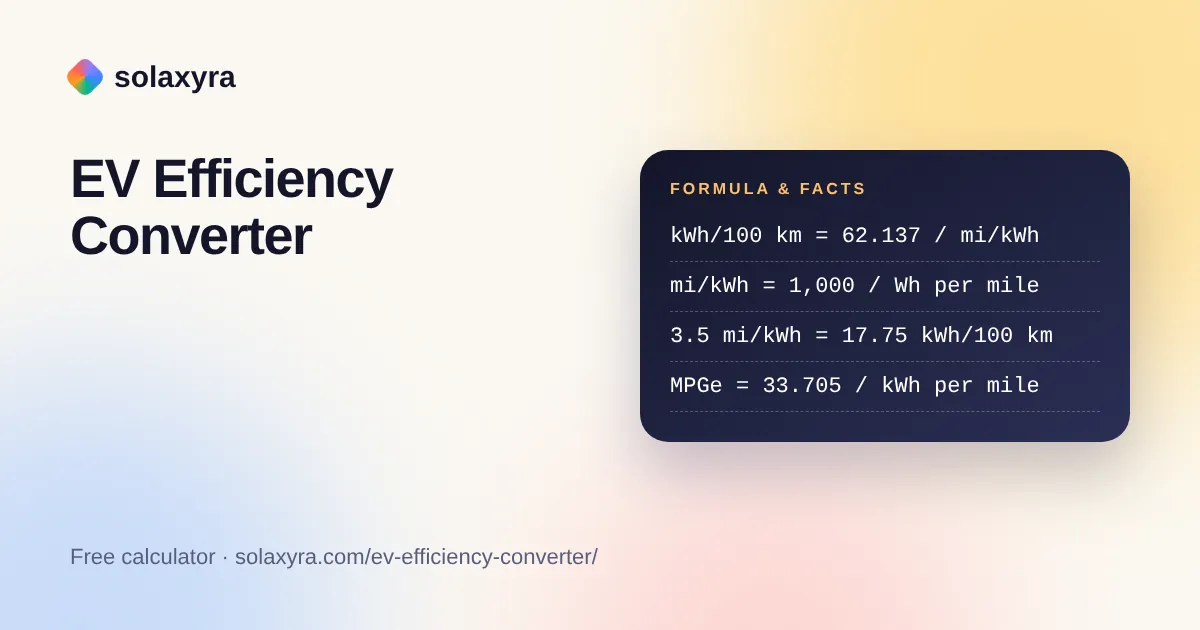
Quick answer: An EV efficiency converter switches between the units used in the UK, Europe and the US. To turn miles per kWh into kWh per 100 km, divide 62.14 by the mi/kWh figure: 3.5 mi/kWh is 17.75 kWh/100 km, 285.7 Wh per mile or 177.5 Wh per km. Higher mi/kWh means a more efficient car.
What Is an EV Efficiency Converter?
An EV efficiency converter is a tool that expresses the same electric vehicle energy use in different units, either as distance per unit of energy (miles or km per kWh) or as energy per unit of distance (kWh per 100 km, Wh per mile). In plain words: find the energy used per kilometre, then scale it by 1.609344 for miles, by 100 for “per 100” units or by 1,000 for watt-hours, or take its reciprocal for distance per kWh.
UK drivers and reviews commonly quote miles per kWh, much like miles per gallon, while many European sources use kWh per 100 km or Wh per km. The two styles run in opposite directions: a higher mi/kWh is better, but a lower kWh/100 km is better. The ev efficiency converter uses the international mile, which the Wikipedia article on the mile gives as exactly 1,609.344 metres since 1959.
How Do You Use the EV Efficiency Converter?
- Enter the efficiency figure from the trip computer, a review or the official rating.
- Choose its unit from the list, from miles per kWh to MPGe.
- Enter a charging loss if your figure comes from the car’s dashboard, or 0 if it was measured at the charger or wall.
- Enter your electricity price per kWh and the currency. The default is the UK price cap unit rate.
- Enter your usable battery size for a range estimate.
- Read every unit at once, plus the at-charger figure, the cost per mile and per 100 km, and the range.

How Do You Convert Miles per kWh to kWh per 100 km?
Divide 62.137 by the miles per kWh: 3.5 mi/kWh is 62.137 / 3.5 = 17.75 kWh per 100 km. The constant is 100 divided by 1.609344, and the formula is its own reverse, so 62.137 divided by a kWh/100 km figure gives miles per kWh. For Wh per mile, divide 1,000 by the mi/kWh figure; for Wh per km, divide 621.37 by it.
The table converts common miles per kWh figures. The cost columns use the Ofgem price cap unit rate of 26.32p per kWh, first with no charging loss and then with an example loss of 10%.
| mi/kWh | kWh/100 km | km/kWh | Wh/km | Wh/mile | Cost per mile, no loss | Cost per mile, 10% loss |
|---|---|---|---|---|---|---|
| 2.0 | 31.1 | 3.22 | 311 | 500 | 13.16p | 14.62p |
| 2.5 | 24.9 | 4.02 | 249 | 400 | 10.53p | 11.70p |
| 3.0 | 20.7 | 4.83 | 207 | 333 | 8.77p | 9.75p |
| 3.5 | 17.8 | 5.63 | 178 | 286 | 7.52p | 8.36p |
| 4.0 | 15.5 | 6.44 | 155 | 250 | 6.58p | 7.31p |
| 4.5 | 13.8 | 7.24 | 138 | 222 | 5.85p | 6.50p |
| 5.0 | 12.4 | 8.05 | 124 | 200 | 5.26p | 5.85p |
Because the units are reciprocals, equal steps in mi/kWh are not equal savings. Going from 2 to 2.5 mi/kWh saves 6.2 kWh per 100 km, while going from 4.5 to 5 saves only 1.4 kWh. Comparing cars in kWh/100 km or Wh/mile makes the real difference in energy, and cost, easier to see.
What Is a Good Miles per kWh?
There is no official benchmark, so the most useful comparison is between your own figure and your car’s published rating, converted to the same unit. Every electric car uses more energy in cold weather, at motorway speeds and on short trips with the heater running, so a winter figure well below the summer one is normal rather than a fault.
To see what your own driving costs over a year, multiply the energy per mile at the charger by your annual miles; the electricity cost calculator then prices any number of kWh. If you plan to charge from your own panels, the solar EV charging calculator starts from the same efficiency figure and works out how much of it solar can supply.
Does Charging Loss Change the Real Cost per Mile?
Yes: you pay for every kWh that passes through your meter, including what is lost in the charger, cable and battery, so the cost per mile at the charger is always higher than the dashboard figure suggests. The Wikipedia article on MPGe notes that US window-sticker ratings are measured wall to wheel, which includes the AC charging conversion and so reflects the energy the owner pays for.
Charging losses vary with the charger, the power level and the temperature, so the ev efficiency converter treats the loss as your own input. If you record the kWh shown by a smart charger or meter and the miles driven between charges, you can enter the result as miles per kWh with a loss of 0%, and compare it with the dashboard figure to find your own loss.
How Do You Convert MPGe to kWh per 100 km?
Divide 33.705 by the MPGe to get kWh per mile, then multiply by 62.137: 118 MPGe is 33.705 / 118 = 0.2856 kWh per mile, or 17.75 kWh per 100 km. MPGe is a US measure that counts 33.705 kWh as the energy in one US gallon of petrol, so it is mainly useful for reading American reviews and labels, and it should not be compared directly with petrol miles per gallon figures from the UK.
Worked Example: Annual Charging Cost From a Dashboard Reading
Example: a family car in Bristol shows 3.2 mi/kWh on its trip computer over a year and covers 8,000 miles. The household assumes a 10% charging loss and pays the price cap rate of 26.32p per kWh, and wants to compare that with an example off-peak tariff of 7.5p per kWh (change it to your own tariff).
- Energy from the battery: 8,000 / 3.2 = 2,500 kWh.
- Energy at the meter: 2,500 / 0.9 = 2,778 kWh, which is 2.88 mi/kWh at the charger.
- Cost at 26.32p: 2,778 x 0.2632 = about £731 a year, or 9.14p per mile.
- Cost at the example 7.5p: 2,778 x 0.075 = about £208 a year, or 2.60p per mile.
- In other units the car uses 19.42 kWh/100 km or 312.5 Wh per mile at the battery.
The calculation behind step 1 is the same energy sum as in the watts to kWh calculator. Installing a home charger on a dedicated circuit is work for a qualified electrician, and in the UK it must meet BS 7671.
Frequently Asked Questions
How do I convert miles per kWh to kWh per 100 km?
Divide 62.137 by the miles per kWh figure. The number comes from 100 divided by 1.609344, the kilometres in a mile. So 4 mi/kWh is 62.137 / 4 = 15.53 kWh/100 km, and 3 mi/kWh is 20.71 kWh/100 km. The same formula works in reverse.
What is a good miles per kWh for an electric car?
There is no official benchmark, so compare your figure with your car’s own published rating after converting it to the same unit. Every car uses more energy in cold weather, at motorway speeds and on short trips with the heater running, so expect your own figure to change through the year.
How do I convert Wh per mile to miles per kWh?
Divide 1,000 by the Wh per mile figure. 250 Wh/mi is 1,000 / 250 = 4 mi/kWh, and 333 Wh/mi is 3 mi/kWh. For Wh per km, divide 621.37 by the figure: 155 Wh/km is about 4 mi/kWh.
Does the dashboard mi/kWh include charging losses?
Often not. A car’s trip computer generally reports energy taken from the battery, while your electricity meter also records energy lost in the charger and cable. Some energy is always lost in charging, so cost per mile should use the figure at the charger. Enter your own loss estimate in the ev efficiency converter.
What is MPGe and how does it relate to kWh?
MPGe is a US measure that treats 33.705 kWh of electricity as equal in energy to one US gallon of petrol. Divide 33.705 by the kWh used per mile to get MPGe. A car using 28.57 kWh per 100 miles, or 3.5 mi/kWh, rates about 118 MPGe.
How do I work out EV cost per mile from mi/kWh?
Divide your electricity price per kWh by the miles per kWh, then adjust for charging losses. At the UK price cap rate of 26.32p and 3.5 mi/kWh, the cost is 7.52p per mile before losses, or about 8.36p per mile with a 10% charging loss.
Checked October 2026 by the Solaxyra Editorial Team. Sources: Wikipedia: Miles per gallon gasoline equivalent, Wikipedia: Mile, Ofgem: Energy price cap, 1 October to 31 December 2026.