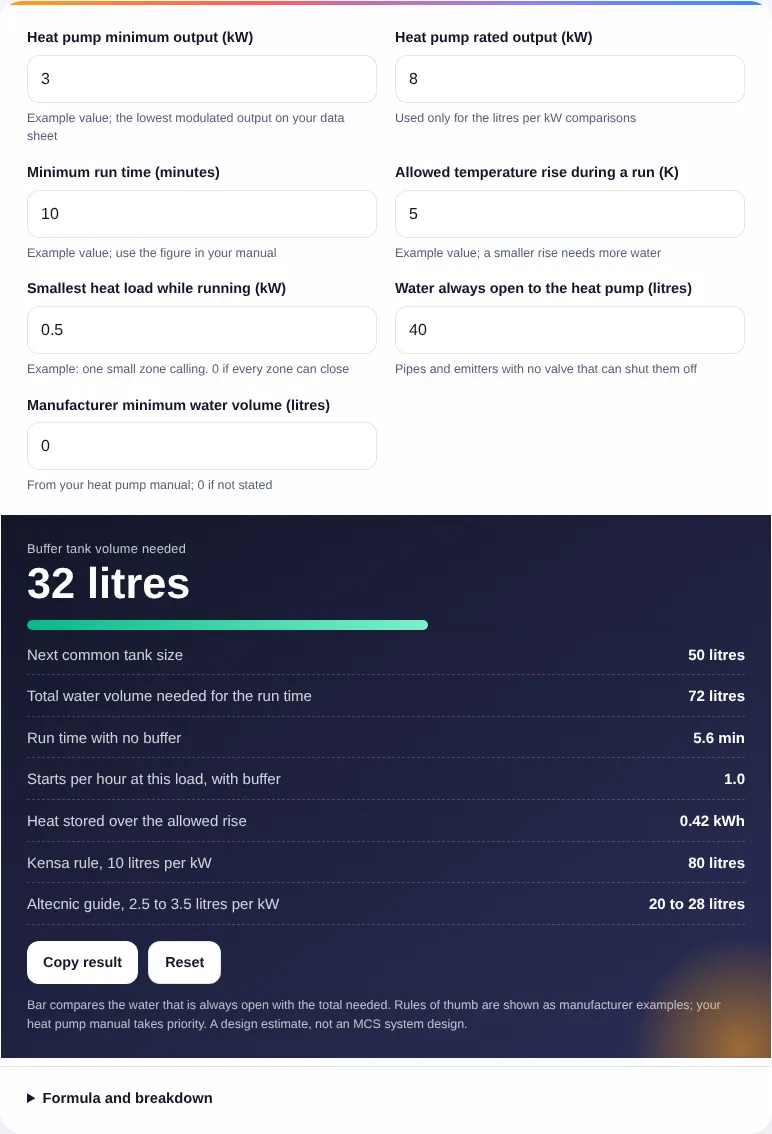
Bar compares the water that is always open with the total needed. Rules of thumb are shown as manufacturer examples; your heat pump manual takes priority. A design estimate, not an MCS system design.
Formula and breakdown
n/a
n/a
n/a
This heat pump buffer tank size calculator works out how many litres of water a heating system needs so that an air source or ground source heat pump can run for a minimum time at its lowest output without short cycling, for UK and European homeowners, designers and installers checking a quote. It uses the physics of heating water rather than a single rule of thumb, subtracts the water already open to the heat pump, and shows the common manufacturer rules side by side.
Quick answer: A heat pump buffer tank size calculator divides the surplus heat during one minimum run by the heat each litre absorbs. A heat pump with a 3 kW minimum output, 0.5 kW of load, a 10 minute run and a 5 K rise needs 72 litres in circulation; with 40 litres always open, the buffer is about 32 litres.
What Is a Heat Pump Buffer Tank Size Calculator?
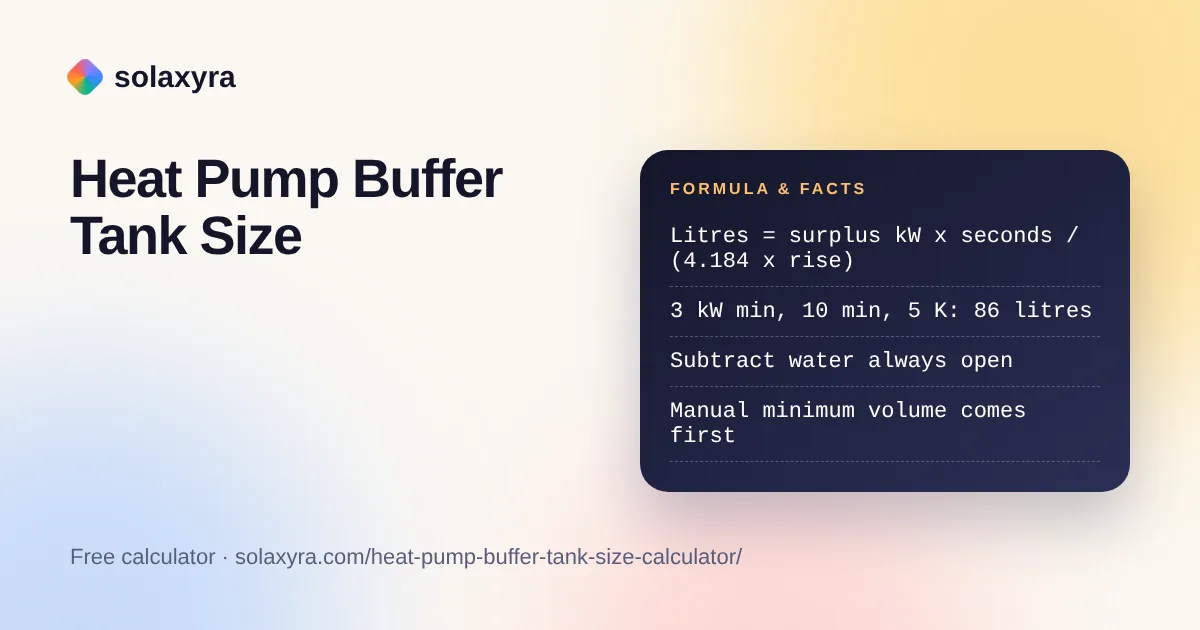
A heat pump buffer tank size calculator is a tool that estimates the volume of water needed to absorb a heat pump's minimum output for a chosen run time, so the compressor does not start and stop every few minutes. In plain words: volume in litres equals the heat pump's minimum output minus the load it is serving, in kW, times the run time in seconds, divided by 4.184 times the temperature rise you allow in kelvin.
The 4.184 is the heat in kilojoules needed to warm one litre of water by one degree. The Wikipedia article on specific heat capacity gives liquid water about 4,184 J per kg per kelvin at 20 °C, and a litre of water weighs close to 1 kg. The same relationship appears in imperial units in Caleffi's idronics design formula, where volume in gallons equals run time times surplus output in Btu per hour divided by 500 times the temperature rise.
How Do You Use the Heat Pump Buffer Tank Size Calculator?
- Enter the heat pump's minimum output in kW from the data sheet. This is the lowest output it can modulate down to, not its rated size.
- Enter the rated output so the calculator can show the litres per kW rules for comparison.
- Enter the minimum run time you want, or the figure your manufacturer gives, and the temperature rise you will accept during that run.
- Enter the smallest load the system might have while the heat pump runs. If every room can be shut off by thermostatic or zone valves, enter 0.
- Enter the water volume that is always open to the heat pump: pipework plus any radiators or underfloor loops with no valve that can close them.
- If your manual states a minimum water volume, enter it. Read the buffer size and the next common tank size.
How Big Should a Heat Pump Buffer Tank Be?
A heat pump buffer tank should hold enough water that, together with the open part of the system, the heat pump can run for its minimum time at its lowest output; for a 3 kW minimum output, a 10 minute run and a 5 K rise that is 86 litres in total with no load. Published rules of thumb disagree widely because they assume different run times and temperature rises.
| Minimum output | 6 minute run, 5 K rise | 10 minute run, 5 K rise | 10 minute run, 3 K rise |
|---|---|---|---|
| 2 kW | 34 litres | 57 litres | 96 litres |
| 3 kW | 52 litres | 86 litres | 143 litres |
| 4 kW | 69 litres | 115 litres | 191 litres |
| 5 kW | 86 litres | 143 litres | 239 litres |
| 6 kW | 103 litres | 172 litres | 287 litres |
Each row comes from the heat pump buffer tank size calculator. The table shows total circulating water with no load, before subtracting what the pipes and open emitters already hold. Halving the allowed rise doubles the volume, and doubling the run time doubles it again, which is why the heat pump buffer tank size calculator asks for both instead of assuming them.
What Do Manufacturers Say About Buffer Tank Size?
Manufacturer guidance ranges from about 2.5 to 10 litres per kW. Kensa, a UK ground source heat pump maker, sizes its buffers at 10 litres per kW of heat pump output and, for a twin compressor unit, sizes for one compressor only, so a 16 kW twin gets 80 litres. Altecnic's wall mounted buffer tank data sheet says modern heat pumps need about 2.5 to 3.5 litres per kW and matches its 15 to 50 litre tanks to heat pumps from 3 to 25 kW.
Both are shown in the results as examples. The rule that matters for your installation is the minimum water volume in your own heat pump's installation manual, which often also covers defrosting on air source units. Enter it and the heat pump buffer tank size calculator uses whichever is larger, the manual's minimum or the run time calculation.
Do You Always Need a Buffer Tank With a Heat Pump?
No: if enough water stays open to the heat pump to cover its minimum run time, no buffer is needed. Kensa's guidance is that a buffer can be left out when about a quarter of the system volume has no thermostatic or zone valves. In the default example 40 litres of open water gives a run time of only 5.6 minutes, so a buffer is needed; raise the open volume to 150 litres and the heat pump buffer tank size calculator shows none.
When the shortfall is small, a volumiser, a simple tank in series with the flow, can add water without the extra pump and separation that a four port buffer brings. Systems with many zones, or with a second heat source such as a wood stove, often need a larger store; our thermal store size calculator covers that case.
How Often Will the Heat Pump Start?
With the default inputs the heat pump starts about once an hour at a 0.5 kW load, because the 72 litres take 10 minutes to warm by 5 K and about 50 minutes to cool again while feeding that small load. The heat pump buffer tank size calculator shows starts per hour from the on time, volume times 4.184 times rise divided by the surplus output, and the off time, the same stored heat divided by the load.
The stored heat itself is small: 72 litres over 5 K holds only 0.42 kWh. A buffer is for smoothing the compressor, not for storing heat for hours. To see what the heat pump costs to run across a year, use the heat pump running cost calculator, and price the circulation pumps with the electricity cost calculator.
Does a Buffer Tank Affect Other Parts of the System?
Yes. Extra water means the sealed system's expansion vessel must handle a larger volume, a four port buffer needs its own circulating pump, and every tank loses some heat through its insulation. Altecnic lists 45 mm insulation with a conductivity of 0.039 W/mK on its tanks. Check the vessel with the expansion vessel size calculator after adding a buffer.
Buffer tanks and heat pumps are part of a pressurised heating system. The design should be carried out by a competent heat pump installer, normally MCS certified, and electrical work must be done by a qualified electrician to BS 7671. The result here is a design estimate to compare with a quote, not a replacement for the installer's system design.
Worked Example: Air Source Heat Pump With Zoned Radiators
Example: an 8 kW air source heat pump in a three-bedroom house can modulate down to 3 kW. Every radiator has a thermostatic valve except the bathroom towel rail, which gives about 0.5 kW and, with the pipework, leaves 40 litres always open. The installer wants at least a 10 minute run with no more than a 5 K rise. These are the default inputs of the heat pump buffer tank size calculator.
- Surplus heat during a run: 3 minus 0.5 = 2.5 kW.
- Run time: 10 x 60 = 600 seconds.
- Volume: 2.5 x 600 / (4.184 x 5) = 1,500 / 20.92 = 71.7 litres.
- Buffer: 71.7 minus 40 = 31.7 litres, so the next common size up is a 50 litre tank.
- Without a buffer: 40 x 4.184 x 5 / 2.5 = 335 seconds, a run of 5.6 minutes.
- For comparison, Kensa's 10 litres per kW rule gives 80 litres and Altecnic's guide gives 20 to 28 litres.
Frequently Asked Questions
What size buffer tank do I need for an 8 kW heat pump?
It depends on the minimum output, not the 8 kW rating. If the unit modulates to 3 kW and you want a 10 minute run with a 5 K rise, you need about 86 litres circulating with no load. Subtract the water that is always open to the heat pump to find the buffer.
Why does the calculator use minimum output instead of rated output?
Short cycling happens in mild weather, when the heat pump is already at its lowest output and the load is smaller still. At rated output the house usually absorbs the heat. The minimum modulated output is the figure that decides how much water is needed to stretch each run.
What temperature rise should I allow in a buffer tank?
Treat it as a design choice. A smaller rise keeps flow temperatures steady but needs more water; the calculator defaults to an example 5 K. Halving the rise to 2.5 K doubles the volume, so check what the heat pump controls actually allow before choosing.
What is the difference between a buffer tank and a volumiser?
A volumiser is a tank that simply adds water in series with the heating circuit. A buffer tank, often with four connections, also separates the heat pump circuit from the heating circuit, which then needs its own pump. Both add volume; only the buffer gives hydraulic separation.
Is 10 litres per kW a good rule for buffer tanks?
It is one manufacturer's rule. Kensa uses 10 litres per kW for its ground source units, while Altecnic's data sheet suggests 2.5 to 3.5 litres per kW. The run time calculation on this page explains the gap and the heat pump manual has the final say.
Does a bigger buffer tank save energy?
Not by itself. A buffer reduces short cycling, which helps compressor life and efficiency, but every extra litre adds standing heat loss and a four port buffer adds a pump. Size it to the run time you need rather than as large as space allows.
Checked October 2026 by the Solaxyra Editorial Team. Sources: Caleffi idronics Appendix B: buffer tank sizing formula, Kensa: buffer tank sizing, Altecnic: wall mounted buffer tank data sheet, Wikipedia: Specific heat capacity.