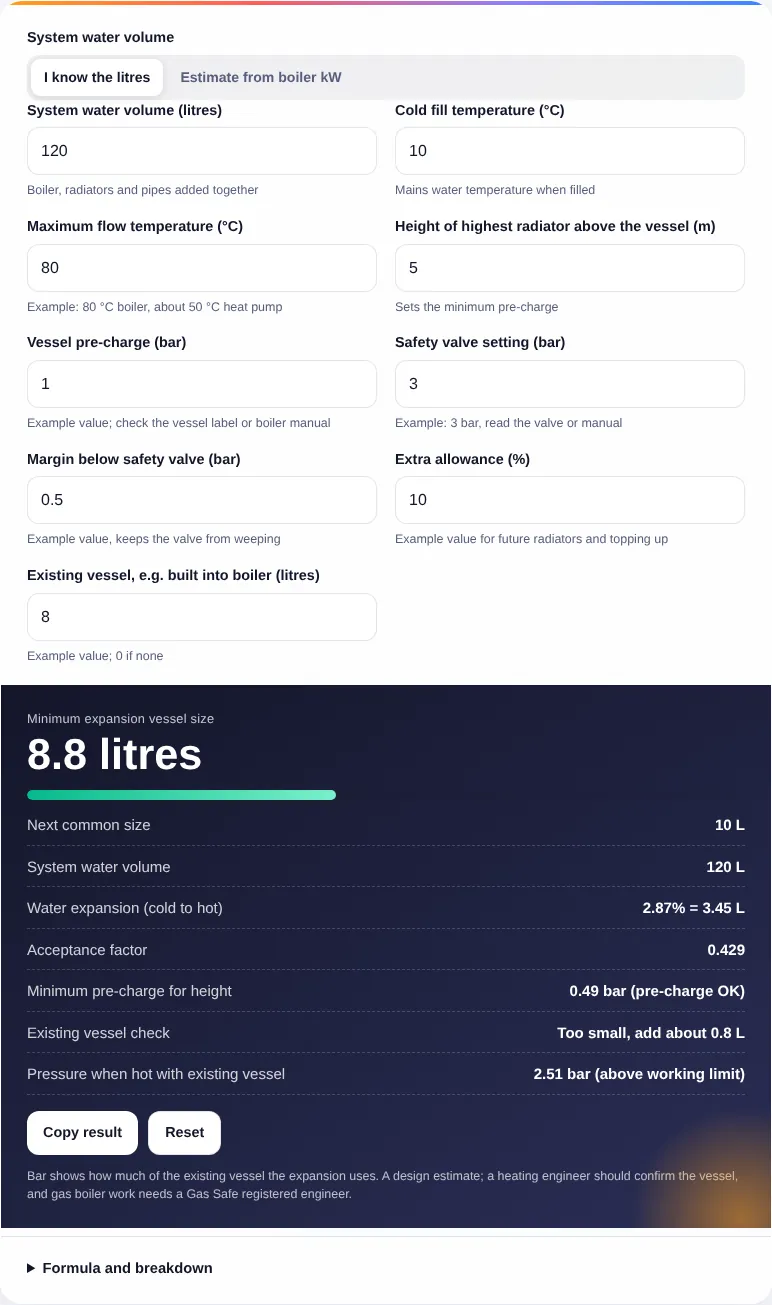
Bar shows how much of the existing vessel the expansion uses. A design estimate; a heating engineer should confirm the vessel, and gas boiler work needs a Gas Safe registered engineer.
Formula and breakdown
n/a
n/a
n/a
n/a
This expansion vessel size calculator works out the minimum vessel volume for a sealed (pressurised) central heating system in the UK and Europe, from the system water volume, the cold fill and maximum flow temperatures, the vessel pre-charge and the safety valve setting. It also checks whether the vessel already built into your boiler is big enough and shows the pressure the system would reach when hot.
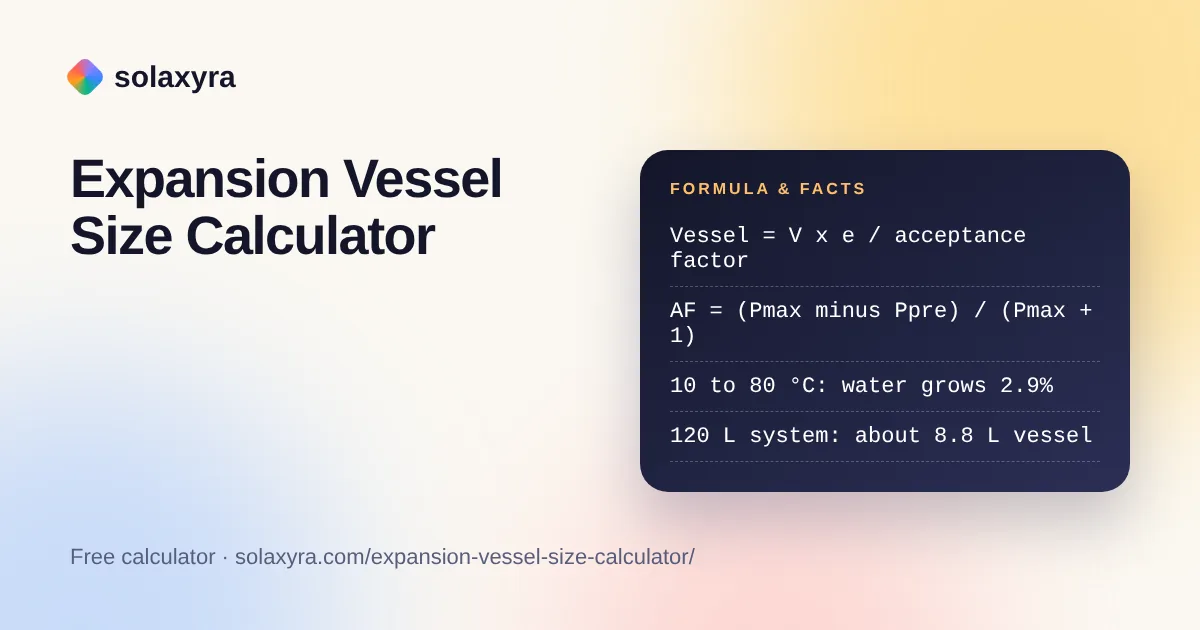
Quick answer: An expansion vessel size calculator divides the volume the water gains when heated by the vessel’s acceptance factor. Water heated from 10 °C to 80 °C grows by about 2.9%, so a 120 litre system gains 3.4 litres; with a 1 bar pre-charge and 2.5 bar working limit it needs about 8.8 litres including a 10% allowance.
What Is an Expansion Vessel Size Calculator?
An expansion vessel size calculator is a tool that finds the smallest pressurised vessel able to absorb the extra water volume a sealed heating system produces as it warms up, without the pressure reaching the safety valve. In plain words: vessel volume equals system volume times the expansion factor, divided by the acceptance factor, where the acceptance factor is the working pressure minus the pre-charge, divided by the working pressure plus 1 bar.
A heating expansion vessel is a steel tank split by a rubber diaphragm, with system water on one side and a cushion of pressurised air on the other. As the water expands it compresses the gas, and the gas pressure rises. The Wikipedia article on expansion tanks describes this layout, and Boyle’s law explains why the gas pressure rises as its volume shrinks, which is where the acceptance factor comes from.
How Do You Use the Expansion Vessel Size Calculator?
- Enter the total water volume of the system in litres, or switch to the estimate and enter the boiler or heat pump output with a litres per kW figure.
- Set the cold fill temperature (mains water, often around 10 °C) and the highest flow temperature the system can reach.
- Enter the height of the highest radiator above the vessel so the tool can check the minimum pre-charge.
- Enter the vessel pre-charge, the safety valve setting and the margin you want to keep below the valve.
- Add an allowance for future radiators if you want one, and the size of any vessel already fitted, such as the one inside a combi boiler.
- Read the minimum size, the next common size, and the check on your existing vessel. Open the breakdown to see each step.
How Much Does Heating Water Expand?
Water heated from 10 °C to 80 °C expands by about 2.9%, and from 10 °C to 50 °C by about 1.2%. The expansion factor used by the expansion vessel size calculator comes from the density of liquid water: e equals the density at the fill temperature divided by the density at the hot temperature, minus 1. The density values are from the water table in the Wikipedia article on density, which lists 999.70 kg/m³ at 10 °C, 983.2 kg/m³ at 60 °C, 971.8 kg/m³ at 80 °C and 958.4 kg/m³ at 100 °C; the tool interpolates between rows.
Because water expands faster as it gets hotter, flow temperature matters more than many people expect. Running the same system at heat pump temperatures roughly halves the expansion compared with a boiler at 80 °C. Some calculators use one fixed factor for every temperature, which oversizes low temperature systems and can undersize systems run near 100 °C.
What Size Expansion Vessel Do I Need?
For a typical sealed system with a 1 bar pre-charge, a 3 bar safety valve and a 10% allowance, you need roughly 7.4 litres of vessel per 100 litres of system water at 80 °C, or about 3.1 litres per 100 litres at 50 °C. The table shows the minimum size the expansion vessel size calculator returns for common system volumes.
| System water volume | 50 °C flow | 60 °C flow | 70 °C flow | 80 °C flow |
|---|---|---|---|---|
| 60 litres | 1.9 L | 2.6 L | 3.5 L | 4.4 L |
| 100 litres | 3.1 L | 4.3 L | 5.8 L | 7.4 L |
| 150 litres | 4.7 L | 6.5 L | 8.7 L | 11.1 L |
| 200 litres | 6.2 L | 8.6 L | 11.7 L | 14.7 L |
| 300 litres | 9.4 L | 12.9 L | 17.5 L | 22.1 L |
All rows assume a 10 °C cold fill, 1 bar pre-charge, 2.5 bar maximum working pressure (a 3 bar valve with a 0.5 bar margin) and a 10% allowance. These are example settings; a higher pre-charge for a tall building shrinks the acceptance factor and needs a bigger vessel. Round up to the next size you can buy.
How Do You Work Out the System Water Volume?
The most reliable way to find system water volume is to add up the water content of the boiler, every radiator and the pipework from manufacturer data. Radiator makers list water content in their technical tables, and pipe volume depends on bore and length. If you only know the heat output, the estimate mode multiplies kW by a litres per kW figure. One vessel maker’s installation guide (Zilmet, 2012) gives 10 to 20 litres per 1,000 kcal/h of boiler output, which is about 11.6 to 23 litres per kW, so the 12 litres per kW default is an example at the low end.
Systems with a buffer tank, a thermal store or underfloor heating hold far more water than a radiator system of the same output, so always use a real total for those. Our heat pump running cost calculator helps compare running costs once the system design is settled.
What Should the Expansion Vessel Pre-Charge Be?
The pre-charge must be at least the static pressure of the water above the vessel, which is about 0.1 bar for every metre of height (0.0981 bar per metre from water density and gravity). With the highest radiator 5 m above the vessel, that is about 0.49 bar, so a 1 bar pre-charge leaves a comfortable margin, and the expansion vessel size calculator flags any charge below the static figure. Boiler manuals often state a factory pre-charge; Zilmet gives 1 bar for its heating vessels.
Check the pre-charge only with the vessel isolated or the system drained to zero pressure, because the gauge reads system pressure while water is in the vessel. A vessel that keeps losing its charge, or a system whose pressure climbs close to the safety valve when hot, is a common cause of a weeping valve and low pressure faults.
Is the Expansion Vessel in My Combi Boiler Big Enough?
A built-in vessel is big enough if the result is no larger than the vessel volume stated in the boiler manual. The expansion vessel size calculator compares the two and also uses Boyle’s law to predict the pressure when hot. In the default example an 8 litre built-in vessel would push a 120 litre system to about 2.51 bar at 80 °C, just over the 2.5 bar working limit, so an extra vessel of at least 1 litre, or a lower flow temperature, is needed.
Adding radiators or a cylinder coil increases the system volume, which is why the allowance input exists. Our electric heater running cost calculator is a quick way to price temporary heat while the system is drained for work.
Who Should Fit or Change an Expansion Vessel?
Work on a gas boiler, including replacing its built-in vessel, must be carried out by a Gas Safe registered engineer. The HSE domestic gas safety FAQ states that anyone employed to work on gas appliances in homes must be on the Gas Safe Register. A heating engineer should size and fit any external vessel and set the pre-charge; never cap or disable a safety valve. This expansion vessel size calculator gives a design estimate to check a quote or a manual, not a certified design.
Worked Example: Combi Boiler System in a Two-Storey House
Example: a two-storey house has a combi boiler and ten radiators holding 120 litres of water in total. The boiler can run at up to 80 °C, mains water is 10 °C, the highest radiator is 5 m above the boiler, the built-in vessel is 8 litres pre-charged to 1 bar, and the safety valve is 3 bar.
- Expansion factor: 999.70 / 971.80 minus 1 = 2.87%.
- Expansion volume: 120 x 0.0287 = 3.45 litres.
- Working limit: 3 bar minus 0.5 bar margin = 2.5 bar. Acceptance factor: (2.5 minus 1) / (2.5 + 1) = 0.429.
- Vessel: 3.45 / 0.429 = 8.04 litres, plus 10% = 8.8 litres. The next common size is 10 litres.
- Pre-charge check: 5 x 0.0981 = 0.49 bar, below the 1 bar charge, so the charge is fine.
- Existing vessel: (1 + 1) x 8 / (8 minus 3.45) minus 1 = 2.51 bar when hot, just over the limit. Lowering the flow temperature to 70 °C cuts the minimum to about 7 litres, which the built-in vessel covers.
Frequently Asked Questions
How do you calculate expansion vessel size?
Multiply the system water volume by the expansion factor for your fill and maximum temperatures, then divide by the acceptance factor: maximum working pressure minus pre-charge, divided by maximum working pressure plus 1 bar. Add any allowance and round up to the next vessel size you can buy.
What size expansion vessel do I need for 100 litres?
With a 10 °C fill, 80 °C maximum flow, 1 bar pre-charge, 3 bar safety valve with 0.5 bar margin and 10% allowance, a 100 litre system needs about 7.4 litres, so an 8 litre vessel. At 50 °C heat pump temperatures it needs about 3.1 litres.
What is the acceptance factor of an expansion vessel?
The acceptance factor is the share of the vessel that can fill with water before the gas reaches the maximum working pressure. It equals working pressure minus pre-charge, divided by working pressure plus 1, using bar gauge. A 1 bar charge and 2.5 bar limit give 0.429.
What pressure should an expansion vessel be charged to?
At least the static head of water above it, about 0.1 bar per metre of height, and usually the figure in the boiler or vessel manual. Many heating vessels leave the factory at 1 bar. Check it only with the vessel isolated or the system at zero pressure.
Does a heat pump need a bigger expansion vessel?
Not for the same water volume, because heat pumps run cooler and water expands less at 50 °C than at 80 °C. However, heat pump systems often hold more water because of buffer tanks and larger emitters, so the total volume, not the heat source, usually decides the vessel size.
Is this expansion vessel size calculator a substitute for an engineer?
No. It is a design estimate based on water density and Boyle’s law. A heating engineer should confirm the system volume, pre-charge and valve settings, and any work on a gas boiler or its built-in vessel must be done by a Gas Safe registered engineer.
Checked October 2026 by the Solaxyra Editorial Team. Sources: Wikipedia: Density (density of liquid water table), Wikipedia: Boyle’s law, Wikipedia: Expansion tank, Zilmet OEM-Pro installation and operations guide (2012), HSE: Domestic gas safety FAQs.