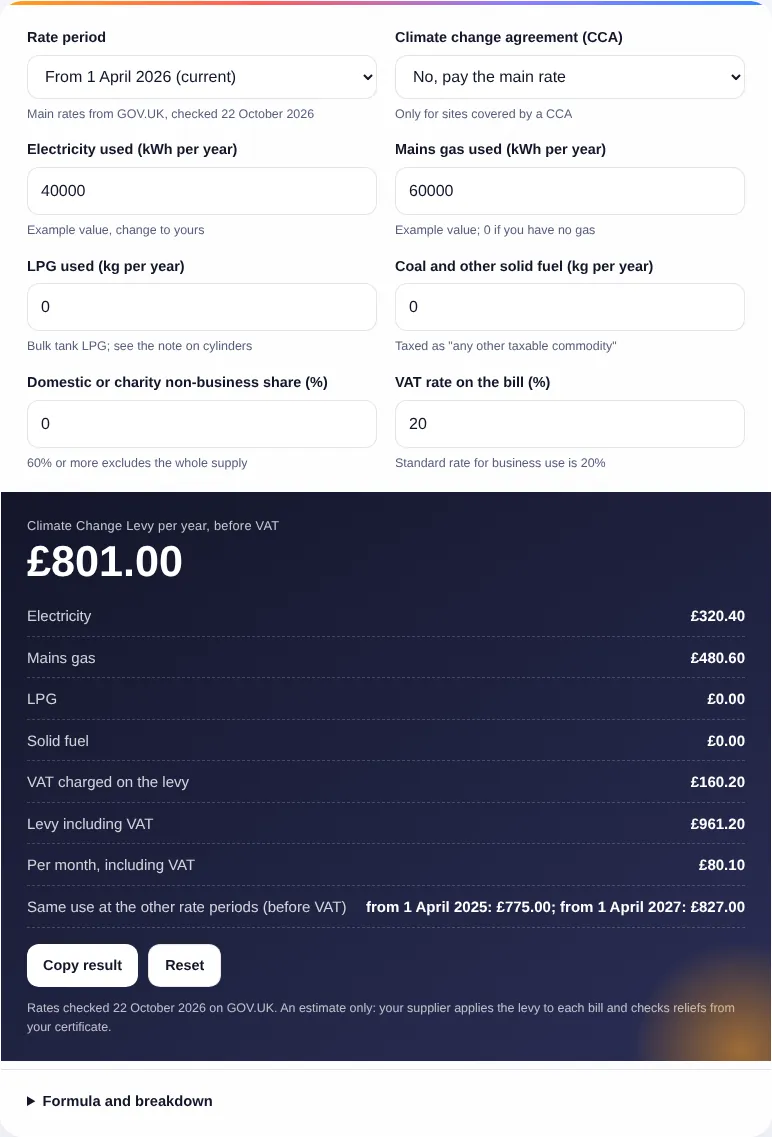
Rates checked 22 October 2026 on GOV.UK. An estimate only: your supplier applies the levy to each bill and checks reliefs from your certificate.
Formula and breakdown
n/a
n/a
n/a
n/a
This climate change levy calculator works out the Climate Change Levy (CCL) a UK business or public sector body pays on its electricity, mains gas, LPG and solid fuel in a year, using the main rates published by HMRC on GOV.UK. It also applies the climate change agreement reduced rate, the 60% mixed use rule and the de minimis limits, then adds the VAT that is charged on top of the levy.
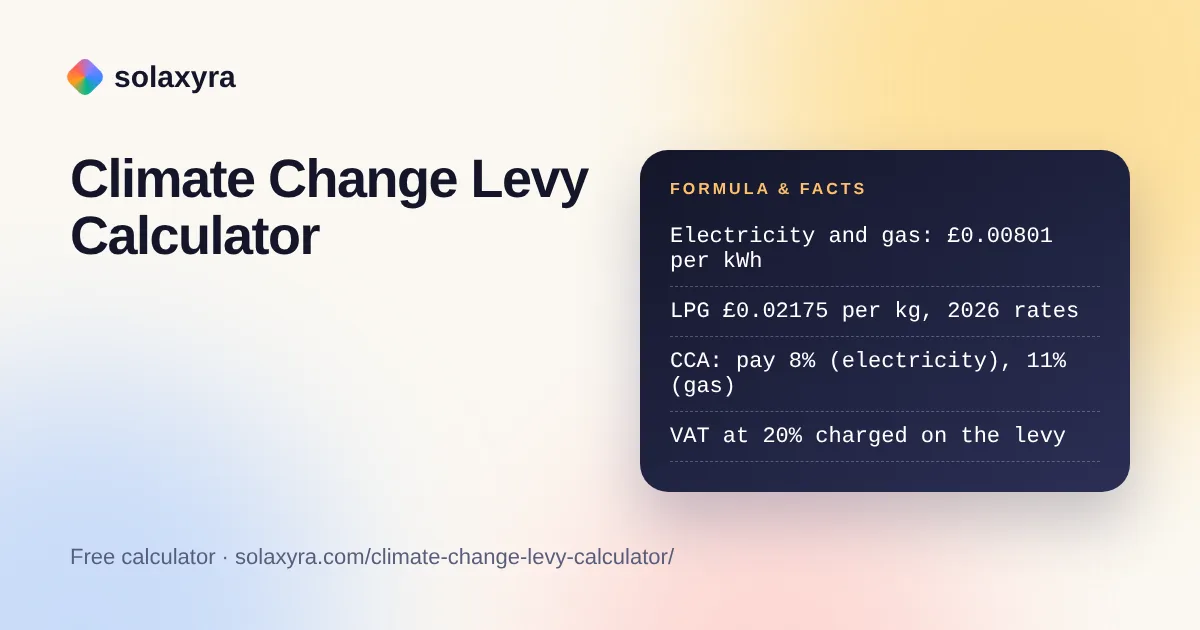
Quick answer: From 1 April 2026 the Climate Change Levy main rate is £0.00801 per kWh for both electricity and mains gas, £0.02175 per kg for LPG and £0.06264 per kg for coal and other solid fuel. In the climate change levy calculator, 40,000 kWh of electricity and 60,000 kWh of gas cost £801 a year before VAT.
What Is a Climate Change Levy Calculator?
A climate change levy calculator is a tool that multiplies the energy a business uses by the CCL rate for each fuel to estimate the levy that appears on its energy bills. In plain words: levy equals taxable kWh (or kg) times the rate per kWh (or kg), summed across electricity, gas, LPG and solid fuel, with VAT then charged on the levy at the same rate as the energy.
The Climate Change Levy is an environmental tax on energy supplied to businesses and the public sector. Your supplier collects it and shows it as a separate line on the bill. HMRC states that the levy is not charged on supplies to individuals and households, so a home energy bill never carries it.
How Do You Use the Climate Change Levy Calculator?
- Choose the rate period. The current rates apply from 1 April 2026; the 2025 and announced 2027 rates are there for budgets and back-checks.
- Say whether the site holds a climate change agreement. Most offices, shops and small firms do not, so leave it on the main rate.
- Enter a year of electricity and gas use in kWh from your bills or meter readings, plus any LPG or solid fuel in kilograms.
- If some of the energy goes to flats, other homes or charity non-business activity, enter that share as a percentage.
- Check the VAT rate, normally 20% for business use, then read the levy per fuel, the VAT on it and the monthly figure. Open the breakdown to see each multiplication.
What Are the Current Climate Change Levy Rates?
Electricity and mains gas both carry a main rate of £0.00801 per kWh from 1 April 2026, up from £0.00775 a year earlier. The figures below come from the HMRC page Climate Change Levy rates on GOV.UK, opened on 22 October 2026, which already lists the rates announced for 1 April 2027. The climate change levy calculator uses exactly these figures.
| Taxable commodity | From 1 April 2025 | From 1 April 2026 | From 1 April 2027 | CCA holders pay |
|---|---|---|---|---|
| Electricity (£ per kWh) | 0.00775 | 0.00801 | 0.00827 | 8% of main rate (92% discount) |
| Mains gas (£ per kWh) | 0.00775 | 0.00801 | 0.00827 | 11% of main rate (89% discount) |
| LPG (£ per kg) | 0.02175 | 0.02175 | 0.02175 | 23% of main rate (77% discount) |
| Coal and other solid fuel (£ per kg) | 0.06064 | 0.06264 | 0.06468 | 11% of main rate (89% discount) |
The government’s note on the 2026 change says the electricity, gas and solid fuel rates rise in line with the Retail Price Index, while LPG stays frozen to keep it competitive with kerosene for premises off the gas grid. A useful way to read the electricity figure: 0.801p per kWh is a little over 0.8p on every unit, so a business using 100,000 kWh a year pays about £801 in levy before VAT.
How Much Does the Climate Change Levy Add to a Business Bill?
At the 2026 rate the levy adds £8.01 for every 1,000 kWh of electricity or gas, or £9.61 once 20% VAT is included. The table shows typical annual use levels so you can place your own business; the climate change levy calculator gives the exact figure for your numbers.
| Example annual use (electricity or gas) | Levy before VAT | Levy with 20% VAT | Levy per month with VAT |
|---|---|---|---|
| 15,000 kWh (just over the de minimis limit) | £120.15 | £144.18 | £12.02 |
| 50,000 kWh | £400.50 | £480.60 | £40.05 |
| 150,000 kWh | £1,201.50 | £1,441.80 | £120.15 |
| 1,000,000 kWh | £8,010.00 | £9,612.00 | £801.00 |
All rows use the main rate from 1 April 2026 and assume no reliefs. Compare the levy with your total spend in the electricity cost calculator, and see where the kWh go with the energy consumption calculator. Our business electricity cost calculator and business gas cost calculator include standing charges as well.
Who Is Exempt From the Climate Change Levy?
Energy used in homes and other residential accommodation, energy a charity uses for non-business activity, and small de minimis supplies are all excluded from the levy. HMRC’s guide to exemptions from Climate Change Levy sets out the details:
- Domestic use includes houses and flats, care homes, hospices, children’s homes, student residences, caravans, houseboats and self-catering holiday lets.
- De minimis supplies are treated as domestic: electricity below 1,000 kWh a month, piped gas below 4,397 kWh a month, LPG in cylinders under 50 kg net each, bulk LPG from a tank under 2 tonnes, and one tonne or less of domestic grade coal or coke.
- Mixed use: if domestic or charity non-business use is at least 60% of the total, the whole supply is excluded; below 60%, the levy applies only to the other part.
- Some transport uses, exports, supplies to electricity generators and fuel used in metallurgical and mineralogical processes are also outside the main rate.
Reliefs are not automatic. A charity or mixed use customer gives the supplier a VAT declaration or certificate, and a landlord passing energy on to tenants sends a Climate Change Levy declaration. The climate change levy calculator tests de minimis on your average month, but the limit applies to each supply, so a site with a cold winter quarter can cross it in some months.
Is VAT Charged on the Climate Change Levy?
Yes, VAT is charged on the levy, because HMRC’s VAT Notice 701/19 on fuel and power says the value of a supply for VAT includes the Climate Change Levy where it applies. Business supplies of fuel and power are standard rated at 20%, so £100 of levy becomes £120 on the bill. A VAT registered business can normally recover that VAT in the usual way, which is why the climate change levy calculator shows the figure both before and after VAT.
The reduced 5% VAT rate, and the temporary 0% rate for qualifying electricity in Great Britain from 1 October 2026 to 31 March 2027, apply to qualifying use: domestic, charity non-business and de minimis supplies. Those are the same supplies that carry no levy, so in practice a bill with CCL on it is a 20% VAT bill.
How Do Climate Change Agreements Reduce the Levy?
A climate change agreement cuts the levy by 92% on electricity, 89% on gas and solid fuel and 77% on LPG for the energy covered by the agreement. They are voluntary agreements for energy intensive sectors in which the operator commits to energy efficiency targets in return for the reduced rate. Set the climate change levy calculator to “Yes, CCA reduced rate” only if your site is a registered facility under an agreement; for an office or shop the main rate applies.
For businesses without an agreement, the only reliable way to pay less levy is to use fewer taxable kWh: efficient lighting and controls, a lower heating set point or better insulation. Rooftop solar that covers part of daytime demand also cuts the kWh bought from the supplier, the figure the levy is charged on; you can estimate that output with the solar panel output calculator. The business carbon footprint calculator turns the same kWh into emissions for reporting.
Worked Example: Office and Workshop Paying the Main Rate
Example: a small engineering firm in Birmingham runs an office and workshop on one meter for each fuel. Its bills show 40,000 kWh of electricity and 60,000 kWh of mains gas over twelve months. It has no climate change agreement and no domestic use, and it is VAT registered.
- De minimis check: 40,000 divided by 12 is about 3,333 kWh of electricity a month, above 1,000; gas averages 5,000 kWh a month, above 4,397. Both supplies are taxable.
- Electricity levy: 40,000 kWh x £0.00801 = £320.40.
- Gas levy: 60,000 kWh x £0.00801 = £480.60.
- Total levy: £320.40 + £480.60 = £801.00 a year before VAT, the default result in the climate change levy calculator.
- VAT at 20% on the levy: £160.20, giving £961.20 a year, or £80.10 a month.
- Rate change: the same use cost £775.00 at the 2025 rates and will cost £827.00 at the rates announced for 1 April 2027, an increase of £26 a year each time.
If the same firm had a caretaker’s flat taking half of the gas, it would enter its domestic share by fuel. The climate change levy calculator applies one share to every fuel, so for a split like that run the electricity and gas separately.
Frequently Asked Questions
What is the Climate Change Levy rate for 2026?
From 1 April 2026 the main rate is £0.00801 per kWh for electricity and for mains gas, £0.02175 per kg for LPG and £0.06264 per kg for coal and other solid fuel. GOV.UK also lists rates from 1 April 2027 of £0.00827 per kWh for electricity and gas.
How do I calculate the Climate Change Levy on my bill?
Multiply the taxable kWh on the bill by the rate for that period, then add VAT at 20%. For example, 3,000 kWh of business electricity at £0.00801 gives £24.03 of levy, and £28.84 once VAT is added. Supplies within the de minimis limits carry no levy at all.
Do households pay the Climate Change Levy?
No. HMRC says the levy is not charged on supplies to individuals and households, and domestic use such as flats, care homes, student halls and self-catering lets is excluded even when a business is billed for it. Home energy bills therefore never include a Climate Change Levy line.
What are the de minimis limits for the Climate Change Levy?
Electricity below 1,000 kWh a month and piped gas below 4,397 kWh a month to one customer are treated as domestic and carry no levy. LPG in cylinders under 50 kg each, bulk LPG from tanks under 2 tonnes and up to one tonne of domestic grade coal are also excluded.
Is VAT charged on top of the Climate Change Levy?
Yes. HMRC’s fuel and power VAT notice says the value of a supply for VAT includes the Climate Change Levy, so business customers pay 20% VAT on the levy as well as on the energy. A VAT registered business can usually reclaim it through its normal VAT return.
Who qualifies for the Climate Change Levy reduced rate?
Only sites covered by a climate change agreement, which are voluntary efficiency agreements for energy intensive sectors. Under one, the business pays 8% of the main rate on electricity, 11% on gas and solid fuel and 23% on LPG. Ordinary offices, shops and restaurants pay the full main rate.
Checked October 2026 by the Solaxyra Editorial Team. Sources: HMRC: Climate Change Levy rates (GOV.UK), HMRC: Climate Change Levy changes to rates from 1 April 2026, HMRC: Exemptions from Climate Change Levy, HMRC: VAT on fuel and power (VAT Notice 701/19).