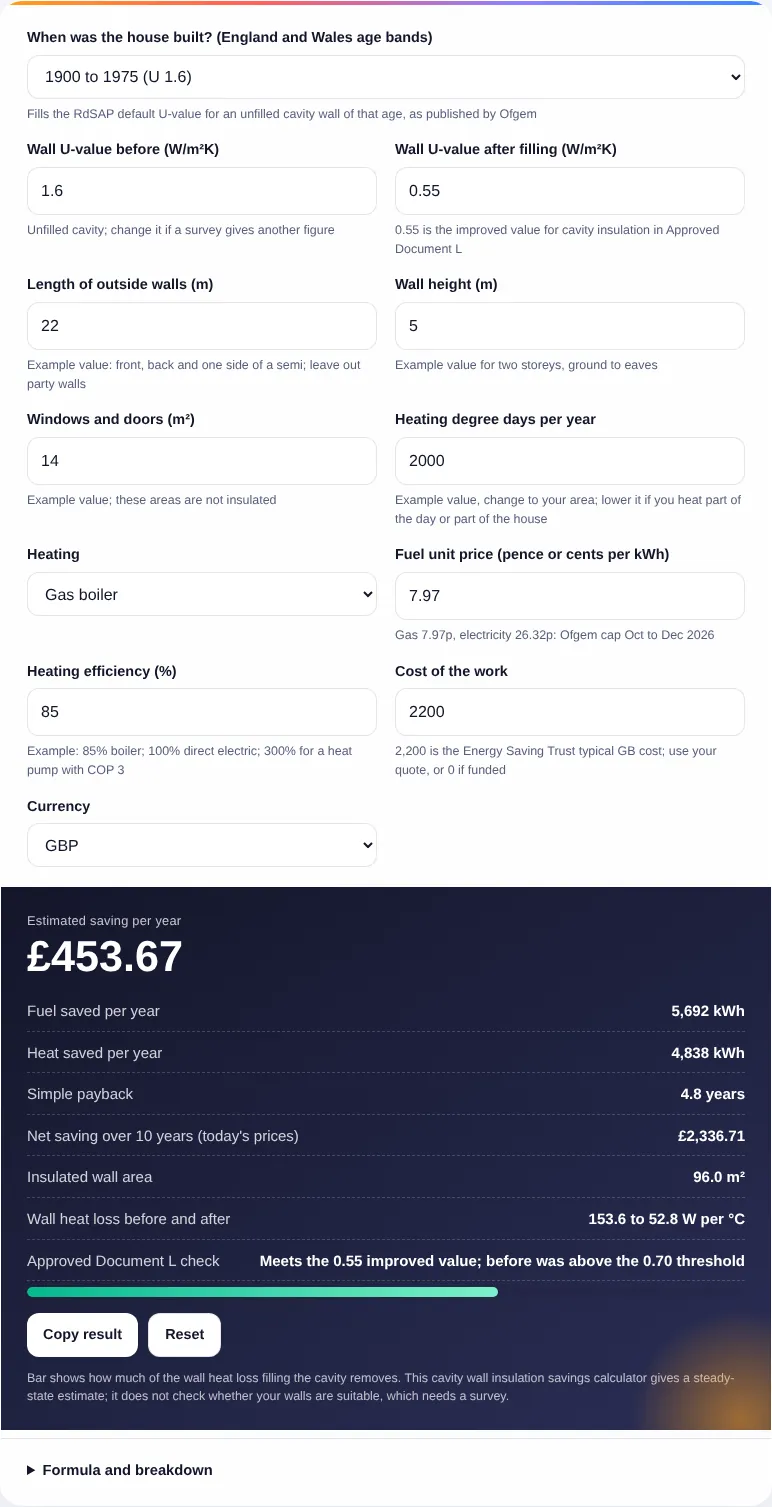
Bar shows how much of the wall heat loss filling the cavity removes. This cavity wall insulation savings calculator gives a steady-state estimate; it does not check whether your walls are suitable, which needs a survey.
Formula and breakdown
n/a
n/a
n/a
This cavity wall insulation savings calculator estimates how much heating energy and money you save each year by filling an empty cavity wall, and how long the work takes to pay back, for homeowners and landlords in England, Wales, Scotland and Northern Ireland. Rather than one fixed figure per house type, it uses the age of your house to fill in a default wall U-value, then works from your actual wall area, local heating degree days, heating system and fuel price.
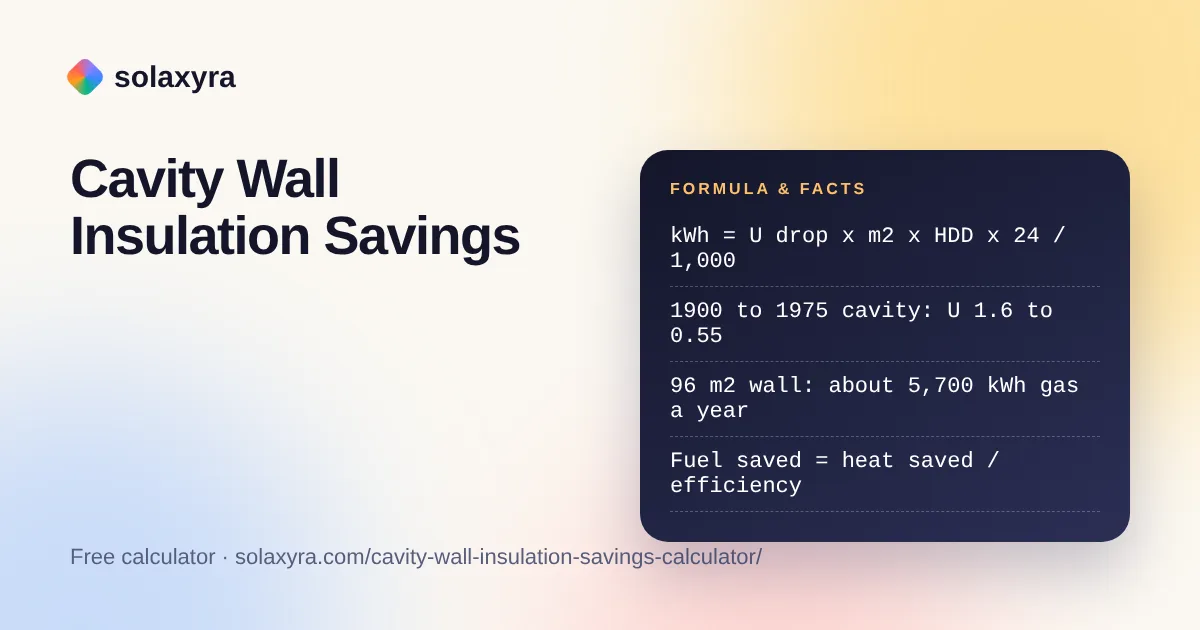
Quick answer: A cavity wall insulation savings calculator multiplies the drop in wall U-value by the insulated wall area, heating degree days and 24, then divides by heating efficiency and applies your fuel price. Filling 96 m2 of 1950s cavity wall saves about 5,700 kWh of gas, roughly £454 a year at 7.97p per kWh.
What Is a Cavity Wall Insulation Savings Calculator?
A cavity wall insulation savings calculator is a tool that turns the improvement in your outside walls’ U-value into kilowatt-hours of heat saved each year and then into money. In plain words: heat saved in kWh equals (U-value before minus U-value after) times insulated wall area in square metres times heating degree days times 24, divided by 1,000. Fuel saved equals heat saved divided by heating efficiency, and the money saved equals fuel saved times your unit price.
A U-value is the heat in watts that passes through one square metre of wall for each degree of temperature difference, so a lower number means a warmer wall. An unfilled cavity wall built between 1900 and 1975 has a default U-value of 1.6 W/m2K in the Reduced Data Standard Assessment Procedure (RdSAP), the method used to produce EPCs for existing homes. Heating degree days measure how cold a year is in a given place, and multiplying them by 24 converts them to degree hours.
How Do You Use the Cavity Wall Insulation Savings Calculator?
- Choose when the house was built. The calculator fills in the RdSAP default U-value for an unfilled cavity of that age; pick “I know my U-value” if a survey gave you a figure.
- Leave the U-value after filling at 0.55 unless your installer quotes a different result for your wall and insulation.
- Enter the length of the outside walls that will be filled, the wall height and the area of windows and doors. Leave out walls shared with a neighbour.
- Enter heating degree days for your area. Reduce the figure if you heat only part of the day or only some rooms.
- Pick your heating type, which fills the Ofgem cap price and an example efficiency, then enter the quote for the work.
How Much Does Cavity Wall Insulation Save per Year?
With the example inputs, filling the cavity of a semi-detached house built between 1900 and 1975 saves about 5,700 kWh of gas and £454 a year, paying back a £2,200 job in about 4.8 years. The Energy Saving Trust cavity wall insulation advice says about 33% of the heat lost from an uninsulated home escapes through the walls, puts typical installation at around £2,200 in Great Britain and £1,000 in Northern Ireland, and expects the cost to be recovered in five years or less.
Your own result can be well below the example, because the steady-state formula assumes the whole house is heated to a comfortable temperature for the full degree-day total. If you heat for a few hours a day, keep the thermostat low or heat only some rooms, reduce the degree days; halving them halves the saving. The cavity wall insulation savings calculator is most useful for comparing options and checking a quote, not for predicting a bill to the pound.
Does the Age of the House Change the Saving?
Yes, a great deal, because older unfilled cavities lose far more heat than newer ones. The RdSAP default U-values for an unfilled cavity in England and Wales, reproduced in an Ofgem ECO document on RdSAP U-values, fall from 2.1 W/m2K before 1900 to 1.6 from 1900 to 1975, 1.0 from 1976 to 1982 and 0.6 from 1983 to 1995. From 1996 onwards the default is 0.45 or lower, so there is little left to gain.
The table runs the cavity wall insulation savings calculator for the same example house (96 m2 of wall, 2,000 degree days, gas boiler at 85%, 7.97p per kWh, £2,200 cost) to each age band, filling to a U-value of 0.55.
| Built | U-value before (W/m2K) | Heat saved per year | Gas saved per year | Saving per year | Payback |
|---|---|---|---|---|---|
| Before 1900 | 2.1 | 7,142 kWh | 8,403 kWh | £669.71 | 3.3 years |
| 1900 to 1975 | 1.6 | 4,838 kWh | 5,692 kWh | £453.67 | 4.8 years |
| 1976 to 1982 | 1.0 | 2,074 kWh | 2,440 kWh | £194.43 | 11.3 years |
| 1983 to 1995 | 0.6 | 230 kWh | 271 kWh | £21.60 | Over 100 years |
| 1996 to 2002 | 0.45 | n/a | n/a | n/a | Already better than 0.55 |
The Planning Portal notes that most houses built after the 1920s have cavity walls, so many older houses have solid walls instead; check your wall type before relying on the first row. A wall that is not suitable for filling needs internal or external insulation instead, which is a different and more expensive job.
What U-Value Should a Filled Cavity Wall Reach?
In England, Approved Document L sets an improved U-value of 0.55 W/m2K for a wall upgraded with cavity insulation, and a threshold of 0.70 W/m2K above which an upgrade is expected during renovation work. Both figures are in Table 4.3 of Approved Document L, Volume 1: Dwellings, 2021 edition incorporating 2023 amendments, and apply only to a wall suitable for cavity insulation. The 2026 edition keeps the same 0.70 and 0.55 values and takes effect from 24 March 2027. The cavity wall insulation savings calculator flags both checks. Scotland, Wales and Northern Ireland publish their own building standards.
Does the Saving Change With a Heat Pump or Electric Heating?
In the cavity wall insulation savings calculator the heat saved stays the same whatever heats the house, but its value changes with the fuel. Using the October to December 2026 Ofgem cap prices, each kWh of heat costs about 9.4p from gas at 7.97p and 85% efficiency, 26.32p from direct electric heating and about 8.8p from a heat pump with a COP of 3. For the example house the yearly saving becomes about £1,273 with direct electric heating and £424 with a heat pump. The heat pump running cost calculator compares the systems in more detail, and the electric heater running cost calculator shows what each heater costs per hour.
Is My Wall Suitable for Cavity Wall Insulation?
Your wall is likely to be suitable only if it is an unfilled cavity at least 50 mm wide, clear of rubble, with masonry in good condition and not exposed to driving rain or flood risk. These are the Energy Saving Trust criteria, and a survey by the installer is the only reliable check.
- Repair brickwork, pointing, roofs, gutters and downpipes before filling, and fix the cause of any damp patches on inside walls first.
- Use a TrustMark certified installer, and ask for a 25-year guarantee from the Cavity Insulation Guarantee Agency (CIGA) or an equivalent insurance-backed guarantee.
- In a block of flats, filling usually needs the agreement of everyone in the building.
- Do not drill into walls yourself to inspect the cavity near cables or gas pipes; any electrical work must be done by a qualified electrician to BS 7671, and gas work by a Gas Safe registered engineer.
Worked Example: Filling the Cavity of a 1950s Semi
Example: a semi-detached house built in the 1950s has unfilled cavity walls and a gas boiler. Its outside walls run 22 m (front, back and one side) and are 5 m high, with 14 m2 of windows and doors. The quote is £2,200, and the example uses 2,000 degree days and the October 2026 gas cap price of 7.97p per kWh. The cavity wall insulation savings calculator works through these steps:
- Insulated area: 22 x 5 minus 14 = 96 m2.
- Wall heat loss: 1.6 x 96 = 153.6 W per °C before, 0.55 x 96 = 52.8 W per °C after.
- Heat saved: (1.6 minus 0.55) x 96 x 2,000 x 24 / 1,000 = 4,838 kWh.
- Gas saved at 85% efficiency: 4,838 / 0.85 = 5,692 kWh, worth £453.67 a year.
- Payback: 2,200 / 453.67 = 4.8 years. If the household heats for about half of the degree-day total, the saving falls to about £227 and payback is about 9.7 years.
For the roof, the loft insulation savings calculator uses the same method, and the energy consumption calculator shows how the saving fits into your whole household use.
Frequently Asked Questions
How much does cavity wall insulation save per year?
It depends on wall age, area, climate and fuel. In the example, filling 96 m2 of 1950s cavity wall in a gas-heated semi saves about £454 a year with the whole house heated for 2,000 degree days. Part-time heating lowers the saving in proportion, so adjust the degree days.
How long does cavity wall insulation take to pay back?
The Energy Saving Trust expects the typical £2,200 cost in Great Britain to be recovered in five years or less. In the calculator, payback is the cost divided by the yearly saving, so it ranges from about three years for a pre-1900 cavity to many decades for walls built after 1983.
What U-value does an unfilled cavity wall have?
RdSAP default values for an unfilled cavity in England and Wales are 2.1 W/m2K before 1900, 1.6 from 1900 to 1975, 1.0 from 1976 to 1982 and 0.6 from 1983 to 1995. A survey or thermal measurement can replace these defaults with a figure for your actual wall.
Is cavity wall insulation worth it in a house built after 1983?
Usually not on energy savings alone, because walls from that period already have a default U-value of 0.6 or lower. In the example, improving 0.6 to 0.55 saves about £22 a year. Check whether the cavity was partly insulated when built before paying for a fill.
Can cavity wall insulation cause damp?
It can if the wall was unsuitable, for example with a narrow or blocked cavity, damaged brickwork or exposure to driving rain. The Energy Saving Trust advises repairing defects and fixing damp first, using a TrustMark certified installer and getting a 25-year CIGA or equivalent guarantee.
Does cavity wall insulation improve an EPC rating?
Filling an unfilled cavity normally raises the SAP score because the assessor’s wall U-value falls, but the size of the change depends on the whole house. Your EPC lists recommended improvements and a potential rating, which is the best guide for your home.
Checked October 2026 by the Solaxyra Editorial Team. Sources: Energy Saving Trust, Cavity wall insulation, Ofgem, ECO2 requirements for overwriting U-values (RdSAP defaults), GOV.UK, Approved Document L Volume 1, Ofgem, energy price cap October to December 2026, Wikipedia, Heating degree day.