Design aid only. PV strings produce DC voltages that can be lethal and cannot be switched off while the panels are lit. Final string design must follow the inverter maker’s limits and be done or checked by a competent, certified installer (UK: MCS installer, work to BS 7671; elsewhere the local rules).
Formula and breakdown
n/a
This solar string size calculator tells installers, students and self-builders in the UK and Europe the minimum and maximum number of panels you can wire in series on one inverter input. It corrects the datasheet voltages for your coldest and hottest site conditions, checks a planned string against the inverter’s DC limit, MPPT window and current rating, and shows every step of the maths.
Quick answer: A solar string size calculator divides the inverter’s maximum DC voltage by each panel’s open-circuit voltage at the coldest site temperature, rounded down, to give the most panels per string. The fewest is the MPPT minimum voltage divided by the panel’s hot-day Vmp, rounded up. Cold Vmp must also stay below the MPPT maximum.
What Is a Solar String Size Calculator?
A solar string size calculator is a design tool that finds how many PV panels can be connected in series so the string voltage stays safe for the inverter in winter and high enough for it to track power in summer. Panels in series add their voltages, so a string of 12 panels at 40 V each presents roughly 480 V to the inverter.
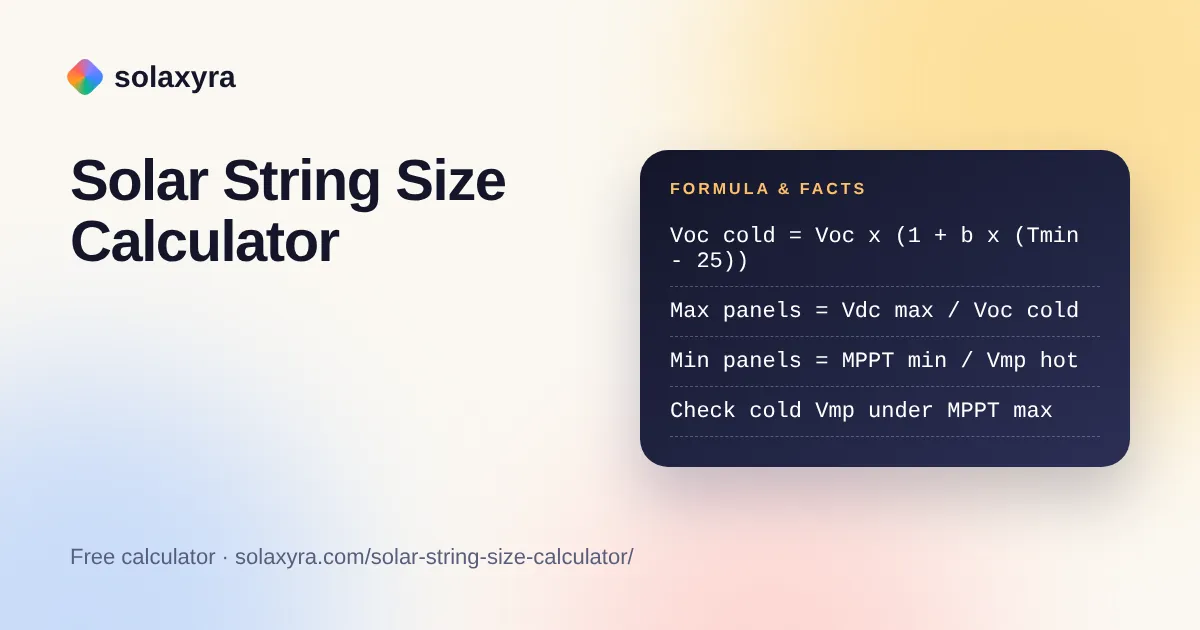
The formula in plain words: take the panel’s open-circuit voltage (Voc) and raise it by the temperature coefficient for every degree below 25 °C. Divide the inverter’s maximum DC input voltage by that cold Voc and round down for the maximum string length. Then take the maximum power voltage (Vmp), lower it for the hot cell temperature, divide the MPPT minimum voltage by it and round up for the minimum length. A third check keeps cold Vmp under the top of the MPPT range so the inverter can still track on a frosty, bright day.
How Do You Use the Solar String Size Calculator?
- Copy Voc, Vmp, Isc and power from the STC column of your panel datasheet.
- Enter the Voc temperature coefficient and the Vmp coefficient in %/°C. Both are negative numbers. If only a Pmax coefficient is listed, it is a rough stand-in for Vmp.
- Enter the lowest and highest air temperatures your site is likely to see, and a cell temperature rise for sunny conditions based on how the panels are mounted.
- From the inverter datasheet, enter the maximum DC input voltage, the MPPT operating range and the maximum short-circuit current per MPPT input.
- Enter how many strings will share that MPPT input and how many panels you plan in each string.
- Read the allowed range, then the verdict for your planned string. Open the breakdown to see each formula with your numbers.
How Many Solar Panels Can I Put in One String?
On a 600 V inverter with 41.5 V panels and a -10 °C design minimum, the limit is 13 panels per string, because each panel reaches about 45.4 V when cold and 13 x 45.4 V is 590 V. The answer changes with every panel and inverter, which is why the cold Voc must be worked out rather than guessed. The same rule applies to small battery chargers: the Victron SmartSolar MPPT 100/30 specification sets a 100 V maximum PV open-circuit voltage, which allows only two such panels in series. Larger inverters accept far more; the Solis example below uses an 1,100 V input. Make sure the inverter itself is the right size for the array with our solar inverter size calculator.
Why Is the Coldest Morning the Worst Case for String Voltage?
Panel voltage rises as cells get colder, so the highest Voc happens when bright light hits panels that are still at a freezing air temperature, usually just after sunrise in winter. Inverter manufacturer Solis explains in its guidance on winter operation of PV systems that low temperatures increase string Voc and that ignoring the temperature coefficient at design stage can push it above the inverter’s maximum input voltage. That is why this calculator assumes the cells are at air temperature in the cold case, with no warming from the sun. Hot days do the opposite and reduce Vmp, which is covered in our solar panel temperature loss calculator.
What Happens If the String Voltage Is Too Low?
If hot-day Vmp falls below the MPPT minimum, the inverter stops tracking the maximum power point and output drops, or it may not start at all on dim mornings. A string that is too short on paper often works in spring but loses energy in the hottest weeks. The fix is one or two more panels per string, or an inverter with a lower MPPT minimum. Similarly, if cold Vmp goes above the MPPT maximum, the inverter clips the string voltage and wastes power on cold, bright days.
How Do Parallel Strings Affect the Inverter Current?
Strings connected in parallel on one MPPT input add their currents while the voltage stays the same, so two strings of panels with 13.9 A Isc present 27.8 A to that input. The calculator compares the total short-circuit current with the inverter’s limit and also with a 1.25 multiplier, a margin many designers add because Isc rises slightly in strong sunshine and heat. Charge controllers for battery systems follow the same voltage rules; see the MPPT charge controller calculator for off-grid designs.
Voc Correction Factors by Minimum Temperature
Multiply the datasheet Voc by the factor for your coefficient and design minimum to get cold Voc. The last two columns show the maximum string length for a 41.5 V Voc panel with a -0.27 %/°C coefficient.
| Lowest temperature | Factor at -0.27 %/°C | Factor at -0.30 %/°C | Factor at -0.35 %/°C | Max panels on 600 V | Max panels on 1,000 V |
|---|---|---|---|---|---|
| 5 °C | 1.054 | 1.060 | 1.070 | 13 | 22 |
| 0 °C | 1.067 | 1.075 | 1.087 | 13 | 22 |
| -5 °C | 1.081 | 1.090 | 1.105 | 13 | 22 |
| -10 °C | 1.095 | 1.105 | 1.123 | 13 | 22 |
| -15 °C | 1.108 | 1.120 | 1.140 | 13 | 21 |
| -20 °C | 1.121 | 1.135 | 1.157 | 12 | 21 |
Worked Example: Tom’s 12-Panel Roof in Leeds
Tom in Leeds has 12 panels rated 430 W, with Voc 41.5 V, Vmp 34.5 V, Isc 13.9 A, a Voc coefficient of -0.27 %/°C and a Vmp coefficient of -0.35 %/°C. His single-phase hybrid inverter accepts 600 V DC maximum, tracks between 80 V and 550 V, and allows 20 A short-circuit current per MPPT input. He designs for -10 °C in winter and 35 °C air in summer with a 25 °C cell rise on his ventilated roof mount.
- Cold Voc per panel: 41.5 x (1 + (-0.27 / 100) x (-10 − 25)) = 45.4 V, so the maximum is floor(600 / 45.4) = 13 panels.
- Hot Vmp at a 60 °C cell: 34.5 x (1 − 0.0035 x 35) = 30.3 V, so the minimum is ceiling(80 / 30.3) = 3 panels.
- Cold Vmp: 38.7 V per panel, so the MPPT top limits him to floor(550 / 38.7) = 14 panels.
A single string of 12 gives 545 V cold Voc, a working range of 363 V to 465 V and 5.16 kWp, which fits every limit, and 13.9 A is within the 20 A input even with the 1.25 margin. If Tom’s roof were split east and west, he would instead run two strings of 6 on two separate MPPT inputs. His installer still checks the design against the inverter manual and fits DC isolation and cabling to the relevant standards, because the string voltage is lethal and stays live in daylight.
Frequently Asked Questions
Why does solar panel voltage go up in cold weather?
Silicon cells produce a higher voltage when they are cold, so a panel’s open-circuit voltage rises as temperature falls. With a coefficient of -0.27% per °C, a panel at -10 °C gives about 9.5% more Voc than its datasheet value at 25 °C.
What minimum temperature should I use for string sizing?
Use the lowest air temperature your site is likely to reach on a bright morning, because panels can be at air temperature when the sun first strikes them. Local climate records are the best guide. Choosing a colder figure adds safety margin at the cost of possibly one fewer panel.
What happens if string voltage exceeds the inverter maximum?
The inverter’s DC input stage can be damaged, and the inverter may refuse to start. Inverter maker Solis warns that string Voc on cold winter days can exceed the rated input if the temperature coefficient was ignored at the design stage, so always leave margin.
What is the difference between Voc and Vmp in string design?
Voc is the voltage with no load and sets the upper safety limit, so it is checked at the coldest temperature. Vmp is the working voltage at maximum power and must stay inside the MPPT window, so it is checked hot for the minimum and cold for the maximum.
Can I put two strings of different lengths on one inverter?
Yes, if each string goes to its own MPPT input, which is common for east and west roof faces. Strings connected in parallel on the same MPPT input should have the same number of identical panels facing the same way, so their voltages match.
Can I design and install a solar string myself?
You can use this calculator to check a design, but PV strings carry high DC voltages that stay live in daylight. In the UK, installation should be done by a certified installer and the electrical work must meet BS 7671; elsewhere follow local rules and the inverter manual.
Checked October 2026 by the Solaxyra Editorial Team. Sources: Solis: winter operation of PV systems, Victron Energy MPPT specifications, PVGIS user manual.