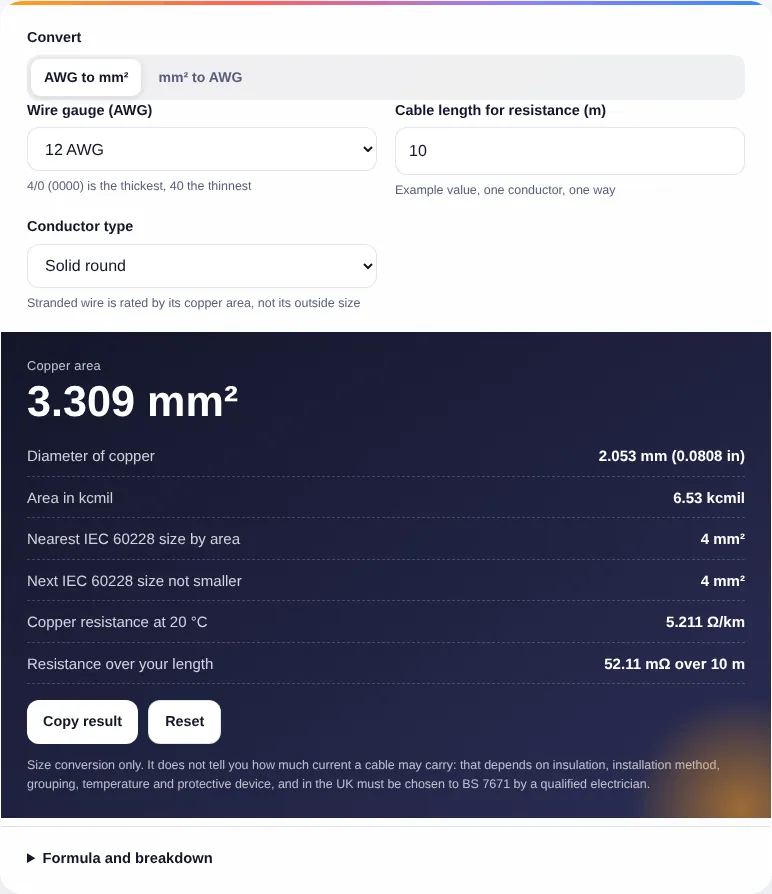
Size conversion only. It does not tell you how much current a cable may carry: that depends on insulation, installation method, grouping, temperature and protective device, and in the UK must be chosen to BS 7671 by a qualified electrician.
Formula and breakdown
n/a
n/a
n/a
This AWG to mm2 calculator converts American Wire Gauge sizes into square millimetres and millimetre diameter, and metric cross-sections back into AWG, for anyone in the UK, Ireland or Europe working with American datasheets, imported solar, battery or audio cable, or US wiring diagrams. Alongside the conversion it names the nearest metric cable size from IEC 60228, the next metric size that is not smaller, and the copper resistance for your cable length.
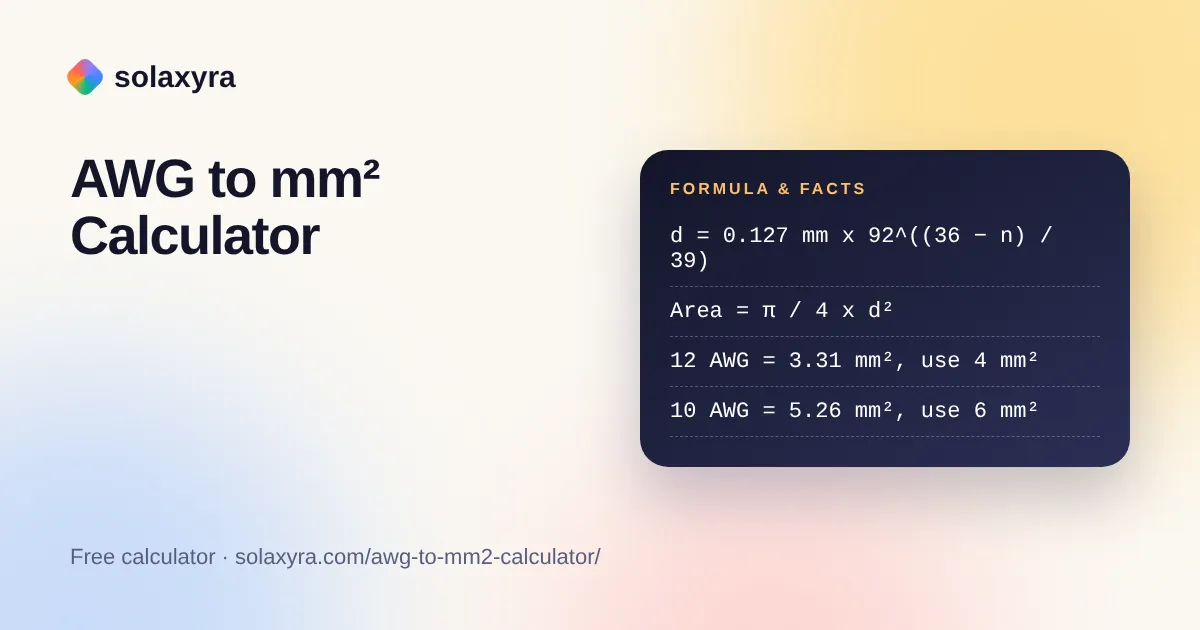
Quick answer: An AWG to mm2 calculator uses the ASTM B258 formula d = 0.127 mm x 92^((36 − n) / 39), then area = π / 4 x d². 12 AWG is 2.05 mm across and 3.31 mm², 10 AWG is 5.26 mm² and 14 AWG is 2.08 mm². AWG sizes rarely match metric sizes exactly, so compare areas before swapping.
What Is an AWG to mm2 Calculator?
An AWG to mm2 calculator is a tool that turns a wire gauge number into the copper cross-sectional area in square millimetres, or works backwards from mm² to the equivalent gauge. In plain words: each gauge step changes the diameter by the same ratio, so the diameter follows a fixed geometric formula and the area is the area of a circle of that diameter.
The Wikipedia article on American Wire Gauge sets out the definition from ASTM B258: 36 AWG is 0.005 inches (0.127 mm) across, 0000 AWG is 0.46 inches, and the 39 steps between them follow a ratio of the 39th root of 92, about 1.1229. Three handy consequences follow. Going down 3 gauge numbers doubles the area, going down 6 doubles the diameter, and going down 10 multiplies the area, weight and conductance by about 10.
Gauges thicker than 1 AWG are written 1/0, 2/0, 3/0 and 4/0 (also 0, 00, 000 and 0000). In the formula, m/0 uses n = 1 minus m, so 4/0 uses n = −3.
How Do You Use the AWG to mm2 Calculator?
- Choose the direction: AWG to mm², or mm² to AWG.
- Pick the gauge from the list (4/0 to 40 AWG), or type the metric area in mm².
- Choose solid or stranded. Stranded wire is rated by the area of the equivalent solid conductor, so the area is the same; only the outside diameter changes.
- Enter a cable length if you want the copper resistance over that run.
- Read the area, diameter, kcmil, the nearest IEC 60228 metric size and the next metric size that is not smaller.
- Open the formula breakdown to see each step.
How Many mm² Is 10, 12 or 14 AWG?
10 AWG is 5.26 mm², 12 AWG is 3.31 mm² and 14 AWG is 2.08 mm², with diameters of 2.59 mm, 2.05 mm and 1.63 mm. None of them is a metric size, which is why the table gives two metric columns: the nearest size by area, and the smallest metric size with at least the same area.
| AWG | Diameter (mm) | Area (mm²) | Nearest IEC 60228 size | Next size not smaller | Copper Ω/km at 20 °C |
|---|---|---|---|---|---|
| 4/0 | 11.68 | 107.2 | 95 mm² | 120 mm² | 0.161 |
| 2/0 | 9.27 | 67.43 | 70 mm² | 70 mm² | 0.256 |
| 1/0 | 8.25 | 53.48 | 50 mm² | 70 mm² | 0.322 |
| 2 | 6.54 | 33.63 | 35 mm² | 35 mm² | 0.513 |
| 4 | 5.19 | 21.15 | 25 mm² | 25 mm² | 0.815 |
| 6 | 4.12 | 13.30 | 16 mm² | 16 mm² | 1.30 |
| 8 | 3.26 | 8.37 | 10 mm² | 10 mm² | 2.06 |
| 10 | 2.59 | 5.26 | 6 mm² | 6 mm² | 3.28 |
| 12 | 2.05 | 3.31 | 4 mm² | 4 mm² | 5.21 |
| 14 | 1.63 | 2.08 | 2.5 mm² | 2.5 mm² | 8.29 |
| 16 | 1.29 | 1.31 | 1.5 mm² | 1.5 mm² | 13.2 |
| 18 | 1.02 | 0.823 | 0.75 mm² | 1 mm² | 20.9 |
| 20 | 0.812 | 0.518 | 0.5 mm² | 0.75 mm² | 33.3 |
| 22 | 0.644 | 0.326 | Below 0.5 mm² | 0.5 mm² | 53.0 |
Areas and diameters are calculated with the ASTM B258 formula and rounded. Resistance uses annealed copper at 0.017241 Ω mm²/m and matches the Wikipedia AWG table (for example 3.277 mΩ per metre for 10 AWG). Metric sizes are the IEC 60228 series from 0.5 to 300 mm².
Is the Nearest Metric Size Always Safe to Use Instead?
No: the nearest metric size by area is sometimes smaller than the AWG wire, so when you replace a specified AWG cable, use the next metric size that is not smaller. 1/0 AWG (53.5 mm²) is closest to 50 mm², 18 AWG (0.82 mm²) is closest to 0.75 mm², and 4/0 (107 mm²) is closest to 95 mm². In each case the closest metric cable has less copper, more resistance and a lower current rating than the cable the designer specified.
Area is only the starting point. How much current a cable can carry depends on its insulation, how it is installed, grouping with other cables, ambient temperature and the protective device. For the volts lost along a run, use our voltage drop calculator, and for photovoltaic strings and battery leads the solar cable size calculator sizes the cross-section from current, length and the drop you accept.
Any change to fixed wiring in a UK home must be designed, installed and tested by a qualified electrician to BS 7671, and elsewhere to the local wiring rules. Do not use a conversion table alone to pick a cable for mains circuits, battery systems or solar arrays.
How Are Metric Cable Sizes Defined?
Metric cable sizes are defined by IEC 60228, which sets a series of nominal cross-sections in mm² and specifies each by a maximum conductor resistance per kilometre rather than an exact physical size. The IEC 60228 article explains the classes: class 1 is solid, class 2 is stranded for fixed installation, class 5 is flexible and class 6 is very flexible.
Because the standard caps resistance rather than fixing an area, a real 4 mm² class 2 copper conductor may have at most 4.61 Ω/km at 20 °C, according to the IEC 60228 resistance table published by the cable maker Bayka. Compare that with 5.21 Ω/km for 12 AWG solid copper: the metric cable has the lower resistance, so it is a sound swap for 12 AWG. The awg to mm2 calculator shows this comparison for every size.
Does Stranded Wire Have a Different AWG?
No: stranded wire takes the AWG of a solid wire with the same copper area, so the mm² figure is identical, but the outside diameter is larger. Wikipedia notes that the gaps between round strands take up about 25% of the bundle, making the overall diameter roughly 13% larger than solid wire of the same gauge. Measure stranded cable by its marked size, not with callipers across the strands.
If you only know the outside diameter of solid wire, the area is π / 4 x d². For example, a 1.78 mm solid conductor has an area of 2.49 mm², close to 2.5 mm².
Worked Example: Replacing 4 AWG Battery Cable With Metric Cable
Example: an off-grid cabin kit from a US supplier specifies 4 AWG copper cable for a 2 m run between a 12 V battery and an inverter, and the owner can only buy metric cable in Ireland.
- Diameter: 0.127 x 92^((36 − 4) / 39) = 5.19 mm.
- Area: π / 4 x 5.19² = 21.15 mm².
- Nearest metric size: 25 mm², which is also the next size not smaller, so 25 mm² carries at least as much copper.
- Resistance: 0.017241 / 21.15 = 0.815 Ω/km for 4 AWG; the IEC 60228 maximum for 25 mm² class 2 is 0.727 Ω/km.
- Over 2 m out and 2 m back, the 25 mm² cable has at most 4 x 0.727 / 1,000 = 2.9 mΩ, against 3.3 mΩ for the 4 AWG cable.
The metric cable is the better choice on area and resistance. The installer still has to check current rating, fusing and terminals for the battery system; our Ohm's law calculator turns that resistance into volts and watts lost at your current.
Frequently Asked Questions
What is 12 AWG in mm²?
12 AWG is 3.31 mm² with a solid copper diameter of 2.05 mm. It sits between the metric 2.5 mm² and 4 mm² sizes. The nearest metric size by area, and the next size that is not smaller, is 4 mm², so 4 mm² is the usual metric replacement where a design calls for 12 AWG.
What is 2.5 mm² in AWG?
2.5 mm² works out at about 13.2 AWG, so the nearest whole gauge is 13 AWG. 13 AWG is rarely stocked, so people compare it with 14 AWG at 2.08 mm², which is smaller, and 12 AWG at 3.31 mm², which is larger. Pick the larger gauge if you must not lose copper area.
What is the formula to convert AWG to mm²?
First find the diameter: d = 0.127 mm x 92^((36 − n) / 39), where n is the gauge number and m/0 sizes use n = 1 minus m. Then the area is π / 4 x d². For 10 AWG, d = 2.588 mm and the area is 5.26 mm².
Why does a bigger AWG number mean a thinner wire?
The gauge number came from the number of drawing steps used to pull wire thinner, so more steps meant a higher number and a thinner wire. Every 3 gauge numbers higher halves the copper area, and every 6 higher halves the diameter.
Can I use AWG cable in a UK installation?
Cable for fixed UK wiring is normally specified in metric sizes, and the installation must meet BS 7671. A qualified electrician must choose cable by current rating, installation method, voltage drop and protection, not by a gauge conversion alone. Use the metric size that is not smaller than the AWG figure as a starting point only.
What is kcmil?
kcmil means thousands of circular mils, the North American unit for cables thicker than 4/0. One circular mil is the area of a circle 0.001 inch across, about 0.000507 mm², so 1 kcmil is about 0.507 mm² and 4/0 AWG is about 212 kcmil.
Checked October 2026 by the Solaxyra Editorial Team. Sources: Wikipedia: American wire gauge (ASTM B258 formula), Wikipedia: IEC 60228, Bayka: conductor resistance to IEC 60228 and VDE 0295.