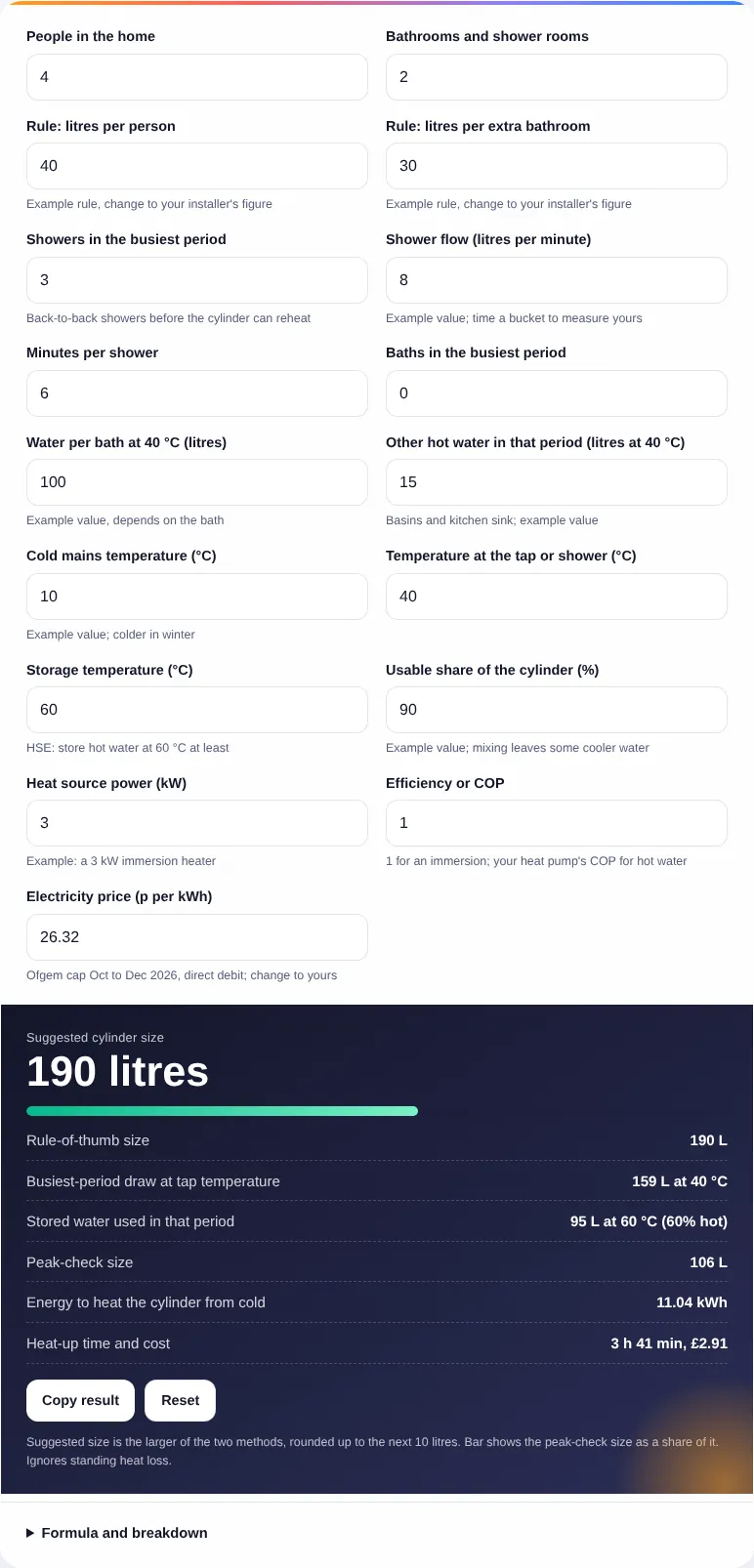
Suggested size is the larger of the two methods, rounded up to the next 10 litres. Bar shows the peak-check size as a share of it. Ignores standing heat loss.
Formula and breakdown
n/a
n/a
n/a
This hot water cylinder size calculator suggests how many litres of stored hot water a UK or European home needs, using both a simple people-and-bathrooms rule and a check of the busiest period of showers and baths, and then shows the energy, time and cost to heat that cylinder. It suits anyone replacing a cylinder, fitting a heat pump or adding a solar diverter.
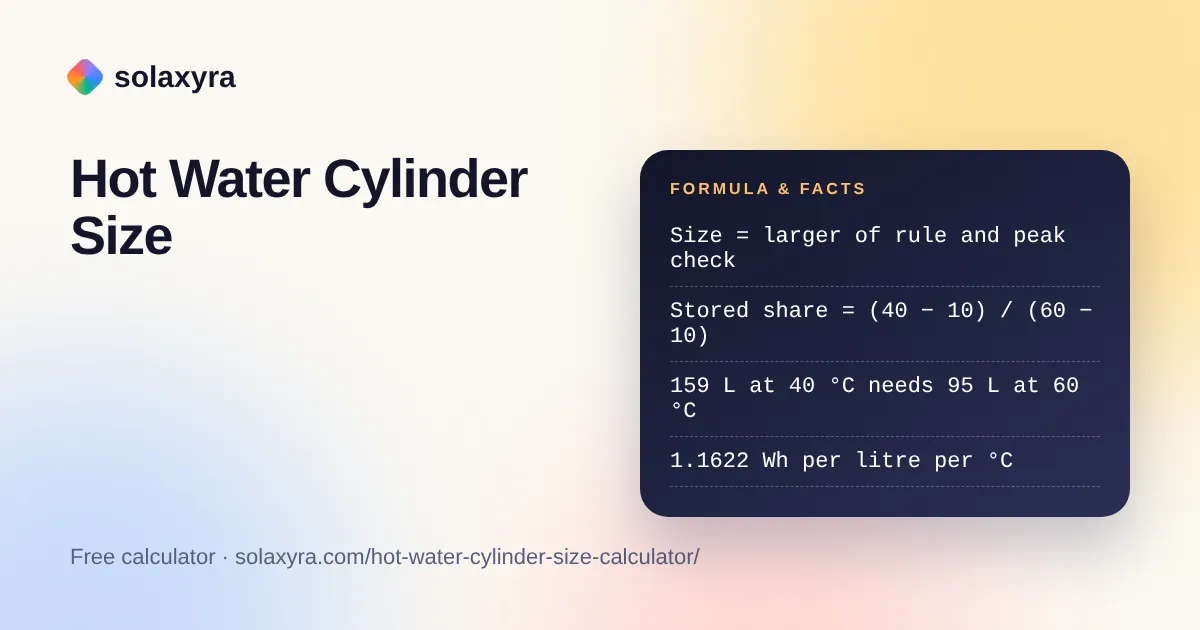
Quick answer: A hot water cylinder size calculator compares a rule of litres per person with your busiest-period draw. Three 6-minute showers at 8 L/min plus 15 L of other use is 159 L at 40 °C, which needs 95 L stored at 60 °C. Heating 190 L from 10 to 60 °C takes 11.04 kWh.
What Is a Hot Water Cylinder Size Calculator?
A hot water cylinder size calculator is a tool that estimates the storage volume a home needs so that hot water does not run out at the busiest time of day. In plain words: size equals the larger of (people x litres per person, plus an allowance per extra bathroom) and (the hot water drawn in the busiest period, converted to storage temperature and divided by the usable share of the cylinder).
The conversion matters because you rarely use water at storage temperature. A shower at 40 °C mixes hot water from the cylinder with cold mains water, so each litre at the shower head uses only part of a litre of stored water. The hotter the store and the warmer the mains, the further the cylinder goes. Rules of thumb vary between installers and manufacturers, so the hot water cylinder size calculator lets you edit them, and the busiest-period check shows whether the rule is too small or larger than needed for the way your household actually uses water.
How Do You Use the Hot Water Cylinder Size Calculator?
- Enter the number of people and bathrooms or shower rooms.
- Keep the example rule or replace it with your installer's or the cylinder maker's figures.
- Describe the busiest period: how many showers run back to back, their flow and length, any baths, and other hot water use such as basins and the kitchen sink.
- Set the cold mains temperature, the temperature you use at the tap or shower, and the storage temperature.
- Add the heat source power, its efficiency or heat pump COP, and your electricity price.
- Read the suggested size, both method results, and the energy, time and cost to heat the cylinder from cold.
What Size Hot Water Cylinder Do I Need for a Family of Four?
With the example rule of 40 litres per person and 30 litres for a second bathroom, a family of four with two bathrooms gets 190 litres, and the busiest-period check (three back-to-back showers) needs only about 106 litres. If the household often runs a bath and showers together, or the showers have high flow rates, the busiest-period figure can overtake the rule, which is why the hot water cylinder size calculator shows both.
A larger cylinder is not free: it costs more, takes up more space, loses more heat through its insulation and takes longer to heat. Size for the real busiest period with a sensible margin, not for the largest cylinder that fits. With a heat pump, a cylinder may be heated less often or to a lower temperature, which changes the result; enter the storage temperature your installer proposes.
Does a Direct or Indirect Cylinder Need a Different Size?
Yes, a direct cylinder usually needs to be larger, because it is heated only by an immersion heater, often on a cheaper overnight rate, so it must hold most of the day's hot water at once. An indirect cylinder has a coil fed by a boiler or heat pump and can reheat between uses, so it can be sized closer to the busiest period.
The table shows what the hot water cylinder size calculator's example rule (40 litres per person plus 30 litres for each extra bathroom) gives for common households. These are example outputs of an editable rule, not product recommendations; change the rule to your installer's or manufacturer's figures and run the busiest-period check as well.
| Example household | People | Bathrooms | Example rule result |
|---|---|---|---|
| 1-bedroom flat | 2 | 1 | 80 L |
| 2-bedroom house | 3 | 1 | 120 L |
| 3-bedroom house | 4 | 1 | 160 L |
| 3-bedroom house, en suite | 4 | 2 | 190 L |
| 4-bedroom house | 5 | 2 | 230 L |
| 5-bedroom house | 6 | 3 | 300 L |
For a direct cylinder on an overnight tariff, compare the result with a full day's use rather than only the busiest period, because the immersion may not run again until the next night.
How Much Stored Hot Water Does a Shower Use?
At 60 °C storage, 10 °C mains and 40 °C at the shower head, 60% of the shower's water comes from the cylinder: the share is (tap temperature minus cold) divided by (storage temperature minus cold). An 8 litre per minute shower for 6 minutes uses 48 litres at the head, of which about 29 litres come from the store.
The table shows the share of stored water in a 40 °C draw for four storage temperatures and three mains temperatures. Mains water is colder in winter, so size for winter.
| Storage temperature | Cold mains 5 °C | Cold mains 10 °C | Cold mains 15 °C |
|---|---|---|---|
| 50 °C | 78% | 75% | 71% |
| 55 °C | 70% | 67% | 62% |
| 60 °C | 64% | 60% | 56% |
| 65 °C | 58% | 55% | 50% |
A cylinder stored at 50 °C delivers noticeably fewer litres at 40 °C than the same cylinder at 60 °C, so a lower storage temperature needs a bigger cylinder for the same peak.
What Temperature Should a Hot Water Cylinder Be Stored At?
Store hot water at 60 °C at least. The Health and Safety Executive's legionella guidance for hot and cold water systems says hot water should be stored at 60 °C at least to kill legionella bacteria, should reach at least 50 °C within one minute of running the tap, and cold water should stay below 20 °C. The hot water cylinder size calculator warns you if you set the storage temperature below 60 °C.
Hot water at 60 °C can scald. In England, Approved Document G says the hot water supply to a bath in new dwellings should be limited to a maximum of 48 °C by an in-line blending valve, and that the installation of an unvented system is notifiable building work. Unvented cylinders carry safety devices that prevent stored water exceeding 100 °C; they must be installed by a suitably qualified installer, and any immersion heater circuit by a qualified electrician to BS 7671.
How Much Does It Cost to Heat a Hot Water Cylinder?
Heating water takes 4,184 joules per kilogram per degree, which is 1.1622 Wh per litre per °C, so raising 180 litres from 10 to 60 °C takes 10.46 kWh, or about £2.75 at the Ofgem cap of 26.32p per kWh with an immersion heater. A heat pump with a hot water COP of 2.5 would need about 40% of that electricity.
| Cylinder | Energy, 10 to 60 °C | Time with 3 kW immersion | Cost at 26.32p per kWh |
|---|---|---|---|
| 120 L | 6.97 kWh | 2.32 h | £1.84 |
| 150 L | 8.72 kWh | 2.91 h | £2.29 |
| 180 L | 10.46 kWh | 3.49 h | £2.75 |
| 210 L | 12.20 kWh | 4.07 h | £3.21 |
| 250 L | 14.53 kWh | 4.84 h | £3.82 |
| 300 L | 17.43 kWh | 5.81 h | £4.59 |
These figures are for a full heat-up from cold and ignore heat lost through the cylinder's insulation, so a daily top-up is usually smaller. To work out the cost of the hours your immersion actually runs, use our electricity cost calculator or the immersion heater running cost calculator. If you have solar panels, the solar self-consumption calculator shows how much surplus could go into the cylinder instead of the grid.
Worked Example: Sizing a Cylinder for a Heat Pump
Example: a family of five in a house with two bathrooms is replacing a gas boiler with a heat pump. The busiest period is two showers at 8 L/min for 6 minutes each, two 100 litre baths and 15 litres of other use. The installer proposes storing at 50 °C, winter mains water is 5 °C, the heat pump gives 2 kW to the cylinder at a COP of 2.5, and 90% of the cylinder is usable.
- Rule: 5 x 40 + 1 x 30 = 230 litres.
- Busiest-period draw: 2 x 8 x 6 + 2 x 100 + 15 = 311 litres at 40 °C.
- Share from the cylinder: (40 minus 5) / (50 minus 5) = 0.778, so 242 litres at 50 °C.
- Peak-check size: 242 / 0.9 = 269 litres, larger than the rule, so the suggestion is 270 litres.
- Energy from cold: 270 x 1.1622 x 45 = 14.12 kWh, about 7 hours at 2 kW, costing 14.12 / 2.5 x 26.32p = £1.49.
Storing at 50 °C is below the HSE's 60 °C, so the installer should explain how the system raises the cylinder to a pasteurising temperature. At 60 °C storage the same peak would need only about 220 litres.
Frequently Asked Questions
How many litres of hot water does a person need?
It depends on habits, shower flow and whether people bathe. A rule of thumb from an installer or manufacturer is a starting point, but a better check is the busiest period: count the showers and baths that happen before the cylinder can reheat, as this hot water cylinder size calculator does, and size for that.
Is a 150 litre cylinder big enough for a family of four?
Often yes if showers are moderate and baths rare: three 6-minute showers at 8 L/min need about 106 litres of usable capacity at 60 °C storage. With high-flow showers, a bath in the same period or a lower storage temperature, a larger cylinder may be needed.
What temperature should my hot water cylinder be set to?
The Health and Safety Executive says hot water should be stored at 60 °C at least to kill legionella bacteria, and should reach 50 °C within one minute at the tap. Because water at that temperature can scald, blending valves are used at baths in new homes.
How long does it take to heat a hot water cylinder?
Divide the energy by the heater power. A 180 litre cylinder heated from 10 to 60 °C needs 10.46 kWh, so a 3 kW immersion takes about 3 hours 30 minutes. A partly used cylinder reheats faster because only the cold part needs heating.
Do heat pumps need a bigger hot water cylinder?
They can. If the cylinder is stored at a lower temperature, each litre stored goes less far, and if the heat output to the cylinder is lower than a boiler gave, reheating between uses takes longer. Enter the storage temperature and heat output your installer proposes to see the effect on size.
How much energy does it take to heat water?
Water needs about 4,184 joules per kilogram per degree, which is 1.1622 Wh per litre per °C. Heating 100 litres by 50 °C therefore takes about 5.8 kWh, before allowing for heat lost from the cylinder and pipes.
Checked October 2026 by the Solaxyra Editorial Team. Sources: HSE: Legionella, hot and cold water systems, GOV.UK: Approved Document G (2015 edition with 2024 amendments), Wikipedia: Specific heat capacity, Ofgem: price cap 1 October to 31 December 2026.