Bar shows the current as a share of the fuse or breaker rating. Fuse, cable and breaker choices for fixed wiring must be made by a qualified electrician (UK: BS 7671).
Formula and breakdown
n/a
n/a
n/a
This volts to amps calculator works out the current in amps from a voltage plus either the power in watts or the resistance in ohms, for DC circuits, 230 V single-phase homes in the UK and Europe, and 400 V three-phase supplies. It also shows how the current changes at a second voltage and how close it comes to a fuse or breaker rating.
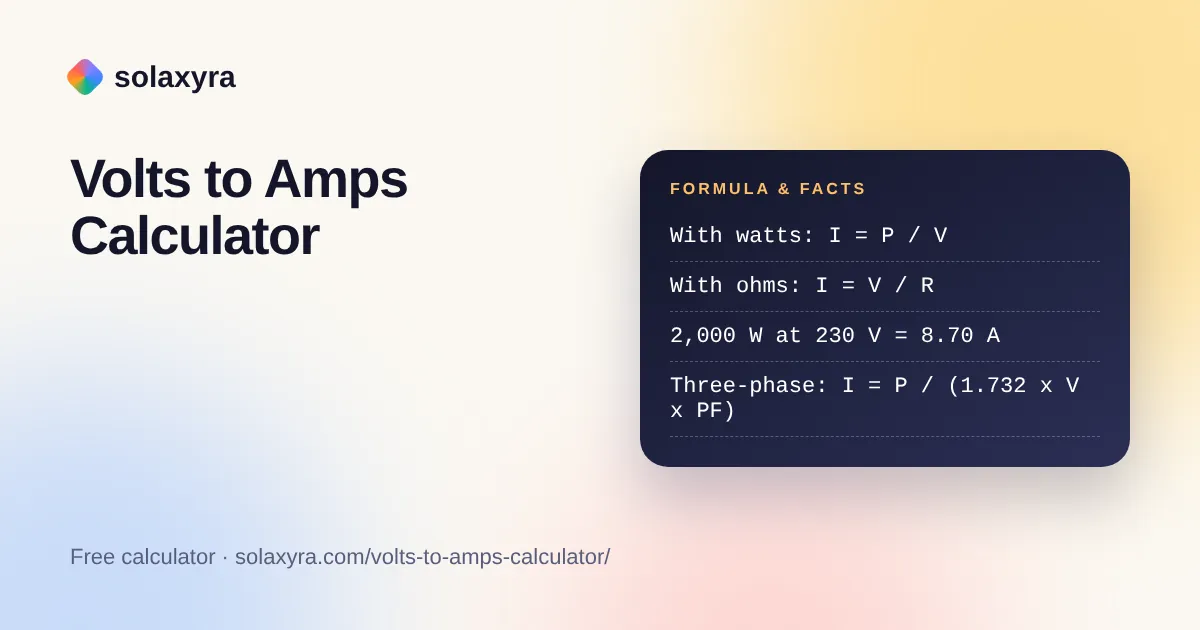
Quick answer: Volts alone cannot give amps: a volts to amps calculator also needs the power or the resistance. With watts, current is I = P / V, so 2,000 W at 230 V draws 8.70 A. With ohms, I = V / R, so 12 V across 0.5 ohms drives 24 A. AC loads also need the power factor.
What Is a Volts to Amps Calculator?
A volts to amps calculator is a tool that finds the electric current flowing in a circuit from its voltage and one other known quantity, either the power drawn or the resistance of the load. In plain words: amps equal watts divided by volts, or amps equal volts divided by ohms.
The second formula is Ohm’s law. The Wikipedia article on Ohm’s law states it as I = V / R and notes that it holds for “ohmic” conductors whose resistance stays constant, while diodes and filament lamps do not follow it, because their resistance changes with current or temperature. For AC circuits with motors, transformers or capacitors, resistance is replaced by impedance, and the power formula gains a power factor.
How Do You Use the Volts to Amps Calculator?
- Choose whether you know the power in watts or the resistance in ohms.
- With watts, pick the supply type: DC, AC single-phase or AC three-phase. For three-phase, enter the line voltage, such as 400 V.
- Enter the voltage, then the power or the resistance.
- For AC loads, enter the power factor: 1 for heaters and kettles, lower for motors and some electronics.
- Optionally enter a second voltage to compare, and the rating of the fuse or breaker that protects the circuit.
- Read the current, the equivalent resistance, the fuse loading and the current at the comparison voltage. Open the breakdown to see each step.

How Do You Convert Volts to Amps?
Divide the power by the voltage, or divide the voltage by the resistance: 1,000 W at 230 V is 1,000 / 230 = 4.35 A, and 230 V across 52.9 ohms is also 4.35 A. Both routes describe the same load, because power, voltage, current and resistance are linked by P = V x I and V = I x R.
On AC, the power rating of an inductive load does not tell the whole story. The Wikipedia article on power factor gives real power as P = V x I x PF, so the current is I = P / (V x PF). A 1,200 W motor at 230 V with a power factor of 0.8 draws 6.52 A rather than 5.22 A. On a three-phase supply the line current is I = P / (1.732 x V x PF); the three-phase power calculator covers kVA and kVAr as well.
The table shows the current for a 1,000 W load at common voltages, with a power factor of 1.
| Supply | Voltage | Current for 1,000 W |
|---|---|---|
| Car or leisure battery (DC) | 12 V | 83.33 A |
| Truck or off-grid system (DC) | 24 V | 41.67 A |
| Home battery or off-grid system (DC) | 48 V | 20.83 A |
| North American outlet (AC) | 120 V | 8.33 A |
| UK and EU single-phase (AC) | 230 V | 4.35 A |
| UK and EU three-phase (AC, per line) | 400 V | 1.44 A |
The same power at 12 V needs about 19 times the current it needs at 230 V, which is why low-voltage systems use thick cables. For a quick power-only conversion with the same supply options, the watts to amps calculator is the simpler tool.
Does Current Rise or Fall When the Voltage Changes?
A fixed resistance draws more current as the voltage rises, in direct proportion, while a load that regulates its own power draws less current as the voltage rises. A kettle element is close to the first kind. A laptop charger, LED driver or most modern electronics with a switch-mode supply behave more like the second.
This matters because mains voltage is not exactly 230 V. Under regulation 27 of the Electricity Safety, Quality and Continuity Regulations 2002, a GB low voltage supply is declared at 230 V between phase and neutral and may vary from 6% below to 10% above, which is 216.2 V to 253 V. The table shows what that range means for a load rated at 1,000 W at 230 V.
| Supply voltage | Resistive load: current | Resistive load: power | Constant-power load: current |
|---|---|---|---|
| 216.2 V (minus 6%) | 4.09 A | 884 W | 4.63 A |
| 230 V (declared) | 4.35 A | 1,000 W | 4.35 A |
| 253 V (plus 10%) | 4.78 A | 1,210 W | 3.95 A |
The resistive load’s power changes with the square of the voltage, so at 253 V a 1,000 W heater element gives about 21% more heat. Enter any second voltage in the volts to amps calculator to see both effects for your own load.
How Many Amps Can a 13 A Plug Take?
A load on a 13 A fused plug should draw no more than 13 A, which at 230 V and a power factor of 1 is about 2,990 W. The BS 1363 standard rates UK plugs and sockets at a maximum of 250 V AC and 13 A, with plug fuses of up to 13 A; 3 A and 13 A are the preferred values. A 3,000 W appliance draws 13.04 A at exactly 230 V, so it sits right at that limit. The volts to amps calculator’s fuse field shows the current as a share of whatever rating you enter.
A fuse or breaker protects the cable, not the appliance, so the rating must suit the cable and the way it is installed. Choosing protective devices and cable sizes for fixed wiring is work for a qualified electrician; in the UK it must meet BS 7671. Long runs also lose voltage along the cable, which the voltage drop calculator estimates.
When Does I = V / R Not Work?
I = V / R gives the wrong answer whenever the resistance is not constant, which includes filament lamps, heating elements measured cold, diodes, LEDs and motors. Resistivity usually depends on temperature, so a meter reading taken with the element or lamp cold can differ from its resistance at working temperature. For a filament lamp the difference is large: V / R from a cold reading overstates the running current, although it does describe the brief surge at switch-on.
For AC motors and other inductive loads, a resistance reading ignores inductance entirely, so use the power and power factor route instead. If you know the volts, amps and watts of an AC load, the power factor calculator works out the power factor for you, and the Ohm’s law calculator solves any two of volts, amps, ohms and watts.
Worked Example: Current Drawn by a Fan Heater at Different Voltages
Example: a 2,000 W fan heater in a UK home is plugged into a 13 A fused plug on a 230 V supply.
- Current at 230 V: 2,000 / 230 = 8.70 A, with a power factor of 1 for a resistive heater.
- Equivalent hot resistance: 230 / 8.70 = 26.45 ohms.
- Fuse loading: 8.70 / 13 = 67% of the plug fuse rating.
- At 253 V, the element’s resistance stays at about 26.45 ohms, so the current is 253 / 26.45 = 9.57 A and the power rises to about 2,420 W.
- At 253 V, the share of the 13 A fuse becomes 9.57 / 13 = 74%, still within the rating.
The volts to amps calculator shows these figures with its default values. For running cost at any power, the electricity cost calculator takes the watts and hours.
Frequently Asked Questions
Can you convert volts to amps directly?
No. Volts measure electrical pressure and amps measure the flow of charge, so you need a second value. With power in watts, divide watts by volts. With resistance in ohms, divide volts by ohms. On AC, also divide by the power factor, and for three-phase divide by 1.732.
How many amps is 230 volts?
It depends on the load connected. A 230 V supply drives 4.35 A through a 1,000 W heater, 8.70 A through a 2,000 W heater and 13.04 A through a 3,000 W appliance, assuming a power factor of 1. The voltage stays the same; the current follows the load.
How many amps is 12 volts?
A 12 V battery supplies whatever current the load draws: 100 W draws 8.33 A, 500 W draws 41.67 A and 1,000 W draws 83.33 A, before inverter losses. Low-voltage systems need much higher currents than 230 V systems for the same power, so cables must be thicker.
What is the formula for volts to amps?
Use I = P / V when you know the power, or I = V / R when you know the resistance. For single-phase AC with a power factor, use I = P / (V x PF), and for three-phase AC use I = P / (1.732 x V x PF), where V is the line voltage.
Does current go up or down when voltage rises?
It depends on the load. A fixed resistance, such as a heating element, draws more current when the voltage rises. A device that regulates its own power, such as a laptop charger or LED driver, draws less current at a higher voltage, because it needs the same watts.
Is a higher voltage safer because the current is lower?
Not in itself. A higher voltage lets the same power flow with less current, which reduces cable heating and voltage drop, but a higher voltage can also drive a dangerous current through a person. Mains and higher voltage work should be done by a qualified electrician.
Checked October 2026 by the Solaxyra Editorial Team. Sources: Wikipedia: Ohm’s law, Wikipedia: Power factor, Wikipedia: BS 1363, legislation.gov.uk: ESQCR 2002, regulation 27.