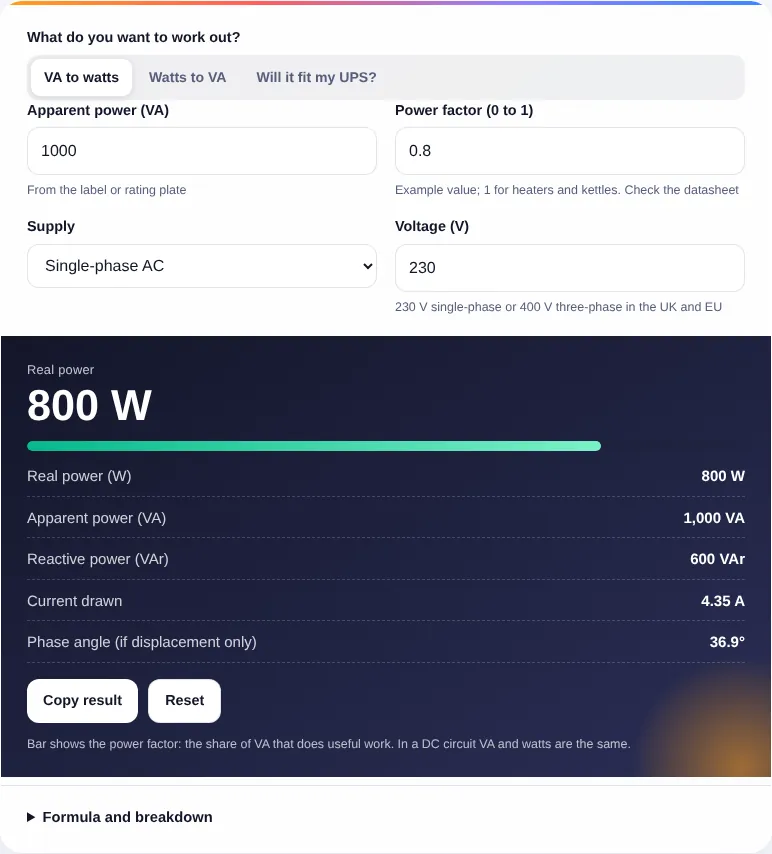
Watts = VA x power factor. In a DC circuit VA and watts are the same.
Formula and breakdown
n/a
n/a
This VA to watts calculator converts apparent power in volt-amperes to real power in watts and back, using the power factor, and checks whether a load fits both the VA and the watt rating of a UPS. It works for single-phase 230 V and three-phase 400 V supplies used in the UK and Europe, and any other voltage you enter.
Quick answer: A VA to watts calculator multiplies volt-amperes by the power factor: watts = VA x PF. A 1,000 VA load with a power factor of 0.8 uses 800 W of real power. For resistive loads such as heaters the power factor is 1, so VA and watts are equal; in DC circuits they are always equal.

What Is a VA to Watts Calculator?
A VA to watts calculator is a tool that turns apparent power, the product of RMS voltage and RMS current, into real power, the part that actually does work or turns into heat. In plain words: watts = VA x power factor, and VA = watts / power factor.
The volt-ampere is the unit of apparent power. With a purely resistive load, real and apparent power are identical. When a load has a reactive part, as motors, transformers and many electronic power supplies do, current and voltage are no longer in step and the apparent power is greater than the real power. The ratio between them is the power factor, a number from 0 to 1 for a load that consumes power.
How Do You Use the VA to Watts Calculator?
- Choose VA to watts, watts to VA, or the UPS check.
- Enter the VA or watt figure from the label, rating plate or a plug-in power meter.
- Enter the power factor. If the datasheet gives it, use that figure; 1 is correct for heaters and kettles.
- Pick single-phase or three-phase and the voltage to see the current.
- For a UPS, enter both its VA and watt ratings from the datasheet and the load in watts.
- Read the result, the reactive power and the current, and open the breakdown to see each step.
How Do You Convert VA to Watts?
Multiply the VA figure by the power factor: 1,500 VA at a power factor of 0.9 is 1,350 W. To go the other way, divide: 600 W at a power factor of 0.6 is 1,000 VA. The table shows real power for common VA ratings at five power factors.
| Apparent power | PF 1.0 | PF 0.9 | PF 0.8 | PF 0.7 | PF 0.6 |
|---|---|---|---|---|---|
| 500 VA | 500 W | 450 W | 400 W | 350 W | 300 W |
| 750 VA | 750 W | 675 W | 600 W | 525 W | 450 W |
| 1,000 VA | 1,000 W | 900 W | 800 W | 700 W | 600 W |
| 1,500 VA | 1,500 W | 1,350 W | 1,200 W | 1,050 W | 900 W |
| 2,000 VA | 2,000 W | 1,800 W | 1,600 W | 1,400 W | 1,200 W |
| 3,000 VA | 3,000 W | 2,700 W | 2,400 W | 2,100 W | 1,800 W |
The same rule scales up: our kVA to kW calculator does the conversion for generators and transformers, and the power factor calculator works out the power factor itself from measured volts, amps and watts.
What Power Factor Should I Use?
Use 1 for purely resistive loads such as kettles, immersion heaters and fan heaters, and the datasheet figure for anything with a motor or an electronic power supply. Wikipedia’s power factor article notes that switched-mode power supplies without power factor correction typically reach only about 0.55 to 0.65, which is why their VA can be well above their watts. Equipment with power factor correction runs much closer to 1. If you have no figure, measure the load with a plug-in meter that shows both watts and VA.
The va to watts calculator also shows reactive power in VAr, from VAr = square root of (VA² minus W²), and the phase angle, which only has a direct meaning when the waveforms are sinusoidal. Distorted currents from rectifiers lower the power factor without a simple phase shift.
Why Does a UPS Have Both a VA and a Watt Rating?
A UPS has two limits because its VA rating caps the current it can deliver while its watt rating caps the real power it can supply, and a load must stay within both. For example, the manufacturer’s datasheet for one 750 VA desktop UPS (APC Back-UPS BX750MI) gives a rated power of 410 W, a watt to VA ratio of about 0.55. A 600 W load would fit the VA figure only on paper; it is well over the watt limit.
A simple rule follows: if your load’s power factor is lower than the UPS’s watt to VA ratio, the VA limit is reached first; if it is higher, the watt limit is reached first. Equipment with power factor correction usually runs well above a ratio like 0.55, so with a UPS like this one it meets the watt limit first. Size with headroom, since a UPS near full load also runs for less time on battery. A hard-wired UPS or any change to fixed wiring must be installed by a qualified electrician, and in the UK the work must meet BS 7671.
How Do You Work Out the Current From VA?
Divide the VA by the voltage for single-phase AC: 1,000 VA at 230 V draws 4.35 A. For three-phase, divide by √3 times the line voltage: 17,647 VA at 400 V draws 25.5 A on each line. Current depends on VA, not watts, which is why cables, fuses and breakers are sized from VA or amps. Our kVA to amps calculator handles larger loads, and in a DC circuit there is no difference between VA and watts at all.
Worked Example: Will a 750 VA UPS Run a Home Office?
Example: a home office has a desktop computer measured at 220 W, two monitors at 30 W each and a router at 15 W, so 295 W in total. The UPS is rated 750 VA and 410 W. The power factors below are example values.
- With a combined power factor of 0.9: VA = 295 / 0.9 = 328 VA.
- VA check: 328 / 750 = 44%. Watt check: 295 / 410 = 72%. The watt limit decides at 72%.
- With a power factor of 0.6 instead: VA = 295 / 0.6 = 492 VA, or 66% of 750 VA. The watt limit still decides at 72%.
- Only below a power factor of 410 / 750 = 0.55 would the VA limit come first: at 0.5 the load is 590 VA, or 79%.
In this example the UPS fits with some headroom, but the rated 750 VA alone would have suggested far more spare capacity than the 410 W limit allows.
Frequently Asked Questions
How many watts is 1,000 VA?
It depends on the power factor. At a power factor of 1, 1,000 VA is 1,000 W; at 0.8 it is 800 W; at 0.6 it is 600 W. For a UPS, read the watt rating on its datasheet rather than converting, because the manufacturer sets both limits separately.
Is VA the same as watts?
Only when the power factor is 1, as with purely resistive loads, or in a DC circuit. For motors, transformers and many electronic power supplies, VA is larger than watts because part of the current does no real work. Watts measure real power; VA measure apparent power.
How do I convert watts to VA?
Divide the watts by the power factor. A 450 W load at a power factor of 0.9 is 500 VA, and at 0.6 it is 750 VA. Use the VA figure to check current, cable and UPS VA ratings, and the watts to check energy use and the UPS watt rating.
Why is my UPS watt rating lower than its VA rating?
Because the UPS can deliver a certain current, which sets its VA rating, but only a smaller amount of real power. For example, one 750 VA desktop UPS is rated 410 W. Check that your load in watts stays below the watt rating and its VA below the VA rating.
What is a good power factor?
A power factor close to 1 is best because the current drawn is no larger than needed. Resistive heaters are at 1. Switched-mode power supplies without correction sit around 0.55 to 0.65, while equipment with power factor correction runs much higher. Low power factor raises current and losses.
Does VA to watts apply to DC?
In a DC circuit with steady voltage and current, VA and watts are the same, because there is no phase shift or reactive power. Power is simply volts times amps. The distinction only matters for AC loads with a power factor below 1.
Checked October 2026 by the Solaxyra Editorial Team. Sources: Wikipedia: Volt-ampere, Wikipedia: Power factor, APC by Schneider Electric: Back-UPS BX750MI datasheet (PDF).