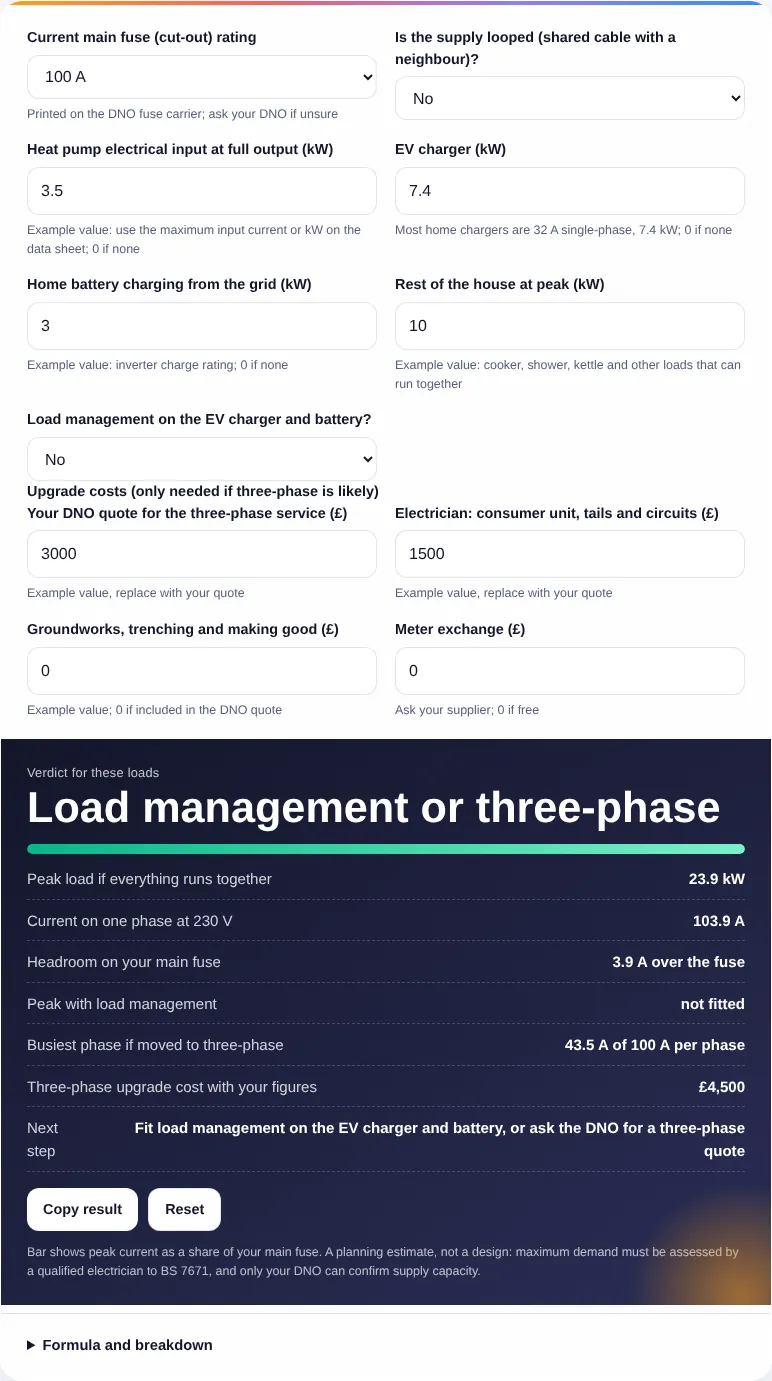
Bar shows peak current as a share of your main fuse. A planning estimate, not a design: maximum demand must be assessed by a qualified electrician to BS 7671, and only your DNO can confirm supply capacity.
Formula and breakdown
n/a
n/a
n/a
n/a
This three-phase supply upgrade calculator checks whether a UK home's single-phase supply can carry a heat pump, an EV charger and a home battery on top of normal use, and tells you whether the answer is no change, a 100 A fuse upgrade, load management or a full three-phase supply. It then adds up the cost of a three-phase upgrade from your own DNO and electrician quotes, because those prices are set case by case.
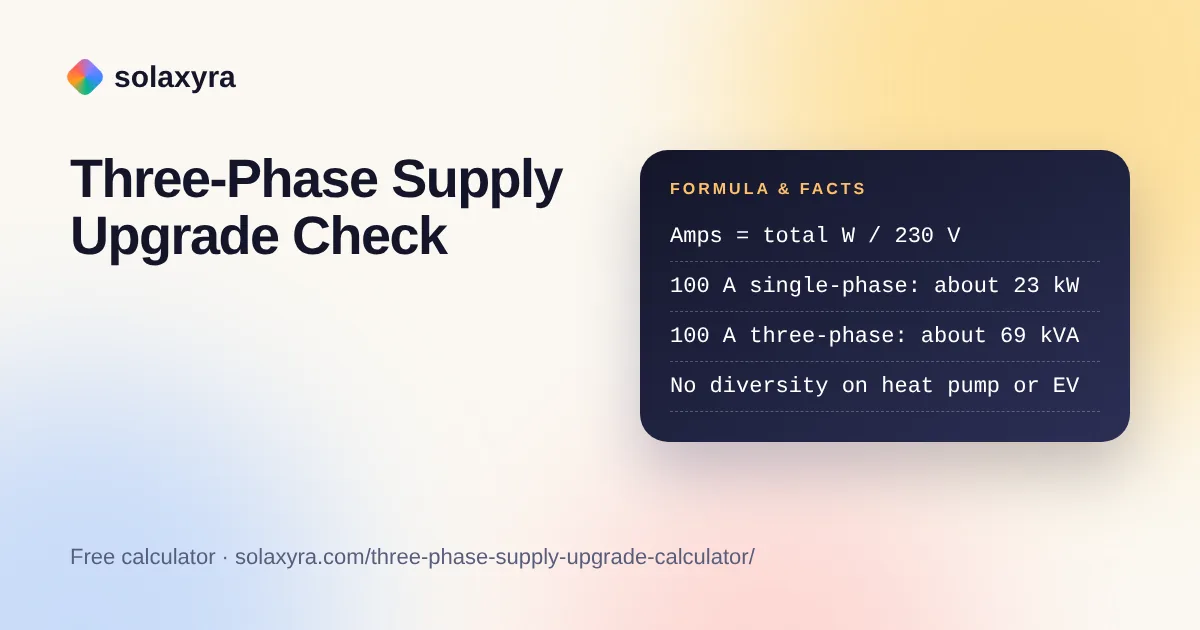
Quick answer: A UK single-phase supply on a 100 A main fuse carries about 23 kW at 230 V. The three-phase supply upgrade calculator adds your loads without diversity: a 3.5 kW heat pump, 7.4 kW charger, 3 kW battery and 10 kW house peak need 104 A, so load management or three-phase is needed.
What Is a Three-Phase Supply Upgrade Calculator?
A three-phase supply upgrade calculator is a tool that compares the peak current your planned loads could draw with the rating of your main fuse, to show whether the existing single-phase connection is enough or a bigger supply is needed. In plain words: current in amps equals total load in watts divided by 230 V; if that exceeds the fuse, you need a fuse upgrade, load management or three-phase.
The supply voltage comes from the law. Regulation 27 of the Electricity Safety, Quality and Continuity Regulations 2002 declares 230 V between phase and neutral for a low voltage supply, allowed to vary from 6% below to 10% above. On three-phase, the voltage between two phases is √3 times higher, about 400 V, and each of the three phases can carry its own share of the load.
How Do You Use the Three-Phase Supply Upgrade Calculator?
- Read the rating on your main fuse carrier (the DNO cut-out next to the meter) and pick 60 A, 80 A or 100 A. If there is no marking, your DNO can tell you.
- Say whether the supply is looped with a neighbour's, or choose "Not sure".
- Enter the heat pump's maximum electrical input, the EV charger rating and the battery's charging power from the grid. Use 0 for anything you are not fitting.
- Estimate the rest of the house at its busiest moment: cooker, electric shower, kettle and anything else that can run at the same time.
- Say whether the EV charger and battery have load management, then read the verdict, the current on one phase and how the same loads would sit on three phases.
- If three-phase looks likely, enter your DNO quote and electrician quote, and the three-phase supply upgrade calculator shows the total.
How Many kW Can a Single-Phase Supply Take?
A 100 A single-phase supply can deliver about 23 kW, since 230 V x 100 A = 23,000 W, while a 100 A three-phase supply can deliver about 69 kVA. The table shows the capacity at each common main fuse size, the same figures the three-phase supply upgrade calculator tests against, worked at the 230 V declared voltage and unity power factor.
| Supply | Main fuse | Capacity | Example loads that fit at the same time |
|---|---|---|---|
| Single-phase | 60 A | 13.8 kW | 7.4 kW charger plus a 6 kW house peak |
| Single-phase | 80 A | 18.4 kW | Above plus a 4.6 kW heat pump input |
| Single-phase | 100 A | 23.0 kW (23 kVA) | Above plus up to 5 kW more |
| Three-phase | 100 A per phase | About 69 kVA (3 x 23 kVA) | Up to 23 kW on each phase if loads are spread |
The Wikipedia article on three-phase electric power notes that the UK may supply one phase and neutral at up to 100 A to a single property, while Germany typically supplies all three phases to every home. To convert other figures, the kW to amps calculator and the three phase power calculator show the working.
When Do You Need a Three-Phase Supply?
You need three-phase when your planned loads would still exceed 100 A on one phase after any load management, because 100 A is the largest single-phase supply UK networks normally provide. The three-phase supply upgrade calculator tests this in four steps:
- Peak current at or below your fuse: no change to the supply, but the installer must still tell the DNO.
- Above your 60 A or 80 A fuse but within 100 A: a fuse and cut-out upgrade to 100 A single-phase.
- Above 100 A, but within 100 A once the EV charger and battery give way to the house: load management on single-phase, or three-phase.
- Above 100 A even with load management: three-phase is likely needed.
The IET's published answers on electrical diversity and load curtailment for EV charging say no diversity should be applied to the heat pump circuit, that most domestic chargers are 32 A single-phase (7.4 kW), and that BS 7671 permits load curtailment for EV charging equipment. That is why the three-phase supply upgrade calculator adds the heat pump and charger at full power and lets the charger step back only when you have load management.
How Much Does a Three-Phase Supply Upgrade Cost?
There is no fixed national price for a three-phase upgrade: your DNO quotes each job after checking the cable, the local substation and the distance to the property. The Energy Networks Association states that GB DNOs will give you what you need to decarbonise your home for free, up to a 23 kVA cable, which matches a 100 A single-phase supply. It does not publish a free allowance or a standard price beyond that, so the three-phase supply upgrade calculator treats every cost as your own quote.
The figures that drive the total are:
- DNO work: a new service cable from the street, a three-phase cut-out and sometimes work on the local network.
- Groundworks: digging through a drive or garden, and reinstating it, if not in the DNO quote.
- Electrician: a three-phase consumer unit or distribution board, new meter tails and moving circuits so the load is balanced.
- Meter: a three-phase meter fitted by your supplier.
Ask for a written quote from the DNO, and keep in mind that load management or a 100 A fuse upgrade, where they fit, avoid the three-phase cost entirely. The default £3,000 and £1,500 in the three-phase supply upgrade calculator are example values, not market prices.
How Long Does a Supply Upgrade Take and Who Do You Contact?
For a home where the new maximum demand is between 60 A and 100 A, the network operator confirms an application within 10 working days, according to the ENA page on connecting electric vehicles and heat pumps. Remedial work, such as a cut-out change or unlooping, has no fixed time: the DNO assesses the premises and network first. Three-phase work that needs a new cable can take longer, so start early.
- Your electrician assesses maximum demand and checks the main fuse, earthing and whether the supply is looped.
- The installer applies to, or notifies, your DNO on the ENA form. A looped supply must be reported before installation.
- The DNO confirms capacity, upgrades the fuse or quotes for three-phase.
- After the DNO work, your supplier changes the meter and your electrician connects the new consumer unit.
Find your DNO from digits 9 and 10 of the 21-digit MPAN on your bill. All work on the fixed wiring must be designed, installed and certified by a qualified electrician to BS 7671, and in England and Wales new circuits fall under Part P of the Building Regulations. Only the DNO may touch its cut-out and service cable.
Worked Example: Heat Pump, EV Charger and Battery on 100 A
Example: a four-bedroom detached house on a 100 A single-phase supply, not looped, plans a heat pump with a 3.5 kW maximum electrical input, a 7.4 kW EV charger and a battery that charges from the grid at 3 kW. The owners estimate the rest of the house at 10 kW at its busiest, with an electric shower, oven and kettle on together.
- Peak load: 3.5 + 7.4 + 3 + 10 = 23.9 kW.
- Current: 23,900 W / 230 V = 103.9 A, which is 3.9 A over the 100 A fuse.
- With load management: the heat pump and house alone are 13.5 kW, or 58.7 A, so the charger and battery can pause at the peak and the supply stays within 100 A.
- On three-phase: house 10 kW on L1 (43.5 A), charger on L2 (32.2 A), heat pump and battery on L3 (28.3 A), so every phase is under half its rating.
- Verdict from the three-phase supply upgrade calculator: load management or three-phase. With example quotes of £3,000 from the DNO and £1,500 from the electrician, three-phase would cost £4,500, so load management is worth pricing first.
Our maximum demand calculator goes room by room, the guide to three-phase electricity in UK homes explains the supply types, and the heat pump running cost calculator shows what the new load costs to run.
Frequently Asked Questions
Do I need three-phase for a heat pump and an EV charger?
Not always. A typical 7.4 kW charger and a heat pump often fit on a 100 A single-phase supply, especially with load management on the charger. Three-phase is usually only needed when the total, after load management, would still exceed 100 A on one phase. An electrician should assess maximum demand first.
How much power does a 100 A single-phase supply give?
About 23 kW, because 230 V multiplied by 100 A is 23,000 W, which is the 23 kVA cable the ENA says GB network operators provide free to help decarbonise a home. A 60 A fuse gives about 13.8 kW and an 80 A fuse about 18.4 kW.
Is a fuse upgrade to 100 A free?
The Energy Networks Association says GB DNOs will give you what you need to decarbonise your home for free, up to a 23 kVA cable, which is a 100 A single-phase supply. Contact your DNO to confirm for your property, as remedial work on older cut-outs or looped supplies is assessed case by case.
How much does it cost to upgrade to three-phase in the UK?
Each DNO quotes per job, based on cable length, digging and local network capacity, and no national price list applies to homes. Add an electrician's cost for a three-phase consumer unit and rewiring of tails, plus any meter charge. Enter your own quotes in the calculator to see the total.
What is load management and can it avoid a three-phase upgrade?
Load management lets a charger or battery reduce its power when the rest of the house is busy, so the total stays under the main fuse. The IET says BS 7671 permits load curtailment for EV charging equipment. If the heat pump and house alone fit within 100 A, it can avoid three-phase.
How do I know if my house has a three-phase supply?
Look at the DNO cut-out next to your meter. A single-phase supply has one main fuse carrier, while a three-phase supply has three, one for each phase, and usually a three-phase meter. If you are unsure, ask your DNO, which you can identify from digits 9 and 10 of your MPAN.
Checked October 2026 by the Solaxyra Editorial Team. Sources: ENA: Connecting electric vehicles and heat pumps, ENA: Frequently asked questions about connecting to the networks, IET: Electrical diversity and load curtailment (EV charging), ESQCR 2002 regulation 27 (legislation.gov.uk), Wikipedia: Three-phase electric power.