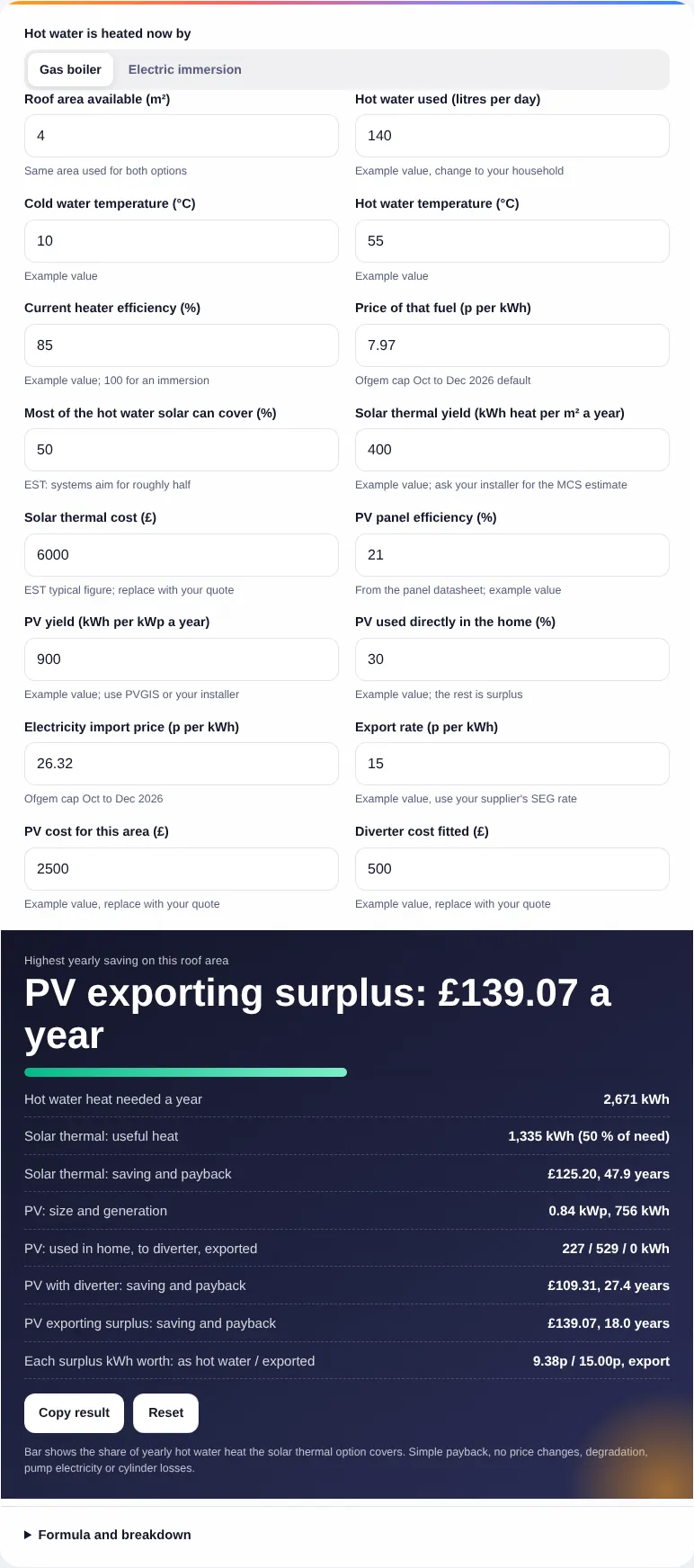
Bar shows the share of yearly hot water heat the solar thermal option covers. Simple payback, no price changes, degradation, pump electricity or cylinder losses.
Formula and breakdown
n/a
n/a
n/a
n/a
This solar thermal vs PV calculator compares, for the same patch of roof, how much a UK household would save on hot water with solar thermal collectors against solar PV panels, either with a diverter that sends surplus electricity to the immersion heater or with that surplus exported. It is for homeowners with a hot water cylinder who are choosing between the two, and it shows the yearly saving and simple payback for all three options side by side.
Quick answer: A solar thermal vs PV calculator works out hot water heat needed, the share each option can supply and what that heat or electricity is worth. On 4 m² with a gas boiler, the examples here give thermal £125, PV with diverter £109 and PV exporting surplus £139 a year; with an electric immersion, thermal leads.
What Is a Solar Thermal vs PV Calculator?
A solar thermal vs PV calculator is a tool that estimates the yearly money saved by putting solar water heating collectors or photovoltaic panels on the same roof area, using your hot water use, your current water heater and your prices. In plain words: thermal saving equals useful solar heat times the cost of a kWh of heat from your boiler or immersion; PV saving equals electricity used at home times the import price, plus surplus either diverted into hot water or exported at your export rate.
Comparing the two is awkward because one makes heat and the other makes electricity. The solar thermal vs PV calculator puts both into pounds a year, then divides each installed cost by its saving for a simple payback. It also shows what one surplus PV kWh is worth as hot water and as export, which settles the diverter question for your fuel and tariff.
How Do You Use the Solar Thermal vs PV Calculator?
- Choose how your hot water is heated now: gas boiler or electric immersion. This sets an example efficiency and the Ofgem cap price for that fuel.
- Enter the roof area you could use, your daily hot water use and the cold and hot water temperatures.
- Set the most of your hot water you expect solar to cover. The default is half, the design aim the Energy Saving Trust describes.
- Enter a solar thermal yield and cost, and the PV panel efficiency, yield and share used in the home, from quotes where you have them.
- Add your import price, export rate, PV cost and diverter cost.
- Read the best option, then compare the three saving and payback rows and open the breakdown.
How Much Hot Water Can Solar Thermal Provide in the UK?
A solar water heating system in the UK is usually designed to provide roughly half of a household’s yearly hot water, with around 90 % in summer falling to around 25 % in winter.
Those figures come from the Energy Saving Trust guide to solar water heating, which also puts the cost of a typical system at around £6,000 and says a boiler or immersion heater is still needed to top up. That is why the solar thermal vs PV calculator caps useful solar heat at a share of your demand: collectors on a bigger roof make more heat in July, but the cylinder is already hot, so the extra is wasted. The same cap applies to PV surplus sent to the immersion.
How Is Hot Water Energy Worked Out?
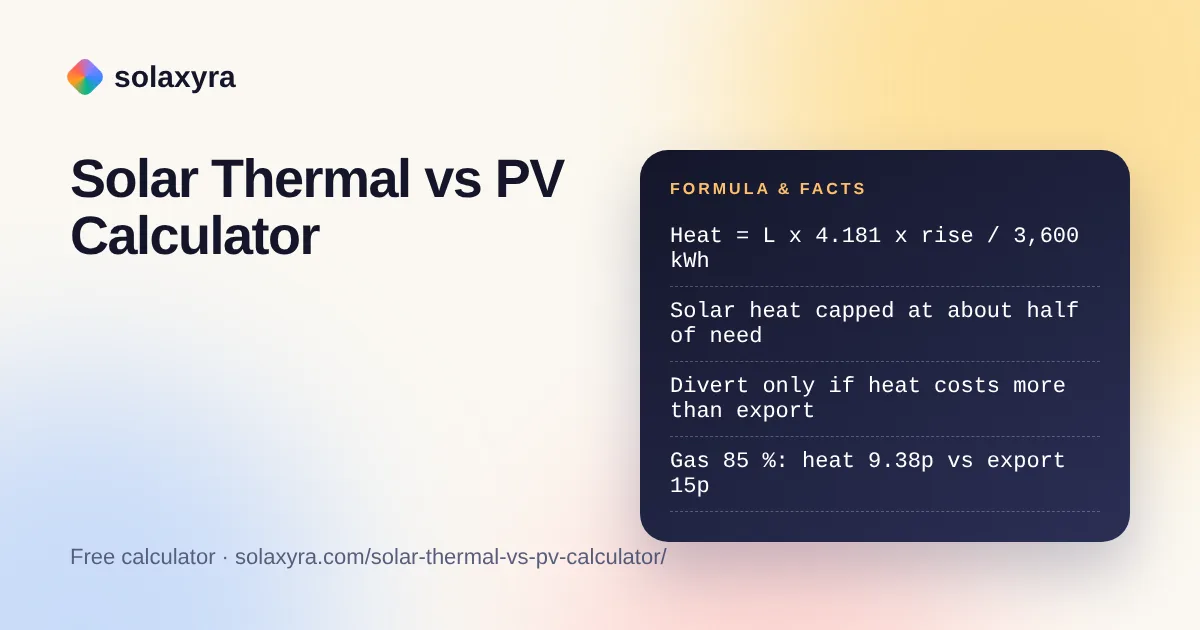
Hot water energy in kWh equals litres times 4.181 kJ per kg per kelvin times the temperature rise, divided by 3,600. Heating 140 litres a day from 10 °C to 55 °C takes about 7.3 kWh a day, or 2,671 kWh a year.
The 4.181 figure is the specific heat capacity of liquid water at 25 °C from the table of specific heat capacities, and one litre of water is taken as one kilogram. The figure is heat delivered into the water. Your boiler or immersion has to burn or use more than that, so each kWh of solar heat saves the fuel price divided by the heater’s efficiency. Cylinder standing losses are not included, so real demand is a little higher.
Is a PV Diverter Better Than Exporting the Surplus?
A diverter beats exporting only when a kWh of hot water heat costs you more than your export rate pays. With an 85 % efficient gas boiler at 7.97p per kWh, each kWh of heat costs about 9.38p, so a 15p export rate is worth more.
With an electric immersion at 26.32p per kWh, the answer flips: every diverted kWh saves 26.32p, well above most export rates. The “each surplus kWh worth” row in the solar thermal vs PV calculator shows both values and recommends divert or export. Use the Smart Export Guarantee calculator to check your export income and the solar self-consumption calculator to estimate the share of PV you use directly.
Which Option Wins on Different Roofs and Fuels?
The table runs the default household, 140 litres a day, 50 % solar cap, 400 kWh per m² thermal yield, 21 % efficient panels at 900 kWh per kWp, 30 % used in the home and a 15p example export rate, for two roof areas and both fuels. PV cost is an example £2,500 for 4 m² and £6,000 for 12 m².
| Roof area and current heater | Solar thermal | PV with diverter | PV exporting surplus |
|---|---|---|---|
| 4 m², gas boiler | £125.20 | £109.31 | £139.07 |
| 4 m², electric immersion | £351.45 | £198.98 | £139.07 |
| 12 m², gas boiler | £125.20 | £342.13 | £417.22 |
| 12 m², electric immersion | £351.45 | £568.38 | £417.22 |
Two patterns stand out. Solar thermal’s saving stops growing once it reaches the hot water cap, while PV keeps earning on extra area because it also powers the house and exports. And on a small roof with an immersion, solar thermal turns more of the sunlight into useful value. For the PV side of a larger roof, the solar panel output calculator gives a location-based yield.
What Else Should You Check Before Choosing?
Check the cylinder first: solar thermal needs a cylinder with a solar coil, while a diverter needs a working immersion heater, and a combi boiler home with no cylinder suits neither without changes.
- Panel size from area: PV nominal power equals area times 1,000 W per m² times efficiency, the standard test condition definition, so 4 m² of 21 % panels is 0.84 kWp.
- Maintenance: the Energy Saving Trust describes a short annual check for solar thermal and a fuller check every five years, including replacing the fluid.
- Safety: a diverter and any new immersion wiring must be installed by a qualified electrician to BS 7671, and any change to a gas boiler or its controls needs a Gas Safe registered engineer.
Worked Example: A Four-Person Home With a Gas Boiler
Example: a family in Bristol uses about 140 litres of hot water a day, heated by an 85 % efficient gas boiler at 7.97p per kWh. They have 4 m² of south-facing roof free.
- Heat needed = 140 x 4.181 x 45 / 3,600 x 365 = 2,671 kWh a year. Half of it is 1,335 kWh.
- Solar thermal: 4 m² x 400 = 1,600 kWh, capped at 1,335 kWh. Each kWh saves 7.97 / 0.85 = 9.38p, so £125.20 a year. At an EST typical £6,000, payback is 47.9 years.
- PV: 4 x 0.21 = 0.84 kWp x 900 = 756 kWh. Home use 227 kWh x 26.32p = £59.69. Surplus 529 kWh.
- Diverting the surplus saves 529 x 9.38p = £49.62, total £109.31, payback 27.4 years on £3,000.
- Exporting it at an example 15p earns £79.38, total £139.07, payback 18.0 years on £2,500.
For this home the solar thermal vs PV calculator shows that exporting PV surplus gives the best return, and a diverter adds cost without adding value while gas is cheap per kWh.
Frequently Asked Questions
Is solar thermal more efficient than solar PV?
Their efficiency figures measure different things, because collectors make heat and panels make electricity. A kWh of electricity is usually worth more than a kWh of heat from gas, and thermal output is capped by your hot water use, so the better choice depends on fuel, roof size and prices.
Can solar PV heat hot water?
Yes. A PV diverter watches the electricity your panels export and sends that surplus to the immersion heater in your hot water cylinder instead. It only uses electricity you would otherwise export, so it never draws from the grid for heating.
How much hot water does solar thermal provide?
The Energy Saving Trust says a solar water heating system can provide around 90 % of hot water in summer and around 25 % in winter, and systems are usually designed to cover roughly half of the yearly need.
Is a solar diverter worth it with a gas boiler?
Often not. Each kWh diverted replaces gas heat costing your gas price divided by boiler efficiency, about 9.38p at 7.97p and 85 %. If your export rate is higher than that, exporting the surplus earns more than the diverter saves.
How much does a solar thermal system cost?
The Energy Saving Trust puts the cost of a typical solar water heating system at around £6,000, varying with collector type and system size. Use your own quote in the solar thermal vs PV calculator, because the payback depends heavily on the installed price.
Can I have both solar thermal and PV?
Yes, if the roof has room and the cylinder has a solar coil. Thermal then covers part of the hot water, and the PV powers the house and exports. A diverter adds little in that case, because the cylinder is often already hot from the thermal panels on sunny days.
Checked October 2026 by the Solaxyra Editorial Team. Sources: Energy Saving Trust: Solar water heating, Ofgem: Changes to the energy price cap, 1 October to 31 December 2026, Wikipedia: Table of specific heat capacities, Wikipedia: Nominal power (photovoltaic).