This guide explains how VAT applies to solar panels and home batteries in the UK, including Northern Ireland, what changes on 1 April 2027 and how to make sure your quote charges the right rate. The rules on solar panel VAT that UK homeowners need come from one HMRC notice, and the key condition is simple: the relief only applies when the same business supplies and installs the equipment in a home.
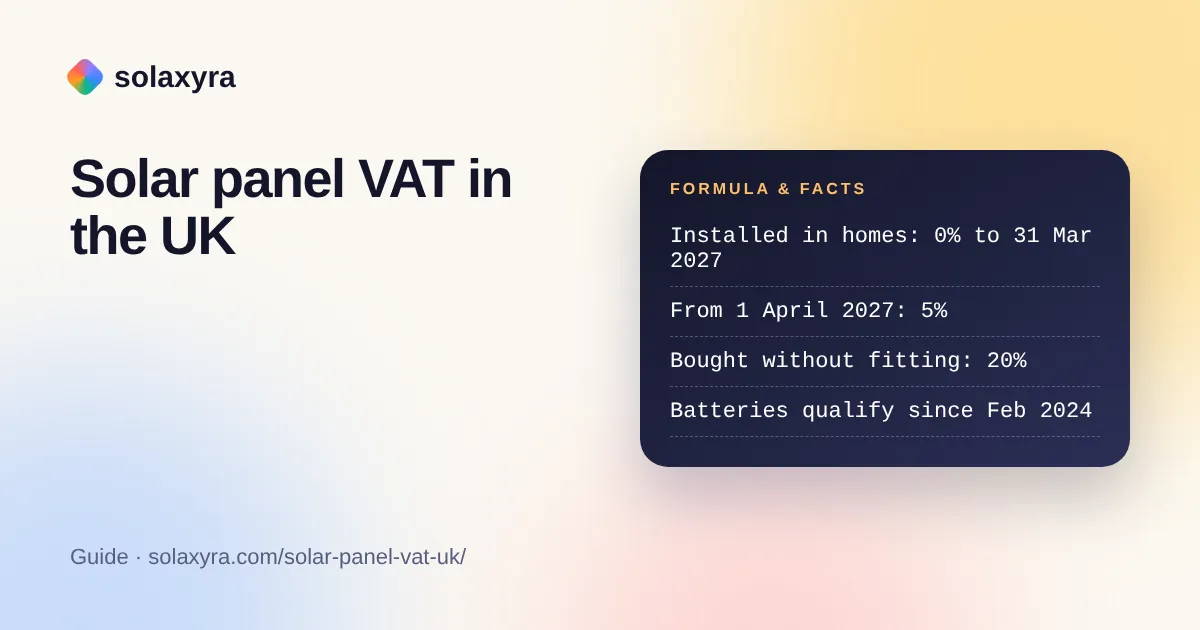
Quick answer: Solar panel VAT UK rules set a 0% rate on solar panels and batteries installed in homes until 31 March 2027, under HMRC VAT Notice 708/6. From 1 April 2027 the rate returns to 5%. Panels or plug-in kits bought without installation carry the standard 20% rate, and Northern Ireland follows the same zero-rate period.
What is the solar panel VAT rate in the UK?
The VAT rate on installed solar panels in UK homes is 0% until 31 March 2027 (in Great Britain since 1 April 2022 and in Northern Ireland since 1 May 2023), after which it reverts to the reduced rate of 5%. This comes from HMRC VAT Notice 708/6 on energy-saving materials, which lists solar panels alongside insulation, heat pumps, wind and water turbines, and heating controls as qualifying materials.
From 1 February 2024 HMRC added batteries that store energy converted from electricity, water source heat pumps and smart diverters to the list. A battery fitted with new panels is normally treated as part of one zero-rated supply. A battery retrofitted to an existing system, or installed on its own to store grid electricity, also qualifies when it is installed in qualifying accommodation.
The three UK rates listed on GOV.UK are 20% standard, 5% reduced and 0% zero rate. Solar panel VAT for homes sits at the zero rate for now and moves to the reduced rate from April 2027, not to 20%.
Who qualifies for 0% VAT on solar panels?
You qualify when a business both supplies and installs the panels or battery in residential accommodation; HMRC states that energy-saving materials supplied without installation are standard-rated. For solar panel VAT, the building matters as well as the way you buy.
| Situation | VAT rate until 31 March 2027 | VAT rate from 1 April 2027 |
|---|---|---|
| Panels supplied and fitted on your house or flat | 0% | 5% |
| Battery supplied and fitted with new panels | 0% (one supply) | 5% |
| Battery retrofitted to existing panels, or standalone battery, fitted by the supplier | 0% | 5% |
| Solar diverter supplied and fitted | 0% | 5% |
| Care home, children’s home, student accommodation, self-catering holiday let, permanent residential caravan, houseboat used as a sole residence | 0% | 5% |
| Building used solely for a relevant charitable purpose | 0% (from 1 February 2024) | 5% |
| New-build home, installed as part of the construction | 0% with the building, see HMRC Notice 708 | Ask your builder; new-build rules are separate |
| Panels, battery or plug-in kit bought without installation | 20% | 20% |
| Hotel, office, shop or other commercial building | 20% | 20% |
The new-build row reflects HMRC’s note that the construction of a new dwelling and the installation of energy-saving materials in it are zero-rated under the separate rules for builders. Ask your builder to confirm how they invoice.
What else on a solar quote gets the 0% rate?
Work that is ancillary to fitting the panels or battery, priced and carried out as part of the same job, follows the zero rate; anything that is a separate, independent supply takes its own rate. HMRC VAT Notice 708/6 section 2.5 explains this single and multiple supply test, with the example that an extension built with insulation is standard-rated because the construction is the main element.
- EV chargers: not on HMRC’s list of energy-saving materials, so a charger fitted alongside panels is normally a separate standard-rated item. Some installer pages say otherwise; check the line on your invoice.
- Re-roofing or roof repairs: a separate job in its own right, not a means of enjoying the solar installation, so expect it to be charged at its own rate.
- Installer certification: HMRC’s notice does not make MCS certification a condition of the zero rate, though MCS matters for the Smart Export Guarantee.
- Customer certificates: HMRC says there is no requirement for you to give the installer a certificate to get the relief.
HMRC’s notice says the rate reverts to 5% from 1 April 2027 but does not say whether the older conditions that applied to the 5% rate before 2022 (social policy conditions or a 60% materials threshold) will return. Some installer pages assume they will. Until HMRC publishes updated guidance, treat 5% as the expected solar panel VAT rate and ask your installer to confirm.
Do plug-in solar kits get 0% VAT?
No: a plug-in solar kit bought from a shop or website without installation is a supply of goods, so it carries the standard 20% rate rather than the 0% rate for installed systems. Plug-in kits of up to 800 W became legal to use in Great Britain from 27 August 2026, according to the GOV.UK plug-in solar announcement, and are sold by major retailers as boxed products you plug in yourself.
Example: a plug-in kit priced at £500 including VAT contains about £83.33 of VAT (£500 ÷ 1.2 × 0.2). Example price only, change it to the kit you are considering. That VAT is already in the shelf price, so there is nothing extra to pay, but it is a fair comparison point when weighing a small installed system against a plug-in kit. To see whether a kit pays back at its full price, use the plug-in solar calculator.
How much will the 5% VAT rate add from April 2027?
On the Energy Saving Trust’s typical 4.5 kWp system at about £7,600, the return of 5% solar panel VAT adds about £380, taking the price to about £7,980. The table applies 5% to typical prices; battery prices are the Energy Saving Trust’s £5,000 to £8,000 range, and the combined line is an example value.
| Installation | Price at 0% VAT | VAT at 5% | Price at 5% VAT |
|---|---|---|---|
| Typical 4.5 kWp solar system (EST) | £7,600 | £380 | £7,980 |
| Home battery, lower end (EST range) | £5,000 | £250 | £5,250 |
| Home battery, upper end (EST range) | £8,000 | £400 | £8,400 |
| Example: solar plus lower-end battery | £12,600 | £630 | £13,230 |
The effect on payback is modest. Example: if the typical system saves £678 a year (40% self-consumption, a 12p export rate and the 26.32p cap unit rate), the extra £380 adds about 7 months to the payback period. Test your own figures, with and without the VAT, in the solar payback calculator. Installer prices can move by more than 5% between quotes, so the solar panel VAT change alone should not push anyone into a rushed decision.
Which VAT rate applies if your installation is around 31 March 2027?
The rate is set by the tax point: for services it is normally when the work is completed, but an earlier invoice or payment creates an earlier tax point for the amount invoiced or paid. These are the general rules in section 14 of HMRC’s VAT Notice 700. Section 30 of that notice sets out special procedures when a rate changes, and your installer’s accountant will apply them.
If your installation is planned near the end of March 2027, work through these steps to get the right solar panel VAT rate:
- Ask the installer, in writing, which VAT rate the quote assumes and on what date.
- Ask whether the deposit and any stage payments will be invoiced, and at which rate.
- Agree a completion date with some margin before 31 March 2027 if the 0% rate matters to your budget, accepting that weather and network approval can cause delays.
- Check that the final invoice shows the VAT rate and amount on each line, and that a battery and panels supplied together appear as one installed supply.
- If anything is unclear, ask the installer to confirm their treatment with HMRC rather than relying on a sales estimate.
Does the VAT relief apply in Northern Ireland?
Yes: from 1 May 2023 Northern Ireland follows the same zero-rate period as Great Britain, ending on 31 March 2027. Before that, from October 2019 to 30 April 2023, a reduced rate applied in Northern Ireland and was subject to social policy conditions or a 60% threshold test, which no longer apply. HMRC Notice 708/6 sets out both periods.
Solar panel VAT is the same in Northern Ireland, but other parts of the solar picture do differ there. Ofgem’s Smart Export Guarantee covers installations in Great Britain only, so export payment terms there come from local suppliers. Check those terms before working out savings.
Is VAT on solar panels the same as VAT on electricity bills?
No: solar panel VAT and VAT on electricity bills are separate reliefs. The 0% rate on solar is for installing energy-saving materials, while Ofgem reports that the government has removed VAT from household electricity bills from 1 October 2026 to 31 March 2027. The cap unit rate for October to December 2026 is 26.32p per kWh on average.
The two interact in one way: a lower electricity price slightly reduces what each self-used solar kWh saves, so payback figures worked out with today’s VAT-free electricity price are a little cautious if VAT returns to bills in April 2027. Run both prices through the solar savings calculator to see the range.
Frequently Asked Questions
When does 0% VAT on solar panels end?
The zero rate for installed solar panels and batteries in homes runs until 31 March 2027. From 1 April 2027 installations in residential accommodation revert to the reduced rate of 5%, according to HMRC VAT Notice 708/6.
Is there VAT on solar batteries?
Batteries installed in homes are zero-rated until 31 March 2027, whether fitted with new panels, added to an existing system or installed on their own. HMRC added batteries to the qualifying materials from 1 February 2024. Batteries bought without installation carry 20%.
Do I pay VAT if I buy solar panels and install them myself?
Yes. HMRC says energy-saving materials supplied without installation are standard-rated, so panels, batteries and plug-in kits bought as goods carry 20% VAT. Any fixed wiring work must be done by a qualified electrician to BS 7671.
Can businesses get 0% VAT on solar panels?
Not on commercial buildings such as offices, shops or hotels, which are excluded from the residential relief and pay the standard rate. Buildings used solely for a relevant charitable purpose qualify from 1 February 2024. VAT registered businesses should take their own advice on recovery.
Does 0% VAT apply to a holiday let?
HMRC lists self-catering holiday accommodation among the types of residential accommodation that qualify, along with care homes, student accommodation, permanent residential caravans and houseboats used as a sole residence. Hotels do not qualify.
Checked October 2026 by the Solaxyra Editorial Team. Sources: HMRC: VAT Notice 708/6, HMRC: VAT Notice 700, GOV.UK: VAT rates, Energy Saving Trust: solar panels, Ofgem: price cap October to December 2026.