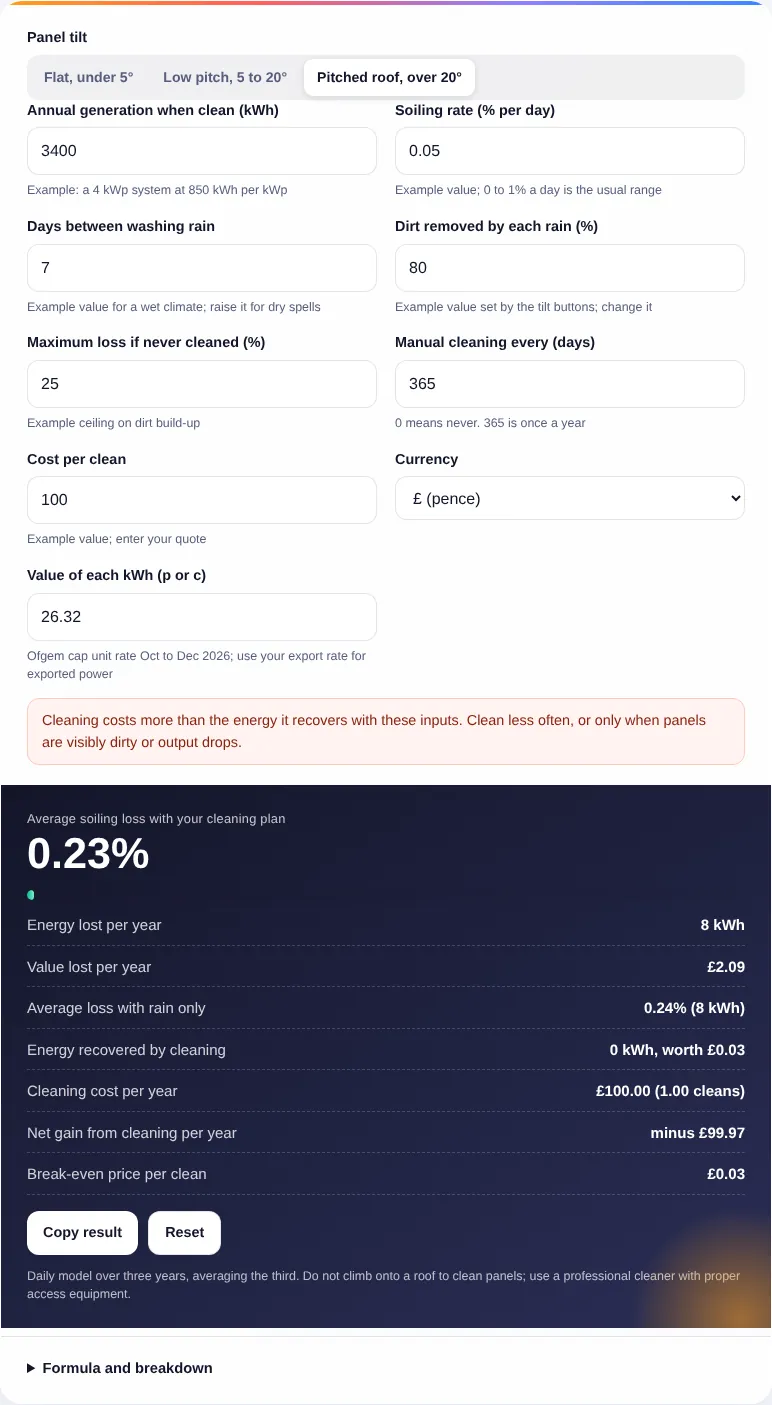
Daily model over three years, averaging the third. Do not climb onto a roof to clean panels; use a professional cleaner with proper access equipment.
Formula and breakdown
n/a
n/a
This solar panel soiling loss calculator estimates how much energy and money dirt on your panels costs each year, and whether paying for cleaning would recover more than it costs, for homeowners in the UK, Ireland and the rest of Europe. Instead of assuming a flat percentage, it models dirt building up day by day, rain washing part of it away and any manual cleans you plan.
Quick answer: A solar panel soiling loss calculator models dirt building up each day and rain washing it off. On a pitched roof in a rainy climate, dirt at 0.05% a day with weekly rain gives an average loss of about 0.2%. Flat panels that rain cannot clean may lose 9% even with a yearly clean.
What Is a Solar Panel Soiling Loss Calculator?
A solar panel soiling loss calculator is a tool that estimates the share of a solar system's output lost to dust, pollen, soot, bird droppings and other dirt on the glass, and turns it into kWh and money. In plain words: each day the loss rises by the soiling rate, each washing rain removes part of the dirt, a manual clean resets it to zero, and the average loss over a year times your clean-panel generation is the energy lost.
The Wikipedia article on soiling describes the soiling rate as the rate of change of soiling loss, usually given in percent per day, with typical values between 0 and 1% a day. It names rain as the most important weather factor, notes that average losses can be below 1% in regions with frequent rain, and says larger tilt angles mean less dirt and a better chance of rain cleaning. The solar panel soiling loss calculator is built on exactly those three ideas.
How Do You Use the Solar Panel Soiling Loss Calculator?
- Pick the tilt that matches your panels. This sets an example value for how much dirt each rain removes, which you can change.
- Enter your annual generation with clean panels. The solar panel output calculator gives a figure if you do not have one from your installer or meter.
- Set the soiling rate. Start low for a rural or suburban roof and raise it near busy roads, farms, building sites or the coast.
- Enter the typical number of days between rain heavy enough to wash the panels.
- Enter how often you plan to have the panels cleaned (0 for never) and the price per clean.
- Enter what each kWh is worth to you, then read the loss, the energy recovered by cleaning and the break-even price per clean.
How Much Power Do Dirty Solar Panels Lose?
On a pitched roof in a rainy climate the average loss is usually well under 1%, because rain keeps resetting the build-up before it grows. Flat panels are different: if rain removes little dirt, the loss keeps climbing between cleans. The table shows the average loss from the solar panel soiling loss calculator's model at a soiling rate of 0.05% a day, an example at the low end of the range, with a 25% ceiling on build-up.
| Dirt removed by each rain | Rain every | Average loss, rain only | Average loss, rain plus one clean a year |
|---|---|---|---|
| 80% (pitched roof example) | 7 days | 0.24% | 0.23% |
| 80% (pitched roof example) | 30 days | 1.10% | 1.03% |
| 50% (low pitch example) | 7 days | 0.50% | 0.49% |
| 50% (low pitch example) | 30 days | 2.22% | 1.95% |
| 0% (flat, rain does not clean) | any | 25.00% | 9.10% |
Two points stand out. When rain does the cleaning, a yearly clean changes the average loss very little, because the dirt it removes would have been washed off within days anyway. When rain does not clean, a yearly clean cuts the average loss sharply but the panels still spend much of the year dirty. Panels tilted closer to the ideal angle for your latitude, which the solar panel angle calculator works out, also shed dirt better.
Is Solar Panel Cleaning Worth the Money?
Cleaning is worth it only when the energy it recovers is worth more than it costs, and the calculator gives that answer as a break-even price per clean. With the defaults, a 3,400 kWh system on a pitched roof with weekly rain recovers about 0.1 kWh a year from one clean, worth a few pence at the Ofgem price cap unit rate of 26.32p per kWh for October to December 2026. Any paid clean costs far more than that.
If you export most of your daytime generation, value the lost kWh at your export rate instead, which makes cleaning even harder to justify. Use the solar savings calculator to see how much of your output you use at home and how much you export.
When Do Solar Panels Need Cleaning?
Panels need attention when something blocks part of a panel and rain will not shift it, such as bird droppings, lichen, leaves or heavy dust from nearby works. Signs to look for are visible patches on the glass and a fall in monitored output compared with the same weeks last year. The kWh per kWp calculator helps you compare your system's yield with a typical figure for your area.
For safety, do not climb onto a roof to clean panels. Use a professional cleaner with proper access equipment, or clean only panels you can reach from the ground with a soft brush and clean water. Avoid pressure washers and abrasive pads, and follow the panel manufacturer's instructions so the warranty is not affected.
Worked Example: Flat-Roof Panels on an Industrial Estate
Example: a small business unit near Manchester has a 4 kWp system laid nearly flat on a flat roof, generating 3,400 kWh a year when clean. Rain removes very little dirt from these panels, so the dirt removed by each rain is set to 0% and the soiling rate is left at 0.05% a day.
- Rain only: dirt builds by 0.05 points a day and reaches the 25% ceiling after 500 days, so in the third year the loss sits at 25%: 3,400 x 25% = 850 kWh lost.
- With one clean a year: the loss climbs from 0 to about 18% over the year and averages 9.10%: 3,400 x 9.10% = 309 kWh lost.
- Energy recovered by cleaning: 850 minus 309 = 541 kWh, worth £142.29 at 26.32p per kWh.
- Net gain with a £100 clean: £142.29 minus £100 = £42.29 a year, and any price below £142.29 per clean pays back.
The same clean on a pitched roof with weekly rain would recover only pennies, which is why the answer to "should I clean my panels?" depends on tilt and site, not on a fixed percentage.
Frequently Asked Questions
How much efficiency do dirty solar panels lose?
It depends on how fast dirt builds up and how often rain removes it. Wikipedia gives soiling rates of 0 to 1% a day and notes that in regions with frequent rain average losses can be below 1%. Flat panels, dusty sites and bird droppings can push losses much higher.
Does rain clean solar panels?
Rain is the most important natural cleaner. Steeper panels gather less dirt and are more likely to be washed clean by rain, while panels laid nearly flat hold on to it. Light rain and dew can even make some dust stick harder.
How often should solar panels be cleaned in the UK?
On a pitched roof with regular rain, many systems need no routine cleaning at all, because the energy recovered is worth less than a clean costs. Check the break-even price in the calculator, and clean when panels are visibly dirty or monitored output drops for no other reason.
Is paying for solar panel cleaning worth it?
Only when the value of the energy recovered is higher than the price of the clean. The calculator shows the break-even price per clean. For a typical pitched UK roof this is often a few pounds, while flat or low-pitch panels near dust sources can justify a paid clean.
What is a soiling rate?
A soiling rate is how fast power output falls as dirt builds up, usually given in percent per day. A rate of 0.1% a day means that after 30 dry days output is about 3% lower than when the panels were clean.
Can I clean solar panels myself?
Only if you can reach them safely from the ground, using soft brushes and clean water. Do not climb onto a roof, avoid pressure washers and abrasive pads, and follow the panel manufacturer's cleaning instructions so you do not damage the glass or void the warranty.
Checked October 2026 by the Solaxyra Editorial Team. Sources: Wikipedia: Soiling (solar energy), Ofgem: Changes to energy price cap between 1 October and 31 December 2026.