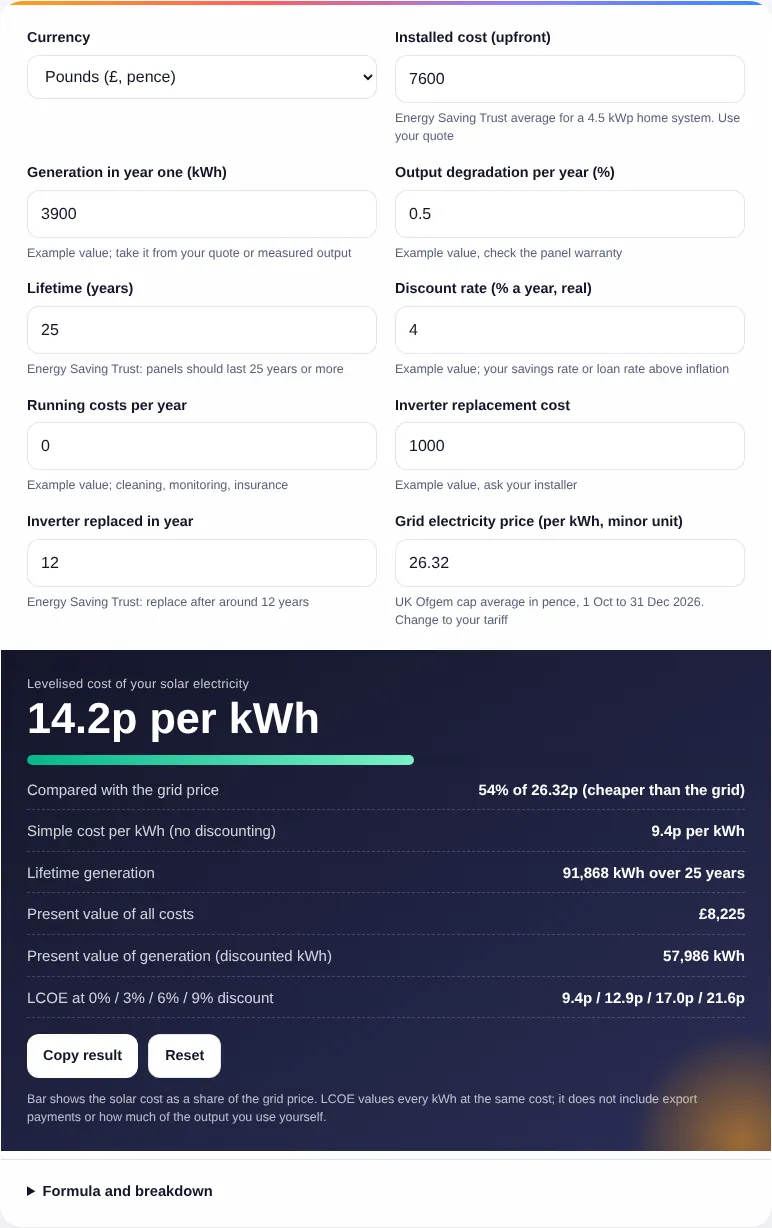
Bar shows the solar cost as a share of the grid price. LCOE values every kWh at the same cost; it does not include export payments or how much of the output you use yourself.
Formula and breakdown
n/a
n/a
n/a
This solar LCOE calculator works out the levelised cost of electricity from a home solar PV system: the average cost of every kWh it will make over its life, allowing for the upfront price, running costs, an inverter replacement, panel degradation and the time value of money. It is built for UK and European homeowners comparing a quote with the price they pay for grid electricity.
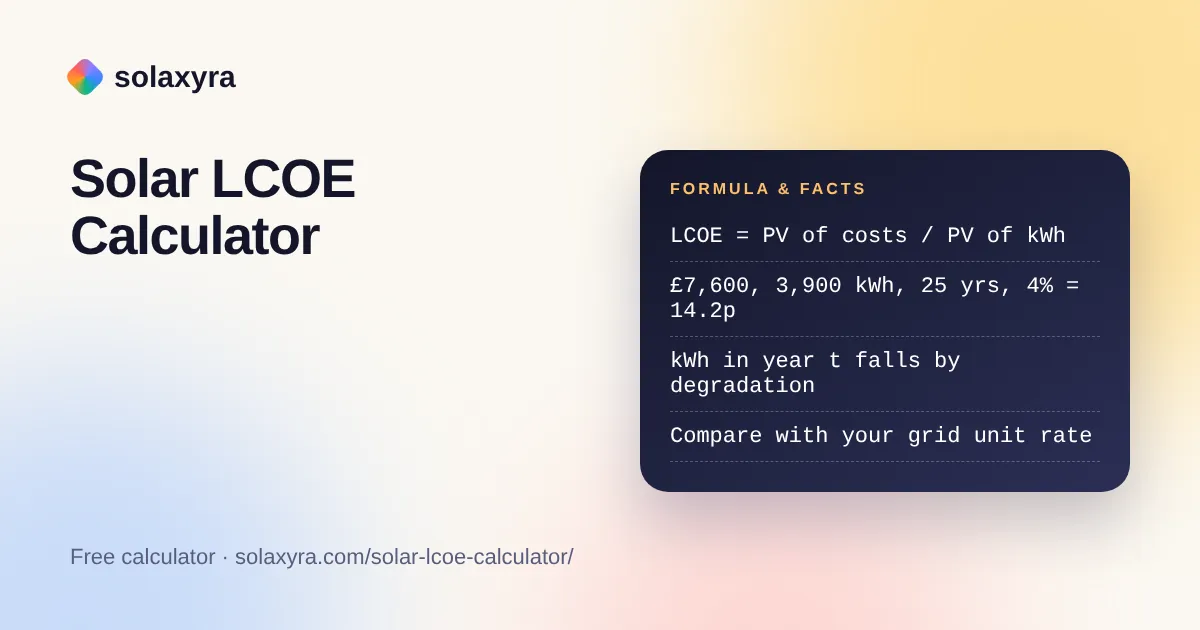
Quick answer: A solar LCOE calculator divides the present value of all lifetime costs by the present value of all lifetime generation. A £7,600 system making 3,900 kWh in year one, losing 0.5% a year over 25 years, with a £1,000 inverter in year 12 and a 4% discount rate, costs about 14.2p per kWh.
What Is a Solar LCOE Calculator?
A solar LCOE calculator is a tool that turns the full lifetime cost of a solar system into one price per kWh generated, so it can be compared directly with an electricity tariff. In plain words: LCOE = (upfront cost + each year’s costs discounted to today) / (each year’s kWh discounted to today).
The levelised cost of electricity is the constant price per unit that would give the project a net present value of zero. Discounting the kWh as well as the costs is what makes it “levelised”: money and energy that arrive in year 20 count for less than those in year 1. With a 0% discount rate, LCOE equals the simple total spend divided by total kWh.
How Do You Use the Solar LCOE Calculator?
- Enter the installed cost from your quote.
- Enter the expected generation in the first year, from the quote or your meter.
- Set the yearly degradation from the panel warranty and the lifetime in years.
- Choose a real discount rate: what your money would earn, or what a loan costs, above inflation.
- Add yearly running costs and the cost and timing of an inverter replacement.
- Enter your grid unit price to see how the solar cost per kWh compares.
How Do You Calculate the LCOE of Solar Panels?
Add the upfront cost to every later cost divided by (1 + discount rate) raised to the year it is paid, then divide by the sum of each year’s kWh divided by the same factor. Generation in year t is the first-year output x (1 minus degradation) to the power (t minus 1). DESNZ uses the same structure in its Electricity Generation Costs 2023 report, dividing the net present value of total costs by the net present value of electricity generation.
The discount rate matters more than most people expect. The table shows LCOE for the default £7,600 system, 0.5% degradation, 25 years and a £1,000 inverter in year 12, at different first-year outputs and discount rates.
| Year-one generation | 0% discount | 4% discount | 8% discount |
|---|---|---|---|
| 3,000 kWh | 12.2p | 18.4p | 26.0p |
| 3,500 kWh | 10.4p | 15.8p | 22.3p |
| 3,900 kWh | 9.4p | 14.2p | 20.0p |
| 4,500 kWh | 8.1p | 12.3p | 17.3p |
Lifetime matters too. With 3,900 kWh and a 4% discount rate, the LCOE is 19.6p over 15 years, 16.2p over 20 years, 14.2p over 25 years, 12.9p over 30 years and 12.1p over 35 years.
What Figures Should I Use for a UK Home System?
Use your own quote where you can. As a reference, the Energy Saving Trust puts the average home system at around 4.5 kWp costing about £7,600, says panels should last 25 years or more, and says a solar inverter needs replacing after around 12 years. Those are the solar lcoe calculator’s defaults for cost, lifetime and inverter timing. The generation, degradation, discount rate and inverter price are example values to replace with your own.
In Great Britain, HMRC’s VAT Notice 708/6 applies a zero rate to the installation of solar panels in homes from 1 May 2023 to 31 March 2027, so check whether a quote includes VAT and when the work will be done. To estimate year-one output for your roof, use the solar panel output calculator.
Why Is Cost per kWp Not the Same as LCOE?
Cost per kWp only tells you what each unit of panel capacity costs to buy, while LCOE also counts how much electricity that capacity will make where you live, for how long, and what it costs to keep running. The Energy Saving Trust reference system of about £7,600 for 4.5 kWp works out at roughly £1,690 per kWp, and that figure is the same in Cornwall and in the Highlands.
The LCOE is not. The same £7,600 system making 3,000 kWh in its first year on a shaded or north-leaning roof costs about 18.4p per kWh at a 4% discount rate, while one making 4,500 kWh on a clear south-facing roof costs about 12.3p, from the table above. Two quotes with the same price per kWp can therefore give very different costs per kWh, so compare quotes on LCOE using a generation figure for your own roof, location and shading.
Is Solar LCOE the Same as Payback or Savings?
No: LCOE tells you what each solar kWh costs, while savings and payback depend on what each kWh is worth to you, which differs for electricity you use yourself and electricity you export. A self-used kWh replaces grid electricity at your unit rate, such as the 26.32p Ofgem cap average for October to December 2026, while an exported kWh earns only the export rate. If your LCOE is below your export rate, every kWh pays; if it sits between the export rate and the grid price, the share you use yourself decides the outcome.
For the money side, use the solar savings calculator and the solar payback calculator; for export income, the Smart Export Guarantee calculator.
Why Is Home Solar LCOE Higher Than Solar Farm LCOE?
Home solar usually has a higher LCOE than a solar farm because the system is small and is judged at a household’s own discount rate. DESNZ estimates the levelised cost of large-scale solar commissioned in 2025 at £41 per MWh in 2021 prices, which is 4.1p per kWh, assuming a 35-year life and an 11% load factor. The home examples on this page, at about 12p to 16p per kWh, are still well below the 26.32p cap unit rate, which is the price a home system actually competes with.
Worked Example: Is a 3.2 kWp Quote Worth It?
Example: a semi-detached house in Norwich has a quote of £6,200 for a 3.2 kWp system expected to make 2,900 kWh in year one. The owner assumes 0.5% degradation a year, a 25-year life, £40 a year of running costs, a £900 inverter in year 13 and a 3% real discount rate. All except the 25-year life are example values.
- Present value of costs: £6,200 + £40 a year discounted over 25 years + £900 / 1.03^13 = £7,509.
- Lifetime generation: 68,312 kWh; discounted at 3%, 47,945 kWh.
- LCOE: £7,509 / 47,945 kWh = 15.7p per kWh.
- Simple cost with no discounting: (£6,200 + £1,000 + £900) / 68,312 kWh = 11.9p per kWh.
- Against a 26.32p unit rate, every self-used kWh saves about 10.7p more than it costs, on these assumptions.
Frequently Asked Questions
What does LCOE mean for solar panels?
LCOE, the levelised cost of electricity, is the average cost of each kWh a solar system produces over its life, including the upfront price, running costs and replacements, with future costs and output discounted to today. It lets you compare solar with the unit rate on your bill.
What is a good LCOE for home solar in the UK?
Anything well below your grid unit rate means solar electricity is cheaper than buying it. With Energy Saving Trust reference figures and a 4% discount rate, the default example gives about 14.2p per kWh against a 26.32p cap rate. Your figure depends on cost, roof and discount rate.
What discount rate should I use?
Use a real rate, above inflation, that reflects your alternative: what savings would earn, or what a loan for the system costs. Higher rates raise the LCOE because later kWh count for less. The solar lcoe calculator shows results at 0%, 3%, 6% and 9% so you can see the effect.
Does LCOE include export payments?
No. LCOE is a cost per kWh generated, whatever happens to that kWh. Export payments and bill savings are the value side. Compare the LCOE with your unit rate for self-used electricity and with your export rate for exported electricity to judge the system.
Why is the simple cost per kWh lower than the LCOE?
The simple figure divides total spend by total kWh without discounting. Because most of the cost is paid on day one while the kWh arrive over decades, discounting reduces the energy side more than the cost side. At a 0% discount rate the two figures are equal.
How does panel degradation affect LCOE?
Degradation lowers the output each year, so the same cost is spread over fewer kWh and the LCOE rises. The effect is modest at 0.5% a year because later years are also discounted. Check your panel warranty for the guaranteed output, and enter that rate.
Checked October 2026 by the Solaxyra Editorial Team. Sources: Energy Saving Trust: Solar panels, DESNZ: Electricity generation costs 2023, HMRC: VAT Notice 708/6, Ofgem: Energy price cap 1 October to 31 December 2026, NREL: Simple LCOE documentation, Wikipedia: Levelized cost of electricity.