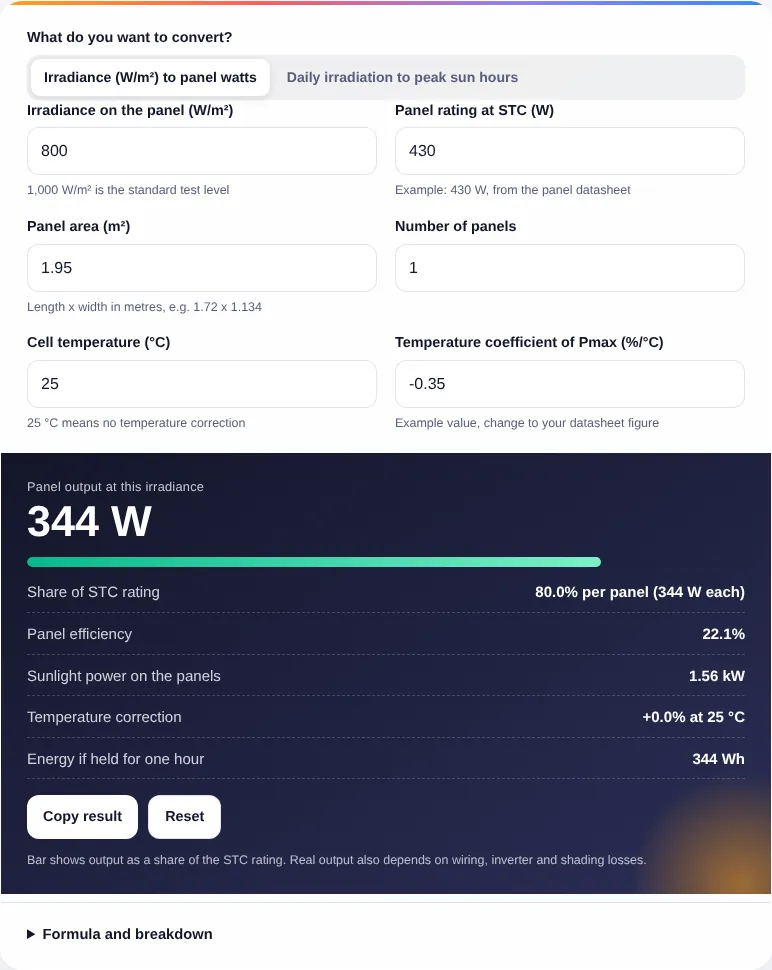
Bar shows output as a share of the STC rating. Real output also depends on wiring, inverter and shading losses.
Formula and breakdown
n/a
n/a
n/a
This solar irradiance calculator turns a sunlight reading in W/m² into the watts a solar panel or array will produce, and converts daily, monthly or yearly irradiation in kWh/m² or MJ/m² into peak sun hours and system output, for homeowners, installers and students in the UK, Ireland, Europe and beyond. It uses the panel’s own datasheet rating, so the answer fits the module you actually have.
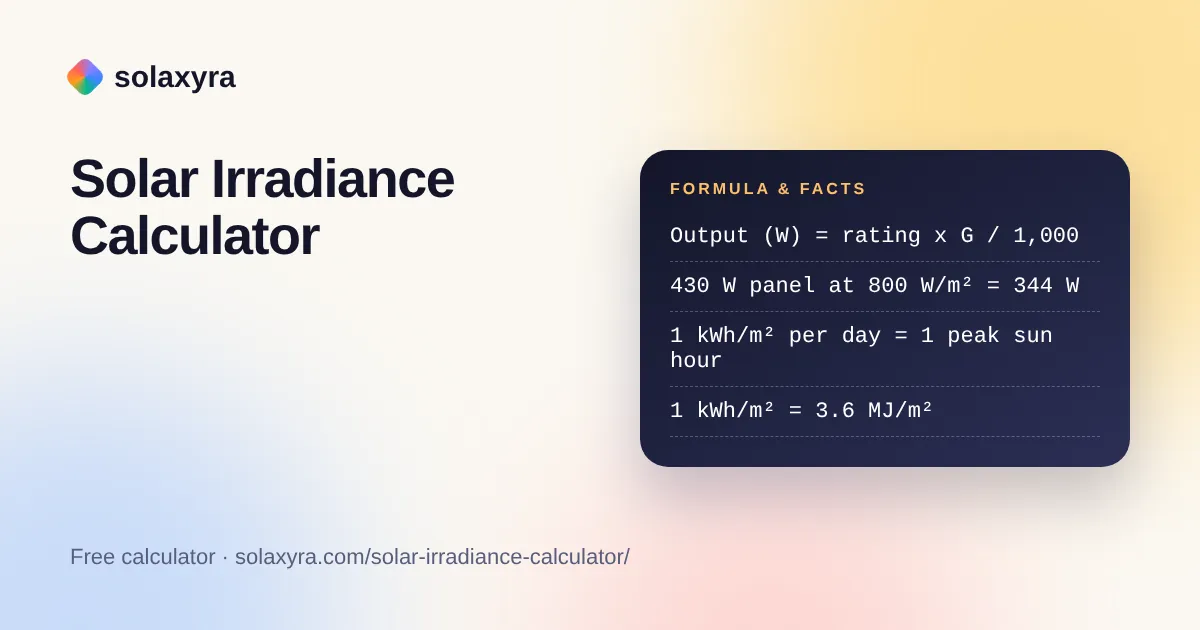
Quick answer: A solar irradiance calculator scales a panel’s rating by the sunlight reaching it: output in watts equals the STC rating times irradiance divided by 1,000 W/m². A 430 W panel under 800 W/m² gives about 344 W before heat losses. Daily irradiation in kWh/m² equals peak sun hours.
What Is a Solar Irradiance Calculator?
A solar irradiance calculator is a tool that converts the strength of sunlight on a surface, measured in watts per square metre, into the electrical power a photovoltaic panel delivers, and converts sunlight energy over a day or year into peak sun hours. In plain words: panel output equals the panel rating multiplied by the irradiance divided by 1,000, then adjusted for cell temperature.
The Wikipedia article on solar irradiance defines irradiance as the power per unit area received from the Sun, in W/m², and irradiation (or insolation) as that power integrated over time, which the solar industry usually gives in kWh/m². Panel ratings are measured at standard test conditions (STC): 1,000 W/m², a cell temperature of 25 °C and an air mass 1.5 spectrum. Because output rises almost in proportion to irradiance, a panel under 500 W/m² gives roughly half its rating.
How Do You Use the Solar Irradiance Calculator?
- Pick the mode: irradiance to panel watts, or daily irradiation to peak sun hours.
- For panel watts, enter the irradiance on the panel surface from a meter, a monitoring system or a model.
- Enter the panel’s STC rating and its area in square metres (length times width from the datasheet), and the number of panels.
- Optionally enter a cell temperature and the datasheet temperature coefficient of Pmax to correct for heat.
- For peak sun hours, enter irradiation in any of five units, then your system size in kWp and a performance ratio.
- Open the formula breakdown to check every step, and copy the result if you need it for a quote or report.
How Do You Convert W/m² to Watts?
Multiply the panel’s STC rating by the irradiance and divide by 1,000: a 430 W panel at 600 W/m² delivers 430 x 600 / 1,000 = 258 W at 25 °C. The same answer comes from the physical route of area x efficiency x irradiance. A 1.95 m² panel rated 430 W has an efficiency of 430 / 1,950 = 22.05%, and 1.95 x 0.2205 x 600 = 258 W.
Cell temperature then trims the result. Each degree above 25 °C reduces output by the temperature coefficient, often printed as a negative percentage per °C on the datasheet. The article on photovoltaic nominal power notes that real conditions can give roughly 15% to 20% less than the rating because the cells heat up. For a closer look at heat losses, use our solar panel temperature loss calculator, which estimates cell temperature from air temperature.
| Irradiance on panel | 430 W panel at 25 °C | Same panel at 45 °C (example coefficient minus 0.35%/°C) |
|---|---|---|
| 100 W/m² | 43 W | 40 W |
| 200 W/m² | 86 W | 80 W |
| 400 W/m² | 172 W | 160 W |
| 600 W/m² | 258 W | 240 W |
| 800 W/m² | 344 W | 320 W |
| 1,000 W/m² | 430 W | 400 W |
The table assumes output scales in direct proportion to irradiance. If your panel maker publishes a low-light efficiency figure or curve, use it for readings well below 1,000 W/m², where the simple model is least precise.
How Do You Convert kWh/m² per Day to Peak Sun Hours?
The number is the same: 1 kWh/m² per day equals one peak sun hour, because a peak sun hour is one hour at 1,000 W/m². A site that receives 3.2 kWh/m² on the panel plane in a day has 3.2 peak sun hours, even though the sun was above the horizon for far longer at lower strength.
Data sources use different units, which is where errors creep in. Yearly totals in kWh/m² divide by 365 for the daily average, monthly totals divide by the days in the month, MJ/m² divide by 3.6, and Wh/m² divide by 1,000. The solar irradiance calculator handles all of these and then multiplies by your system size and performance ratio to estimate kWh.
| Daily irradiation (kWh/m²) | Peak sun hours | MJ/m² per day | Yearly at this average (kWh/m²) | 4 kWp system, 80% performance ratio (kWh per day) |
|---|---|---|---|---|
| 1 | 1 | 3.6 | 365 | 3.2 |
| 2 | 2 | 7.2 | 730 | 6.4 |
| 3 | 3 | 10.8 | 1,095 | 9.6 |
| 4 | 4 | 14.4 | 1,460 | 12.8 |
| 5 | 5 | 18.0 | 1,825 | 16.0 |
| 6 | 6 | 21.6 | 2,190 | 19.2 |
Where Do You Get Irradiance Data for Your Site?
For locations in Europe and most of the world, PVGIS from the European Commission’s Joint Research Centre is the free reference: it gives monthly and yearly irradiation for any point except the poles, on horizontal or tilted surfaces. Use the in-plane figure for your tilt and azimuth, not the horizontal one, because the sunlight a tilted roof receives differs from the flat-ground figure.
For live readings, an irradiance sensor (pyranometer or reference cell) mounted at the same angle as the panels is the most direct source. Many inverters and monitoring platforms log this, and comparing measured watts with the solar irradiance calculator’s figure is a quick health check on an array. To set the tilt that collects the most sunlight, see our solar panel angle calculator.
What Do GHI, DNI and DHI Mean?
GHI, global horizontal irradiance, is the total sunlight on a flat horizontal surface; DNI, direct normal irradiance, is the direct beam measured square to the sun; and DHI, diffuse horizontal irradiance, is light scattered by the sky onto a flat surface. Weather and solar databases often report all three. For a panel you need the plane-of-array value, sometimes called global tilted irradiance, which combines the beam, diffuse and ground-reflected parts for your exact angle.
Above the atmosphere the average is the solar constant of about 1,361 W/m². Air, water vapour, dust and cloud absorb and scatter part of it, so clear-sky sunlight at sea level peaks around 1,000 W/m², which is why STC uses that figure.
How Much Power Does a Panel Make From Irradiance Over a Year?
Yearly output equals system kWp x yearly in-plane irradiation in kWh/m² (which equals yearly peak sun hours) x performance ratio. A 4 kWp array receiving 1,100 kWh/m² a year with an 80% performance ratio produces about 4 x 1,100 x 0.8 = 3,520 kWh. The performance ratio here is an example value; it bundles inverter, cable, temperature, soiling and mismatch losses and varies by system. Our solar panel output calculator and kWh per kWp calculator take this further with country yields.
Worked Example: Checking a Roof Array Against an Irradiance Reading
Example: a roof array of ten 430 W panels, each 1.95 m², and a monitoring sensor showing 700 W/m² on the panel plane on a spring afternoon. The estimated cell temperature is 40 °C and the datasheet temperature coefficient is minus 0.35% per °C.
- Output at 25 °C per panel: 430 x 700 / 1,000 = 301 W.
- Temperature factor: 1 + (minus 0.0035 x 15) = 0.9475.
- Corrected output per panel: 301 x 0.9475 = 285.2 W, so the array should make about 2.85 kW DC.
- If the inverter shows much less, for example 2.2 kW, check for shading, dirt, a failed string or a fault, and ask the installer to investigate.
The same array, 4.3 kWp, on a day with 3.5 kWh/m² of in-plane irradiation and an example 80% performance ratio, would produce about 4.3 x 3.5 x 0.8 = 12.04 kWh. Any electrical checks on a live array, including opening isolators or combiner boxes, should be left to a qualified electrician or the installer, and in the UK work must meet BS 7671.
Frequently Asked Questions
What is the difference between irradiance and irradiation?
Irradiance is power: the sunlight arriving on each square metre at one moment, in W/m². Irradiation, also called insolation, is energy: irradiance added up over a period, in kWh/m² per day, month or year. Panels respond to irradiance; yearly generation follows irradiation.
How do I convert W/m² to watts from a solar panel?
Multiply the panel’s STC rating by the irradiance and divide by 1,000. A 430 W panel at 600 W/m² gives 430 x 600 / 1,000 = 258 W. You get the same answer from panel area x efficiency x irradiance. Then apply the temperature coefficient for cell heating.
Is 1 kWh/m² per day the same as one peak sun hour?
Yes. A peak sun hour is defined as one hour at 1,000 W/m², which delivers 1 kWh/m². So a site receiving 3.2 kWh/m² on the panel surface in a day has 3.2 peak sun hours, even if the sun was up for twelve hours at lower strength.
Why does my panel make less than irradiance x rating suggests?
The rating assumes cells at 25 °C, but in sun they run much hotter, which cuts output by the temperature coefficient for each degree. Inverter conversion, cable losses, dirt, shading and mismatch take more. A performance ratio, entered as a percentage, covers these together; check your inverter and installer figures.
Where can I find irradiation data for my location?
PVGIS, the free tool run by the European Commission’s Joint Research Centre, gives monthly and yearly irradiation for almost any location in the world, on horizontal or tilted surfaces. Enter your coordinates, tilt and azimuth and copy the in-plane figure into this solar irradiance calculator.
What is the solar constant and why is ground irradiance lower?
The solar constant is about 1,361 W/m², the average sunlight above the atmosphere at Earth’s distance from the Sun. Air, water vapour, dust and clouds absorb and scatter part of it, so clear-sky sunlight at sea level peaks at around 1,000 W/m².
Checked October 2026 by the Solaxyra Editorial Team. Sources: Wikipedia: Solar irradiance, Wikipedia: Nominal power (photovoltaic), European Commission JRC: PVGIS.