n/a
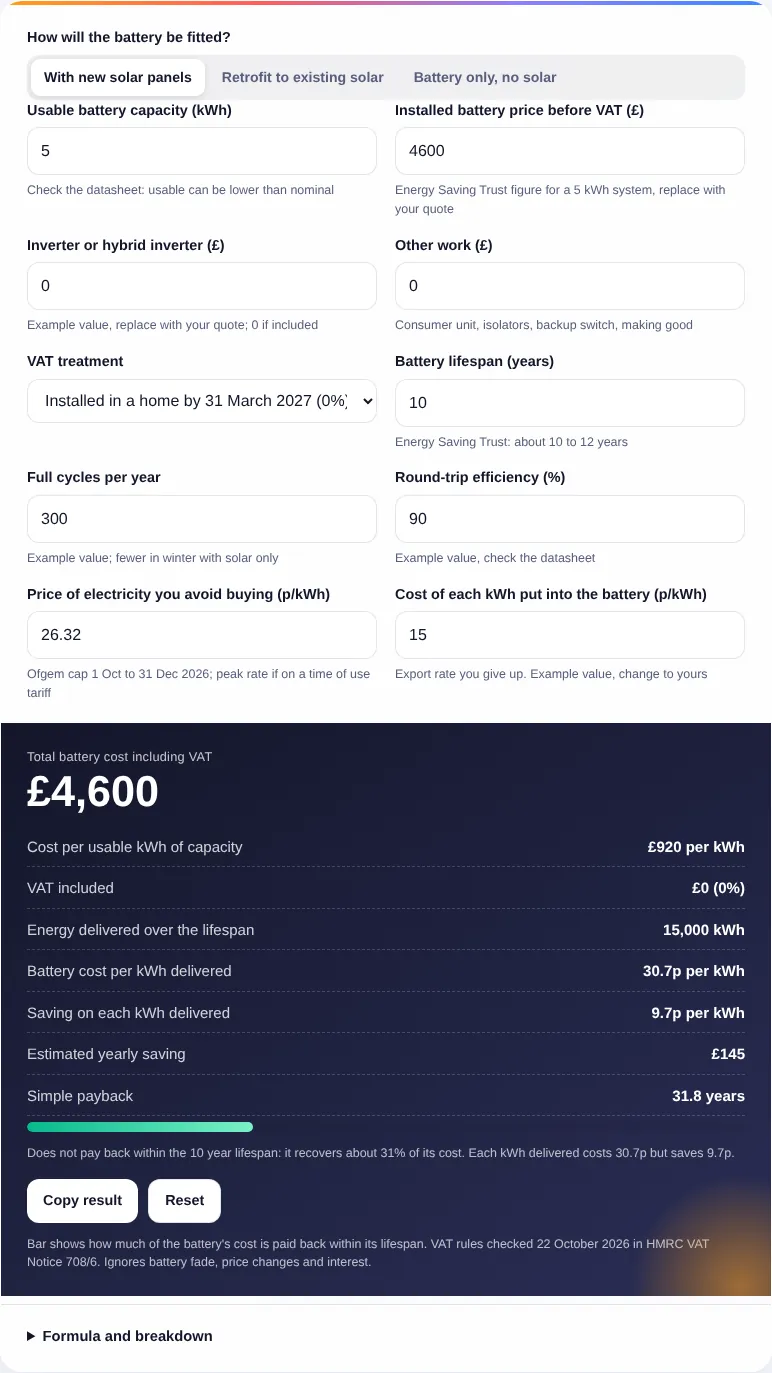
Bar shows how much of the battery’s cost is paid back within its lifespan. VAT rules checked 22 October 2026 in HMRC VAT Notice 708/6. Ignores battery fade, price changes and interest.
Formula and breakdown
n/a
n/a
n/a
This solar battery cost calculator shows what a home battery will cost you in the UK once VAT, an inverter and other work are added, then turns that price into a cost per kWh of capacity and per kWh actually delivered, so you can see whether the battery can pay for itself. It suits homeowners adding a battery with new solar panels, retrofitting one to an existing system, or fitting one without solar.
Quick answer: The Energy Saving Trust says home batteries range from £1,500 to £10,000 and a 5 kWh system costs around £4,600. Installed in a home before 1 April 2027 it carries 0% VAT. The solar battery cost calculator shows that price works out at about 31p per kWh delivered over a 10 year life.
What Is a Solar Battery Cost Calculator?
A solar battery cost calculator is a tool that adds up the installed price of a home battery, applies the correct VAT rate and divides the total by the battery's usable capacity and by the energy it will deliver over its life. In plain words: total cost equals battery plus inverter plus other work plus VAT; cost per kWh delivered equals total cost divided by usable kWh times cycles per year times years of life.
The second figure is the one most price guides leave out. A battery does not create energy; it moves electricity from a cheap time to an expensive one. It only saves money if the cost of each kWh it delivers is lower than the saving on that kWh, which is why this solar battery cost calculator shows both numbers side by side.
How Do You Use the Solar Battery Cost Calculator?
- Choose how the battery will be fitted: with new solar panels, as a retrofit to existing panels, or on its own.
- Enter the usable capacity from the datasheet and the installed price from your quote, or keep the Energy Saving Trust 5 kWh figure for a first look.
- Add an inverter or hybrid inverter if your quote lists one, plus any other electrical work.
- Pick the VAT treatment that matches your installation date.
- Set lifespan, cycles per year and round-trip efficiency, then the electricity price you avoid and what each charged kWh costs you.
- Read the total, cost per kWh and payback, and open the breakdown to check each step.
How Much Does a Solar Battery Cost in the UK?
The Energy Saving Trust gives a range of £1,500 to £10,000 for home battery storage and says a 5 kWh battery system costs around £4,600, while noting that a typical home system might be 10 kWh. Its solar panels guidance gives a broader £5,000 to £8,000 for battery storage, and both pages advise getting at least three quotes from MCS certified installers.
Prices depend on capacity, brand, whether a new inverter is needed and how much electrical work the installer finds. Trade lead-generation sites publish their own price tables, but they rarely show where the numbers come from and several contradict themselves, so the solar battery cost calculator uses only the Energy Saving Trust figures as defaults. Replace the price with your quote as soon as you have one.
| Figure | Value | Source |
|---|---|---|
| Home battery storage, price range | £1,500 to £10,000 | Energy Saving Trust, battery storage advice |
| 5 kWh battery system | Around £4,600 | Energy Saving Trust, battery storage advice |
| Battery storage alongside solar | Around £5,000 to £8,000 | Energy Saving Trust, solar panels advice |
| Typical home system size | 10 kWh | Energy Saving Trust, battery storage advice |
| Typical lifespan | About 10 to 12 years | Energy Saving Trust, battery storage advice |
| VAT when installed in a home | 0% to 31 March 2027, then 5% | HMRC VAT Notice 708/6 |
Is There VAT on a Solar Battery?
No VAT is charged on a battery installed in a home in Great Britain until 31 March 2027, after which the rate returns to 5%. HMRC's VAT Notice 708/6 on energy-saving materials added electrical storage batteries to the zero rate from 1 February 2024, covering both standalone batteries that store grid electricity and batteries retrofitted to solar panels.
The relief applies to installation and to materials supplied by the business that fits them. A battery bought without installation is standard rated at 20%, so a DIY purchase loses the relief. On the £4,600 example, 5% VAT would add £230 and 20% would add £920.
What Does a Battery Cost per kWh Delivered?
A 5 kWh battery costing £4,600 that completes 300 full cycles a year for 10 years delivers 15,000 kWh, which works out at about 30.7p for each kWh it supplies. That is more than the 26.32p per kWh Ofgem price cap unit rate for 1 October to 31 December 2026, before counting what it costs to charge the battery.
The table, built with the solar battery cost calculator, shows how the cost per kWh delivered changes with use and life for the same £4,600, 5 kWh battery. More cycles and a longer life spread the price over more energy.
| Full cycles per year | 10 year life | 12 year life |
|---|---|---|
| 200 | 46.0p per kWh | 38.3p per kWh |
| 300 | 30.7p per kWh | 25.6p per kWh |
| 365 | 25.2p per kWh | 21.0p per kWh |
The 10 and 12 year lives come from the Energy Saving Trust; the cycle counts are examples. Real batteries also lose some capacity with age, so treat these as best case figures and check your battery's warranty for its guaranteed throughput.
How Long Does a Solar Battery Take to Pay Back?
With the defaults, a £4,600 battery saves about £145 a year and takes about 32 years to pay back, longer than its life. The saving on each kWh is the price you avoid minus what it cost to put that kWh in, divided by round-trip efficiency: 26.32p minus 15p divided by 0.9 gives about 9.7p.
Payback improves when the gap between the charging cost and the avoided price is wide. Charging from the grid at an example off-peak rate of 7p raises the saving to about 18.5p per kWh, £278 a year, and cuts payback to about 16.5 years. For a full model of time of use tariffs and solar storage, use the home battery savings calculator, and to check what size you need, the solar battery size calculator. To break even within 10 years at a 9.7p saving, this 5 kWh battery would need to cost no more than about £1,450.
What Makes Battery Prices Vary?
The biggest factors are usable capacity, whether you need a new or hybrid inverter, and the electrical work at your property. Adding a battery at the same time as new panels can share the inverter and the installer's visit, while a retrofit to an older system may need a separate inverter, which is why the solar battery cost calculator gives it its own line.
Usable capacity matters more than the number on the box. Some batteries reserve part of their capacity, so always divide the price by the usable kWh on the datasheet, not the nominal figure. Our Ah to kWh calculator converts a capacity given in amp hours.
Who Can Install a Home Battery?
A home battery connects to your mains wiring, so it must be installed by a qualified electrician and the work must meet BS 7671; in England and Wales, Part P of the Building Regulations applies to electrical work in homes. The Energy Saving Trust advises getting quotes from MCS certified installers and talking to an experienced professional about where the battery should go.
Lithium batteries store a lot of energy in a small space. Never open a battery case, move a fitted unit yourself or connect one to a socket or consumer unit without a qualified installer. You can read more in the Energy Saving Trust guide to solar battery storage.
Worked Example: Retrofitting a Battery to Existing Solar Panels
Example: a semi-detached house in Bristol already has solar panels and gets a quote for a 5 kWh usable battery at £4,600 plus a £1,000 hybrid inverter, installed in January 2027. The household exports surplus solar under a Smart Export Guarantee tariff at an example rate of 15p per kWh and pays the price cap rate of 26.32p for electricity it imports. These prices are example values, not a real quote.
- Total cost: £4,600 + £1,000 = £5,600. VAT is 0% because the battery is installed in a home before 1 April 2027.
- Cost per usable kWh: £5,600 / 5 = £1,120.
- Lifetime energy: 5 kWh x 300 cycles x 10 years = 15,000 kWh. Cost per kWh delivered: £5,600 / 15,000 = 37.3p.
- Saving per kWh: 26.32p minus 15p / 0.9 = 9.65p. Yearly saving: 5 x 300 x 9.65p = £145.
- Simple payback: £5,600 / £145 = about 38.7 years, so at these prices the battery recovers about 26% of its cost in 10 years.
The result does not mean a battery is never worth it, only that this example relies on more than bill savings. Backup power, a wider time of use price gap or a cheaper quote would change the answer, and the solar battery cost calculator lets you test each one.
Frequently Asked Questions
How much does a solar battery cost in the UK?
The Energy Saving Trust gives a range of £1,500 to £10,000 and says a 5 kWh battery system costs around £4,600. Your price depends on usable capacity, whether you need a new inverter and the electrical work at your home, so always compare at least three quotes.
Is there VAT on solar batteries?
Not on a battery installed in a home in Great Britain until 31 March 2027. HMRC has zero rated installed batteries since 1 February 2024, including retrofits and standalone batteries. The rate becomes 5% from 1 April 2027, and a battery bought without installation is charged at 20%.
What is a good price per kWh for a home battery?
Compare quotes on cost per usable kWh, but also on cost per kWh delivered. At the Energy Saving Trust 5 kWh figure of £4,600, capacity costs £920 per kWh and each kWh delivered over 10 years at 300 cycles a year costs about 30.7p.
How long do solar batteries last?
The Energy Saving Trust puts the typical lifespan at about 10 to 12 years. Capacity falls gradually with use, so check the warranty for its years, guaranteed capacity at the end and total energy throughput, and use the lifespan field in the calculator to test both ends of the range.
Can I add a battery to my existing solar panels?
Yes. A battery can be retrofitted to most solar systems, and the zero VAT rate covers retrofits. You may need a new or hybrid inverter, which adds to the cost, so ask the installer to list it separately and enter it in the inverter field.
Does this solar battery cost calculator include savings?
Yes, as a simple estimate. It multiplies usable capacity by cycles per year by the saving on each kWh, after round-trip losses, and divides the total cost by that yearly saving. It ignores battery fade, price changes and interest, so treat payback as a guide.
Checked October 2026 by the Solaxyra Editorial Team. Sources: Energy Saving Trust: Solar panel battery storage, Energy Saving Trust: Solar panels, HMRC VAT Notice 708/6, Ofgem: Energy price cap 1 October to 31 December 2026.