Sizing estimate only. Battery and inverter wiring should be installed or checked by a qualified electrician; a mains supply to a shed is notifiable work under Part P in England.
Formula and breakdown
n/a
n/a
n/a
n/a
n/a
This shed solar calculator sizes the solar panels, battery, inverter and charge controller for a garden shed, workshop or garden office in the UK and Ireland, starting from the things you actually plug in, and shows what the same electricity would cost from the mains.
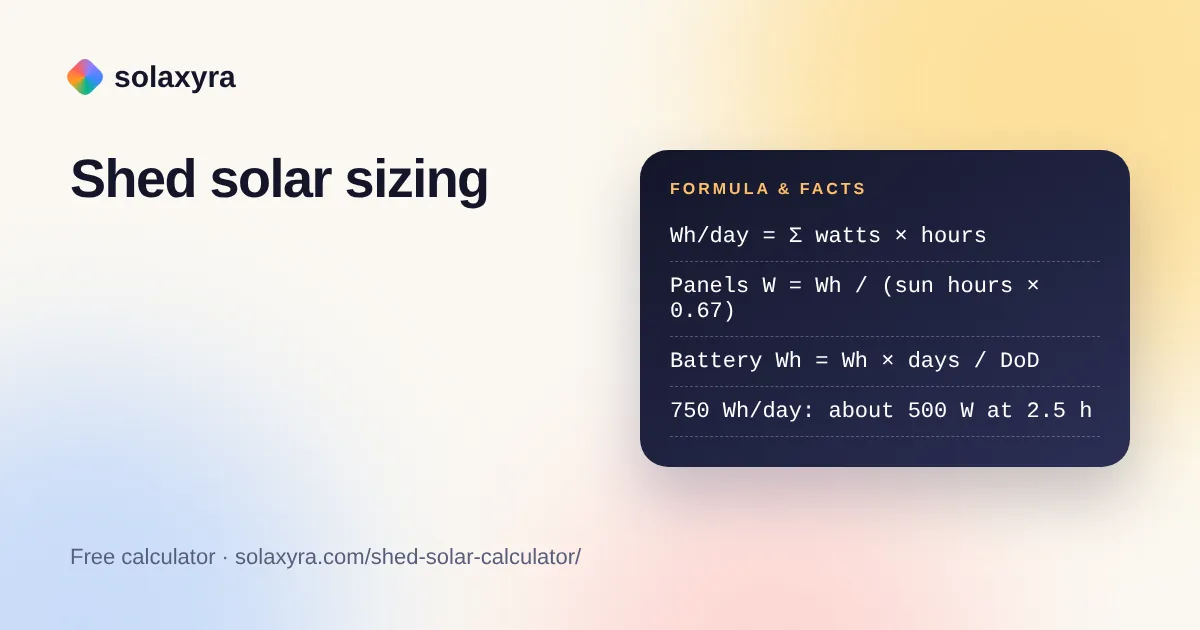
Quick answer: A shed solar calculator adds up watts × hours for each load, allows for inverter losses, then divides by peak sun hours and a 0.67 off-grid performance ratio to size the panels. A garden office using 750 Wh a day needs about 500 W of panels at an example 2.5 sun hours and a 2.1 kWh battery for two days.
What Is a Shed Solar Calculator?
A shed solar calculator is a tool that turns a list of shed appliances into the size of a stand-alone solar system that can power them. In plain words: multiply each appliance's watts by the hours it runs to get watt-hours a day, add a little for inverter losses, divide by peak sun hours and system losses to get panel watts, and multiply daily use by the days of backup you want, divided by the usable share of the battery, to get battery size.
The system losses figure matters. The PVGIS user manual from the EU Joint Research Centre uses a performance ratio of 0.67 for a whole off-grid system, because energy passes through a charge controller, a battery and often an inverter before you use it. It also sets a default battery cut-off of 40% for lead-acid and suggests 20% for lithium, which is where the shed solar calculator's 60% and 80% usable depth of discharge come from.
How Do You Use the Shed Solar Calculator?
- Enter the watts and daily hours for each item. Start with the defaults for a garden office and change them to match your kit.
- Only add a heater or power tool if you really plan to run it from solar; the shed solar calculator will warn you when it dominates.
- Enter peak sun hours for the darkest month you need the shed to work. Use PVGIS for your location and panel tilt.
- Keep the 67% performance ratio, set the days of backup, and pick lithium (80%) or lead-acid (60%) depth of discharge.
- Enter your inverter efficiency and the panel size you plan to buy.
- Choose 12 V, 24 V or 48 V and read the results. The formula breakdown shows every step.

How Many Solar Panels Do You Need for a Shed?
A garden office using 750 Wh a day needs about 500 W of panels at an example 2.5 peak sun hours, but about 2,100 W at 0.6 sun hours, so the month you design for matters more than anything else. The table shows the same office (laptop, monitor, lights, router and a fan, 833 Wh a day from the battery after a 90% efficient inverter) with 400 W panels at different example sun hours.
| Peak sun hours (example) | Minimum array | 400 W panels | Fitted |
|---|---|---|---|
| 4.0 | 311 W | 1 | 400 W |
| 2.5 | 498 W | 2 | 800 W |
| 1.5 | 829 W | 3 | 1,200 W |
| 1.0 | 1,244 W | 4 | 1,600 W |
| 0.6 | 2,073 W | 6 | 2,400 W |
These sun-hour values are examples to show the scale of change, not measurements for a particular place. Read your own monthly figures from PVGIS. Panel tilt and shading from trees, fences and the house also matter a great deal on a low shed roof; the solar panel angle calculator shows how a steeper tilt helps in winter.
What Can You Run From Solar in a Shed?
LED lights, phone and laptop charging, a monitor, a router and a small fan are all easy loads for a shed system, while kettles, heaters and large power tools are not. The table compares typical setups using the shed solar calculator's method at an example 2.5 sun hours, two days of backup and a lithium battery.
| Shed setup (example) | Load per day | Minimum array | Battery | Same energy from mains per year |
|---|---|---|---|---|
| Lights only (20 W, 5 h) | 100 Wh | 66 W | 278 Wh | 36 kWh, about £10 |
| Lights, radio and phone charging | 240 Wh | 159 W | 667 Wh | 88 kWh, about £23 |
| Garden office (calculator defaults) | 750 Wh | 498 W | 2.1 kWh | 274 kWh, about £72 |
| Workshop with 1.5 kW tools for 1 hour | 1,600 Wh | 1,061 W | 4.4 kWh | 584 kWh, about £154 |
| Garden office plus 1 kW heater for 2 hours | 2,750 Wh | 1,824 W | 7.6 kWh | 1,004 kWh, about £264 |
Mains costs use the Ofgem price cap average of 26.32p per kWh for 1 October to 31 December 2026. Power tools also need an inverter with enough surge capacity to start their motors; check the shed solar calculator's rating plate and the inverter datasheet. For an appliance-by-appliance view, the appliance solar panel calculator and the power station runtime calculator are useful companions.
What Size Battery and Inverter Does a Shed Need?
Battery capacity = daily watt-hours × days of backup ÷ usable depth of discharge, and the inverter must cover every load that can run at once with some headroom. For the default garden office that is 833 Wh × 2 ÷ 0.8 = 2,083 Wh, or about 87 Ah at 24 V. The calculator adds 25% headroom to the inverter as an example; motors and compressors need a separate check of surge power.
Battery voltage decides the current. With the calculator's 25% margin, the same 800 W of panels needs a controller of about 42 A at 24 V but 83 A at 12 V, so a 12 V system needs heavier cable and a larger controller. For bigger banks or mixed battery types, the battery bank size calculator covers series and parallel layouts, and the off-grid solar calculator handles cabins and homes.
Is Solar or a Mains Supply Better for a Garden Office?
For a garden office used all year, a mains supply is often simpler, while solar suits sheds far from the house, seasonal use or light loads. The energy itself is cheap: the default office uses about 274 kWh a year, about £72 from the mains at the cap rate. The real comparison is the price of a solar kit, battery and inverter against the price of a properly installed cable from the house, so get quotes for both.
A mains supply to a shed is fixed electrical work, not DIY. The Approved Document P guidance on GOV.UK states that Part P applies to installations in outbuildings such as sheds and detached garages, and that installing a new circuit is notifiable work in England. It must be designed and installed to BS 7671 by a registered electrician, or notified to building control. Solar systems with batteries and inverters should also be installed or checked by a qualified electrician. Wales, Scotland and Northern Ireland have their own building regulations, and planning rules for panels on outbuildings vary, so check with your local planning authority before you buy.
Worked Example: A Garden Office in Bristol
Example: a garden office in Bristol is used on weekdays from spring to autumn. It has two 10 W LED lights for 5 hours, a 60 W laptop and a 25 W monitor for 6 hours, a 10 W router and charger for 8 hours and a 30 W fan for 2 hours. The owner wants it to work in October and March, and for this example assumes 2.5 peak sun hours for a 30 degree south-facing panel, to be checked in PVGIS.
- Daily load: 100 + 360 + 150 + 80 + 60 = 750 Wh. With a 90% inverter, 833 Wh comes from the battery.
- Array: 833 ÷ (2.5 × 0.67) = 498 W, so two 400 W panels.
- Battery for two dull days with lithium: 833 × 2 ÷ 0.8 = 2,083 Wh, about 87 Ah at 24 V.
- Inverter: 145 W of loads × 1.25 = 181 W continuous; a 300 W to 500 W pure sine inverter leaves room for a printer.
- Controller: 800 W ÷ 24 V × 1.25 = 42 A, so a controller of that output or more.
- Mains comparison: 274 kWh a year, about £72 at 26.32p per kWh.
In this example the solar kit is modest because the loads are light and winter use is not needed. Adding a 1 kW heater for two hours a day would more than triple the system, which is when a mains supply makes more sense.
Frequently Asked Questions
Can solar panels power a garden office all year?
Lights, a laptop, a monitor and a router can run from a modest system for most of the year. In midwinter UK sun hours fall so far that the same loads need several times more panels, so many owners accept a generator, a portable power station or a mains supply for December and January.
Can a shed solar system run an electric heater?
Technically yes, but it is rarely sensible. A 1,000 W heater for two hours uses 2 kWh a day, more than double a typical office load, and that demand peaks exactly when solar output is lowest. Insulation and a mains supply are usually better answers for heating.
What battery voltage should a shed system use?
12 V suits small lighting and charging systems. Once the array passes a few hundred watts, 24 V halves the current and lets you use thinner cable and a smaller controller; 48 V suits larger systems with bigger inverters. The calculator shows the controller current at each voltage.
Do I need an electrician for shed solar?
A small self-contained kit with plug-in appliances may need none, but batteries, inverters and fixed wiring should be installed or checked by a qualified electrician. In England, a new mains circuit to a shed is notifiable work under Part P of the Building Regulations and must meet BS 7671.
Is it cheaper to run mains power to a shed?
The running cost of mains electricity is usually small for an office load: 274 kWh a year costs about £72 at the October 2026 price cap. The real comparison is the cost of a solar kit against the cost of a cable installation, so get quotes for both.
What peak sun hours should I use for a shed in the UK?
Use the figure for the darkest month you want the system to work, from the free PVGIS tool for your location, tilt and direction. Summer months give several times the energy of midwinter, so a year-round system sized on an annual average will fall short in winter.
Checked October 2026 by the Solaxyra Editorial Team. Sources: PVGIS user manual, European Commission JRC, Approved Document P (GOV.UK), Ofgem price cap October to December 2026.