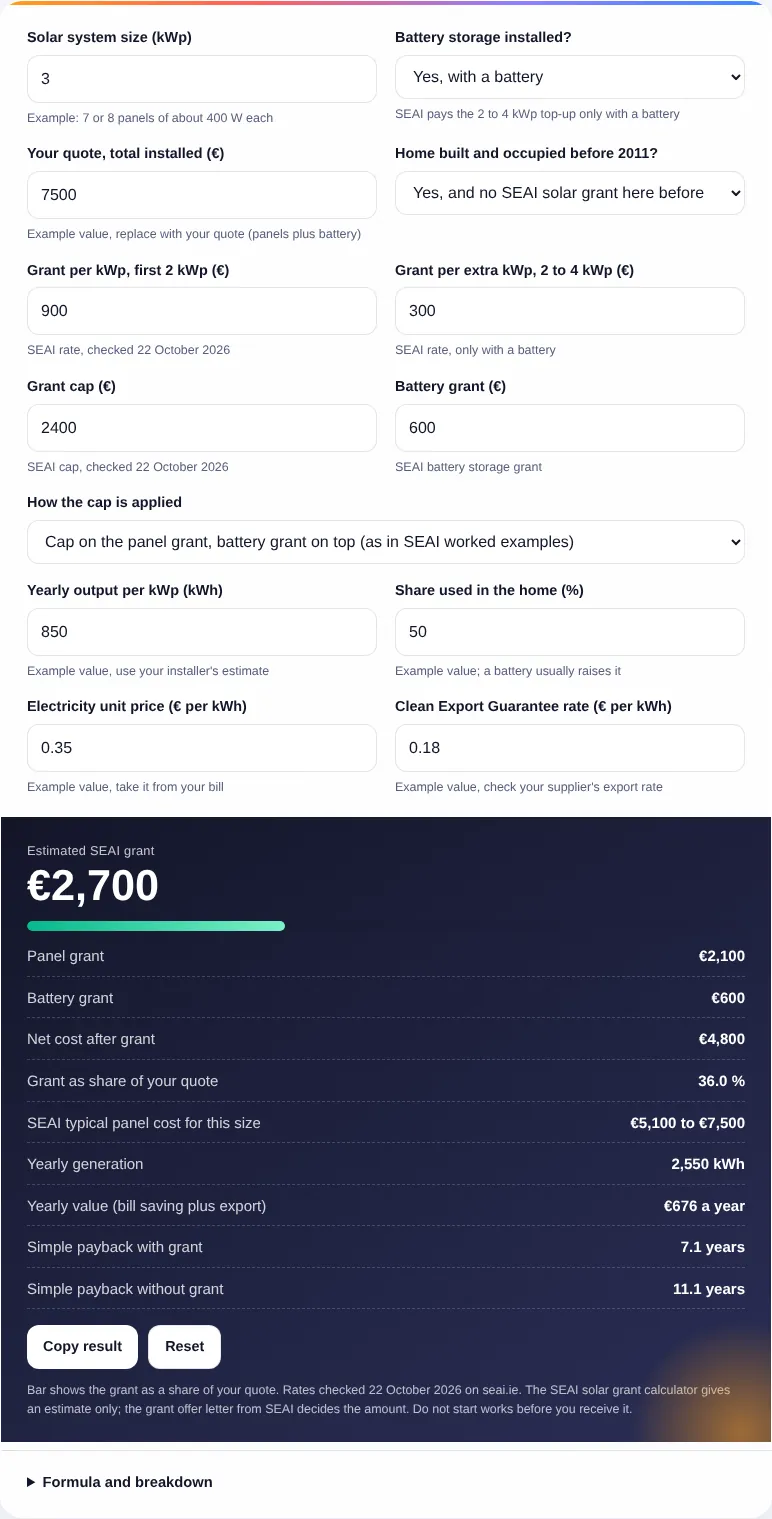
Bar shows the grant as a share of your quote. Rates checked 22 October 2026 on seai.ie. The SEAI solar grant calculator gives an estimate only; the grant offer letter from SEAI decides the amount. Do not start works before you receive it.
Formula and breakdown
n/a
n/a
n/a
n/a
This seai solar grant calculator estimates the Sustainable Energy Authority of Ireland grant for a home solar PV system, the net cost after the grant and the simple payback once your bill savings and Clean Export Guarantee payments are counted. It is built for homeowners in Ireland comparing installer quotes, and every rate is editable so you can match it to your grant offer.
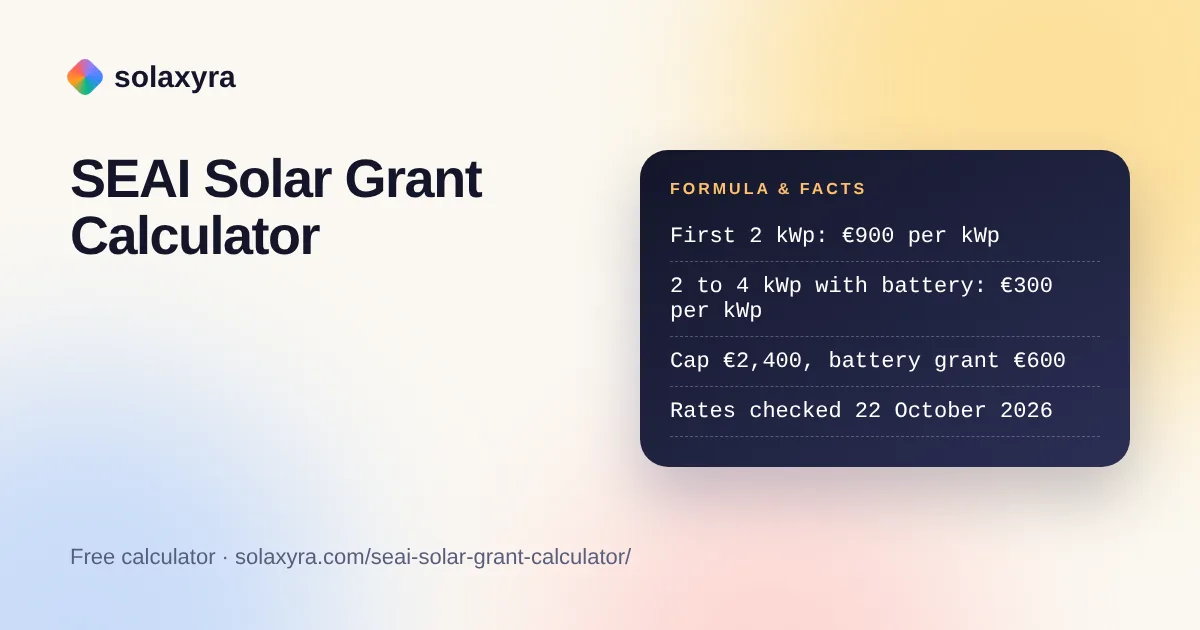
Quick answer: An SEAI solar grant calculator works out the Irish home solar PV grant from system size and battery choice. SEAI pays €900 per kWp for the first 2 kWp and €300 per extra kWp up to 4 kWp when a battery is fitted, capped at €2,400, plus a €600 battery storage grant.
What Is an SEAI Solar Grant Calculator?
An SEAI solar grant calculator is a tool that applies the published SEAI solar electricity grant rates to the size of your system in kilowatt-peak (kWp) and tells you how much of your quote the grant covers. In plain words: grant equals the first 2 kWp times €900, plus each extra kWp up to 4 kWp times €300 if you add a battery, limited by the €2,400 cap, plus €600 for the battery.
Kilowatt-peak is the nameplate output of the panels measured under standard test conditions of 1,000 W/m² of sunlight with cells at 25 °C, as explained in the article on photovoltaic nominal power. Seven or eight panels of about 400 W make roughly 3 kWp, so you can find your kWp on any quote by adding up the panel wattages and dividing by 1,000.
How Do You Use the SEAI Solar Grant Calculator?
- Enter the system size in kWp from your quote.
- Say whether a battery is included, because the 2 to 4 kWp top-up and the battery grant depend on it.
- Type the full installed price from your quote, including any battery.
- Confirm the home was built and occupied before 2011 and has not had an SEAI solar grant before.
- Leave the grant rates as they are unless your offer letter shows different figures, and choose how the cap is applied.
- Replace the example yield, home use share, unit price and export rate with your own figures, then read the grant, net cost and payback. Open the breakdown to see each step.
How Much Is the SEAI Solar Grant in 2026?
On 22 October 2026 the SEAI page listed €900 per kWp up to 2 kWp, €300 for every additional kWp up to 4 kWp if you get a battery, a total cap of €2,400 and a separate €600 battery storage grant. A 2 kWp system without a battery therefore gets €1,800, which is also the most any system gets without a battery.
The page also gives two worked figures: €2,100 for 3 kWp of panels plus €600 for the battery, and €2,400 for 4 kWp of panels plus €600 for the battery. Those examples add the battery grant on top of the €2,400 panel figure, while the same page describes €2,400 as the total cap. Because the two readings differ by up to €600, the SEAI solar grant calculator lets you pick either one. The SEAI solar electricity grant page and your grant offer letter are the final word.
| System size | Grant, no battery | Grant with battery (cap on panels, as SEAI examples) | Grant with battery (cap on total) |
|---|---|---|---|
| 1 kWp | €900 | €1,500 | €1,500 |
| 2 kWp | €1,800 | €2,400 | €2,400 |
| 2.5 kWp | €1,800 | €2,550 | €2,400 |
| 3 kWp | €1,800 | €2,700 | €2,400 |
| 3.5 kWp | €1,800 | €2,850 | €2,400 |
| 4 kWp or more | €1,800 | €3,000 | €2,400 |
The table shows why system size above 2 kWp only changes the grant when a battery is part of the job. Without one, a 6 kWp system receives the same €1,800 as a 2 kWp system, so the extra panels must pay for themselves through savings alone.
Who Qualifies for the SEAI Solar PV Grant?
SEAI support is available to owners of homes built and occupied before 2011, provided SEAI has not already supported a solar PV system at that address. After installation the home must reach a BER of C or better, and a post-works BER is required; SEAI says its cost is included in the grant.
The order of steps matters. You get quotes from SEAI registered installers, apply and wait for the grant offer, and only then sign off the works. SEAI states that homeowners must not start works before the offer arrives, and offers are valid for eight months. Your installer applies to ESB Networks for the grid connection, which SEAI says takes at least 20 working days, and payment of the grant can take up to 6 weeks after the claim.
How Long Is the Payback After the Grant?
Simple payback equals the net cost after the grant divided by the yearly value of the electricity you use yourself plus the electricity you export. With the example inputs in the SEAI solar grant calculator, a 3 kWp system with a battery quoted at €7,500 pays back in about 7.1 years, against about 11.1 years without any grant.
Three inputs move the answer most. Yearly output per kWp depends on roof direction, tilt and shading, so take the figure from your installer’s design. The share used at home matters because self-used units save your full unit price while exported units earn the lower export rate. The self-consumption calculator helps you estimate that share, and the battery sizing tool shows how much storage your evening use needs. Export income comes from the Clean Export Guarantee, where each supplier sets its own rate, so check yours before relying on it.
Is the Quote in Line With SEAI’s Typical Cost?
SEAI gives a typical cost of €1,700 to €2,500 per kWp for solar PV, so a 3 kWp system would normally sit between €5,100 and €7,500 before any battery. The calculator shows this range for your system size next to your quote, which makes an unusually high price easy to spot before you sign.
A battery adds cost that the panel range does not include. If your quote is well above the SEAI range, ask the installer for an itemised price covering panels, inverter, battery, scaffolding and any consumer unit work. For a longer view of returns with price changes and panel ageing, the solar payback calculator adds those effects to the simple figure shown here.
Worked Example: 3 kWp With a Battery on a 1990s Semi
Example: a semi-detached house in Galway built in 1996 gets a quote of €7,500 for 3 kWp of panels and a battery. The grant is 2 kWp x €900 = €1,800, plus 1 kWp x €300 = €300 for the battery top-up, giving €2,100 for the panels, plus the €600 battery grant. The SEAI solar grant calculator shows €2,700 and a net cost of €4,800.
Using example figures of 850 kWh per kWp, 50 per cent used at home, €0.35 per kWh and an export rate of €0.18, the system makes 2,550 kWh a year. The 1,275 kWh used at home saves €446.25 and the 1,275 kWh exported earns €229.50, a total of €675.75. Payback is €4,800 / €675.75 = 7.1 years. Under the cautious cap reading the grant would be €2,400, the net cost €5,100 and payback 7.5 years.
What Should You Check Before Accepting a Quote?
Check that the installer is on the SEAI register, that the quote states kWp and battery capacity clearly, and that the price includes the grid notification and post-works BER. Confirm the battery is included in the grant application, since the 2 to 4 kWp top-up and the €600 battery grant both depend on it. Ask how the installer arrived at the yearly output figure.
Roof work and electrical work should be done by the registered installer, and you should not alter the wiring or the inverter yourself. If you want to compare panel counts against your yearly use first, the solar panel calculator gives a size from your annual kWh, and you can then return to the SEAI solar grant calculator to price the grant for that size.
Frequently Asked Questions
How much is the SEAI solar panel grant?
On 22 October 2026 SEAI listed €900 per kWp for the first 2 kWp, €300 per extra kWp up to 4 kWp when a battery is installed, a €2,400 cap and a separate €600 battery storage grant. Without a battery the most you can get is €1,800.
Do I need a battery to get the full SEAI solar grant?
Yes, under the current rates. The €300 per kWp top-up between 2 and 4 kWp is only paid if you get a battery, and the €600 battery storage grant also needs one. Without a battery the grant stops at €1,800 for 2 kWp or more.
Is the SEAI solar grant capped at €2,400 including the battery?
The SEAI page says the total grant is capped at €2,400, but its worked examples show €2,400 for 4 kWp of panels plus €600 for the battery. The calculator lets you test both readings. Your grant offer letter shows the exact amount.
Which homes qualify for the SEAI solar PV grant?
Homes built and occupied before 2011 qualify, as long as SEAI has not already supported a solar PV system at the address. The home must reach a BER of C or better after installation, and a post-works BER is required before the grant is paid.
Can I start installing before the SEAI grant is approved?
No. SEAI says homeowners must not start works until they receive the grant offer. Offers are valid for eight months, so agree a date with your installer that leaves time for the ESB Networks connection notice and the post-works BER.
How long does the SEAI grant take to pay out?
SEAI says to allow up to 6 weeks for payment after your installer submits the completion documents, with extra time if your home is selected for inspection. You normally pay the installer first, so plan your cash flow for the full quote amount.
Checked October 2026 by the Solaxyra Editorial Team. Sources: SEAI Solar Electricity Grant, Wikipedia: Nominal power (photovoltaic).