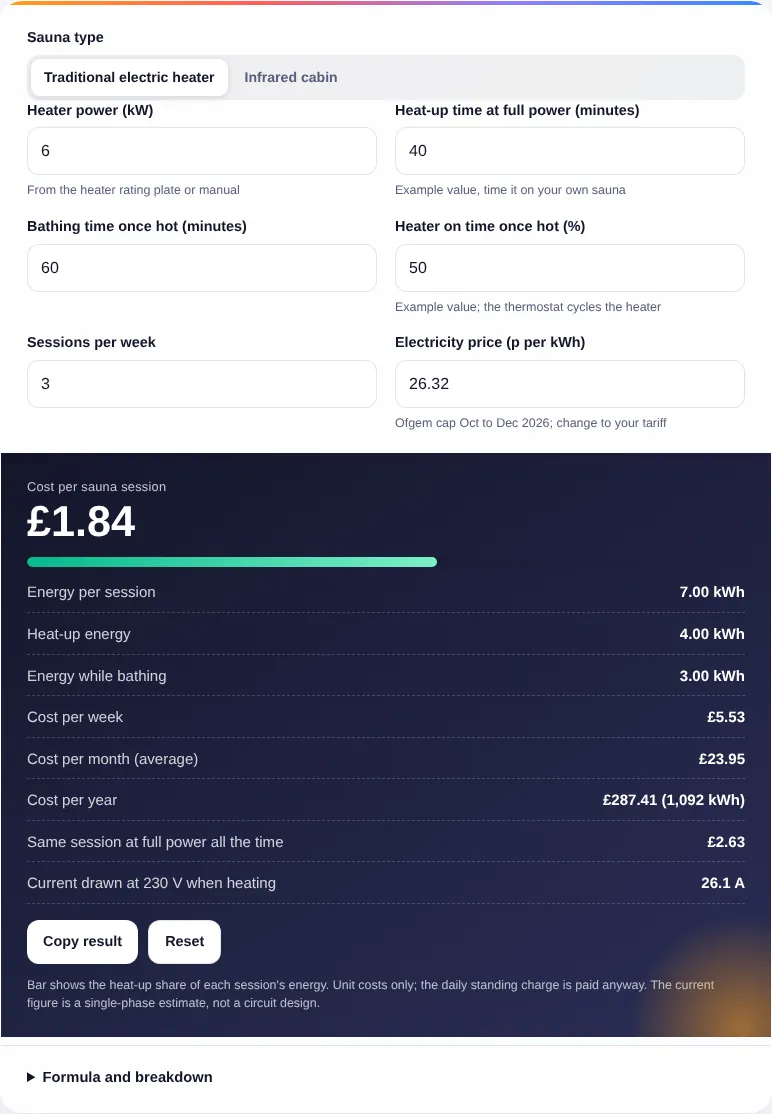
Bar shows the heat-up share of each session’s energy. Unit costs only; the daily standing charge is paid anyway. The current figure is a single-phase estimate, not a circuit design.
Formula and breakdown
n/a
n/a
n/a
This sauna running cost calculator estimates what a home sauna costs to use per session, week, month and year, for owners and buyers of traditional electric and infrared saunas in the UK and Europe. It splits each session into the heat-up, when the heater runs flat out, and the bathing time, when the thermostat switches it on and off, so the answer reflects how a sauna actually draws power.
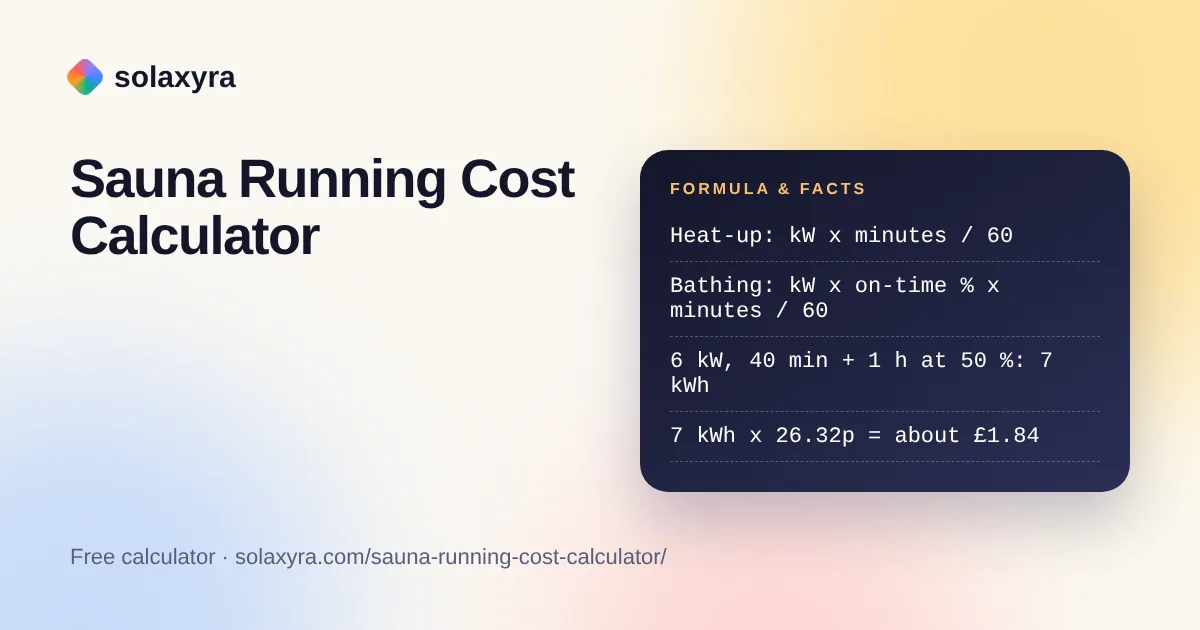
Quick answer: A sauna running cost calculator multiplies heater kW by heat-up hours, adds kW times on-time share times bathing hours, then multiplies by your unit price. A 6 kW heater with a 40-minute heat-up and an hour at 50 % on time uses 7 kWh, about £1.84 at 26.32p per kWh.
What Is a Sauna Running Cost Calculator?
A sauna running cost calculator is a tool that converts a sauna heater’s power rating, the time it takes to heat up, the length of a session and your electricity price into the cost of each use. In plain words: energy equals heater kW times heat-up hours, plus heater kW times the share of time the heater is on times bathing hours; cost equals that energy times the unit price.
Many sauna sellers multiply the full heater rating by the whole session, which overstates the bill because the thermostat cycles once the room reaches temperature. Others assume a cycling share but never show it. Here every assumption is an input you can see and change, and the result row “same session at full power all the time” shows the worst case next to the realistic one.
How Do You Use the Sauna Running Cost Calculator?
- Choose traditional electric heater or infrared cabin. Each loads its own example values.
- Enter the heater power in kW from the rating plate or manual.
- Enter how long the sauna takes to reach temperature, and how long you bathe once it is hot.
- Set the share of time the heater stays on once hot. Leave it at 100 % for a worst case.
- Enter sessions per week and your unit price in pence per kWh.
- Read the cost per session, week, month and year, and open the breakdown to see the heat-up and bathing energy separately.
How Much Does It Cost to Run a Sauna for an Hour?
A 6 kW traditional sauna costs about £1.58 for an hour at full power at 26.32p per kWh, but a typical hour of bathing after heat-up costs nearer 79p because the heater is only on part of the time.
The Which? home sauna buying guide, quoting the heater maker Harvia, says a 6 kW heater uses around 4 to 5 kWh in the first hour and 3 to 4 kWh in the following hour. The second figure equals 50 % to 67 % of the heater’s full output, which is why the sauna running cost calculator uses 50 % as its example on-time. The default traditional session, 40 minutes of heat-up and an hour of bathing, adds up to 7 kWh over 100 minutes, inside the 7 to 9 kWh that range implies for two hours.
Is an Infrared Sauna Cheaper to Run?
An infrared cabin is usually cheaper to run per session because its panels are rated at a fraction of a traditional heater’s power; a 1.5 kW cabin used for 70 minutes costs about 46p even if the panels never switch off.
Which? notes that infrared saunas run at around 45 to 60 °C against 70 to 90 °C for traditional saunas, and generally use less electricity. The infrared example in the sauna running cost calculator uses 1.5 kW, 30 minutes of warm-up and 40 minutes of use at 100 % on time, a deliberately cautious setting. Check your cabin’s manual for its real rating; larger multi-person cabins draw more.
How Much Do Different Heater Sizes Cost per Session?
The table uses the same example session for every heater, 40 minutes of heat-up at full power and 60 minutes of bathing at 50 % on time, at the Ofgem cap unit rate of 26.32p per kWh and three sessions a week. In reality a larger heater serves a larger room, so treat the rows as a comparison, not a prediction for your cabin.
| Heater power | kWh per session | Cost per session | Cost per year (3 a week) | Current at 230 V |
|---|---|---|---|---|
| 4.5 kW | 5.25 | £1.38 | £215.56 | 19.6 A |
| 6 kW | 7.00 | £1.84 | £287.41 | 26.1 A |
| 8 kW | 9.33 | £2.46 | £383.22 | 34.8 A |
| 9 kW | 10.50 | £2.76 | £431.12 | 39.1 A |
| 10.5 kW | 12.25 | £3.22 | £502.98 | 45.7 A |
The current column is power divided by 230 V for a single-phase supply. It shows why a traditional sauna heater cannot run from a plug socket and needs its own circuit. Use our kW to amps calculator for three-phase heaters, which split the load across three lines.
What Affects a Home Sauna’s Running Cost?
Heater power, heat-up time and how often you use the sauna drive most of the cost; the price you pay per kWh scales everything else. Change one input at a time in the sauna running cost calculator to see which matters most for you.
- Heat-up: a cold outdoor cabin in winter takes longer to reach temperature, and every extra minute is billed at full power.
- Target temperature and insulation: a hotter setting or a leaky door raises the on-time once hot.
- Session habits: back-to-back sessions share one heat-up, so two people bathing together cost less per person than two separate warm-ups.
- Tariff: a sauna is a large, movable load, so a cheaper off-peak or time-of-use rate can cut the bill if you can use it at those times.
To compare the sauna with other big loads in the house, run the same kWh through the electricity cost calculator or a hot tub running cost calculator.
Does a Sauna Need Its Own Electrical Circuit?
Yes, a traditional electric sauna heater needs a dedicated circuit sized for its full load, and in the UK the installation must be designed, installed and certified by a qualified electrician to BS 7671.
The wiring regulations treat rooms and cabins containing sauna heaters as a special location with extra requirements, as the overview of BS 7671 lists. In England and Wales, adding a new circuit is notifiable work under Part P of the Building Regulations. Never connect a sauna heater to an extension lead or a socket outlet unless its manual allows it, which normally applies only to small infrared cabins.
Worked Example: Three Sessions a Week in a Garden Sauna
Example: a household in Leeds has a garden barrel sauna with a 6 kW heater and pays the Ofgem cap unit rate of 26.32p per kWh. In autumn it takes 40 minutes to heat, and two people then bathe for an hour, three times a week.
- Heat-up energy = 6 kW x 40 / 60 h = 4.0 kWh.
- Bathing energy at 50 % on time = 6 kW x 0.5 x 1 h = 3.0 kWh.
- Energy per session = 7.0 kWh. Cost = 7.0 x 26.32p = 184.2p, about £1.84.
- Per week = 3 x £1.84 = £5.53. Per year = £5.53 x 52 = £287.41, or about £23.95 a month.
- Worst case at full power for all 100 minutes = 10 kWh, about £2.63 a session.
If the same household bathed for 30 minutes instead of an hour, the sauna running cost calculator shows 5.5 kWh and about £1.45 a session, because the heat-up stays the same while the bathing share halves.
Frequently Asked Questions
How many kWh does a sauna use per session?
A typical 6 kW home sauna uses about 7 kWh for a 40-minute heat-up followed by an hour of bathing, if the heater is on half the time once hot. A small 1.5 kW infrared cabin uses under 2 kWh for a similar visit.
Does a sauna heater run at full power all the time?
No. A traditional heater runs flat out while the room warms up, then its thermostat switches it on and off to hold the temperature. Figures quoted by Which? from Harvia suggest a 6 kW heater uses 3 to 4 kWh in its second hour.
Is it cheaper to heat a sauna once and share the session?
Yes. The heat-up is often the biggest single part of the energy used. When two or more people bathe in the same heated session, they share that heat-up, so the cost per person falls compared with heating the sauna separately for each.
What electricity price should I use?
Use the unit rate on your latest bill or app. The default is the Ofgem price cap average of 26.32p per kWh for direct debit from 1 October to 31 December 2026. Your standing charge is paid whether or not you use the sauna, so it is left out.
Can I plug a sauna into a normal socket?
A traditional electric sauna heater cannot run from a 13 A socket because it draws far more current, for example about 26 A for 6 kW at 230 V. Some small infrared cabins are designed for a socket; follow the manual and ask an electrician if unsure.
How can I reduce my sauna running cost?
Shorten the heat-up by keeping the door shut and checking the seals, set a slightly lower temperature, share sessions and use a cheaper off-peak rate if your tariff has one. Re-run the calculator with your new heat-up time to see the saving.
Checked October 2026 by the Solaxyra Editorial Team. Sources: Ofgem: Changes to the energy price cap between 1 October and 31 December 2026, Which?: How to buy the best home sauna, Wikipedia: BS 7671.