Formula and breakdown
n/a
n/a
n/a
This resistor colour code calculator reads 4-band and 5-band resistor colour codes and gives the resistance, tolerance and the range the real value can fall in. Pick the colours in order from the end with the bands closest together.
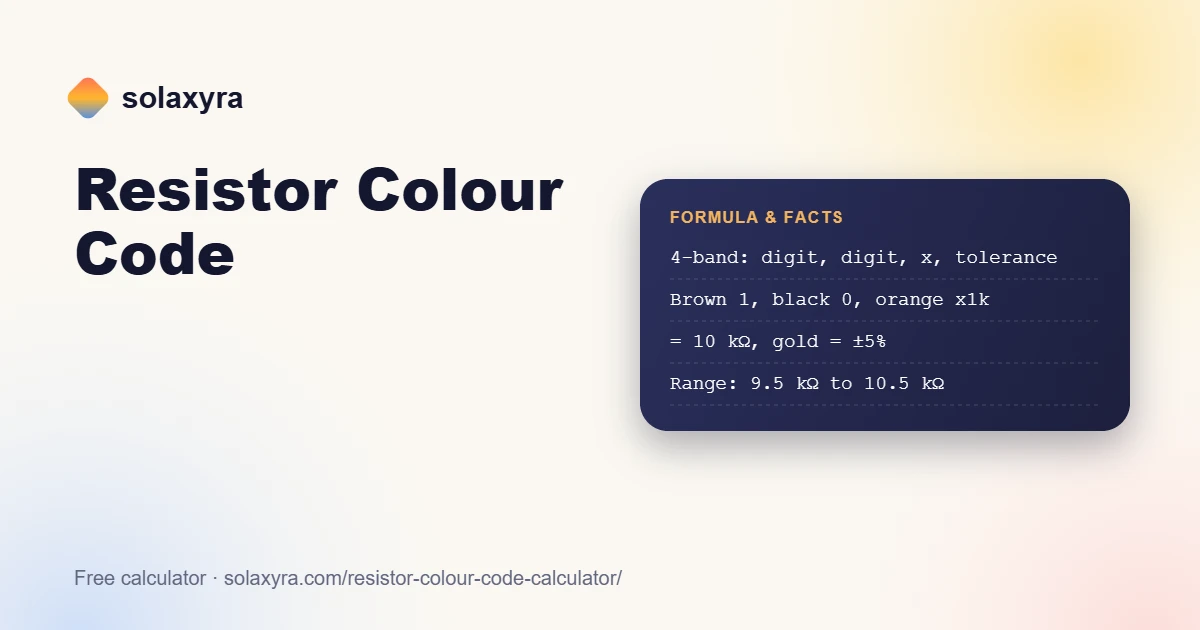
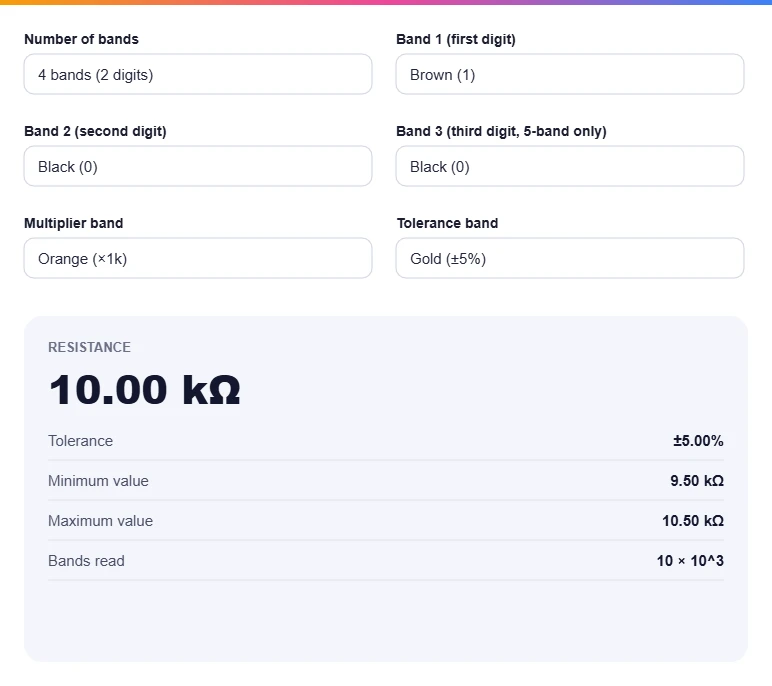
Quick answer: On a 4-band resistor, the first two bands are digits, the third is the multiplier and the fourth is the tolerance. Brown, black, orange, gold means 1, 0, × 1,000, ±5%: 10 kΩ, which can measure between 9.5 kΩ and 10.5 kΩ.
What Is a Resistor Colour Code Calculator?
A resistor colour code calculator decodes the coloured bands printed on through-hole resistors. Each colour stands for a number, and the position of the band tells you whether it is a digit, a multiplier or the tolerance. The scheme is set out in the international standard IEC 60062.
How Do You Use the Resistor Colour Code Calculator?
- Hold the resistor so the tolerance band, often gold or silver and slightly apart from the others, is on the right.
- Choose 4 or 5 bands.
- Select the colours from left to right. On a 4-band resistor, ignore the third digit field.
- Read the resistance, tolerance and the minimum and maximum values.
Resistor Colour Code Chart
| Colour | Digit | Multiplier | Tolerance |
|---|---|---|---|
| Black | 0 | ×1 | n/a |
| Brown | 1 | ×10 | ±1% |
| Red | 2 | ×100 | ±2% |
| Orange | 3 | ×1k | n/a |
| Yellow | 4 | ×10k | n/a |
| Green | 5 | ×100k | ±0.5% |
| Blue | 6 | ×1M | ±0.25% |
| Violet | 7 | ×10M | ±0.1% |
| Grey | 8 | n/a | n/a |
| White | 9 | n/a | n/a |
| Gold | n/a | ×0.1 | ±5% |
| Silver | n/a | ×0.01 | ±10% |
Common Resistor Values
- Brown, black, brown: 100 Ω.
- Red, red, brown: 220 Ω.
- Yellow, violet, red: 4.7 kΩ.
- Brown, black, orange: 10 kΩ.
- Brown, black, yellow: 100 kΩ.
Which End Do You Read From?
The first band is usually closer to one end. The tolerance band is often separated by a slightly wider gap. If in doubt, try both directions: only one will usually give a standard E-series value. A multimeter settles it.
Worked Example: A 5-Band Precision Resistor
Example: a student finds a resistor marked brown, black, black, red, brown.
- The digits are 1, 0, 0.
- The red multiplier is × 100, so 100 × 100 = 10,000 Ω, or 10 kΩ.
- The brown tolerance is ±1%, so the value is between 9.9 kΩ and 10.1 kΩ.
Frequently Asked Questions
How do you read a 4-band resistor?
First two bands are digits, the third is the multiplier and the fourth is tolerance.
What does a gold band mean on a resistor?
At the end it means ±5% tolerance; as a multiplier it means × 0.1.
What colour is a 10k resistor?
Brown, black, orange on a 4-band resistor, or brown, black, black, red on a 5-band one.
What is the difference between 4-band and 5-band resistors?
5-band resistors have a third digit, used for more precise values.
Checked November 2026 by the Solaxyra Editorial Team. Sources: IEC 60062: Marking codes for resistors and capacitors.