Formula and breakdown
n/a
n/a
n/a
This RC time constant calculator works out tau (τ) for a resistor and capacitor, the time to charge to about 63% and 99%, the capacitor voltage after any time, and the cut-off frequency if the pair is used as a filter.
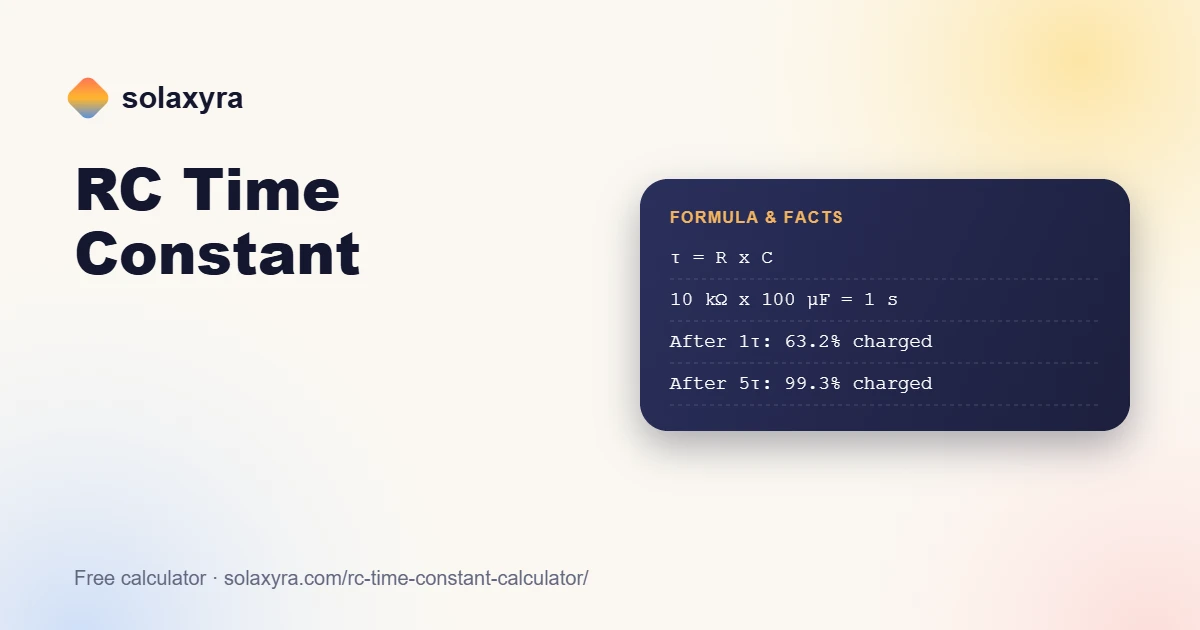
Quick answer: Multiply resistance by capacitance: τ = R × C. A 10 kΩ resistor with a 100 µF capacitor gives τ = 1 second. The capacitor reaches about 63.2% of the supply voltage after 1τ and about 99.3% after 5τ, so 5 seconds here.
What Is an RC Time Constant Calculator?
An RC time constant calculator describes how quickly a capacitor charges or discharges through a resistor. The time constant, tau, is the product of resistance in ohms and capacitance in farads, and it is measured in seconds. After one time constant a charging capacitor reaches about 63.2% of the supply voltage.
How Do You Use the RC Time Constant Calculator?
- Enter the resistance in ohms.
- Enter the capacitance in microfarads. For nanofarads divide by 1,000; for picofarads divide by 1,000,000.
- Enter the supply voltage and a time to see the capacitor voltage at that moment.

How Much Is a Capacitor Charged After Each Time Constant?
| Time | Charge reached | Remaining when discharging |
|---|---|---|
| 1τ | 63.2% | 36.8% |
| 2τ | 86.5% | 13.5% |
| 3τ | 95.0% | 5.0% |
| 4τ | 98.2% | 1.8% |
| 5τ | 99.3% | 0.7% |
Where Are RC Time Constants Used?
- Timing and delay circuits, such as power-on reset and debounce for switches.
- Simple low-pass and high-pass filters, where the cut-off frequency is 1 ÷ (2πRC).
- Smoothing and snubber circuits in power electronics.
- Estimating how long a capacitor holds a dangerous voltage after power is removed.
Discharging a Capacitor
Discharge follows the mirror curve: V(t) = V0 × e^(−t/τ). After 5τ the voltage is under 1% of its starting value. Large capacitors in inverters and power supplies can stay charged for some time after switching off, so always check with a meter before touching terminals.
Worked Example: A Switch Debounce
Example: an electronics student in Glasgow uses a 10 kΩ resistor and a 100 nF capacitor to debounce a button on a 3.3 V microcontroller.
- τ = 10,000 × 0.1 µF = 1 ms.
- After 5 ms the input is above 99% of its final level.
- That smooths out contact bounce, which usually lasts a few milliseconds.
Frequently Asked Questions
What is the RC time constant?
The product of resistance and capacitance, giving the time to reach about 63.2% charge.
How long does a capacitor take to fully charge?
About 5 time constants, by which point it is above 99% charged.
What unit is the time constant?
Seconds, when R is in ohms and C is in farads.
How do you find the cut-off frequency of an RC filter?
Divide 1 by 2π times RC.
Checked November 2026 by the Solaxyra Editorial Team. Sources: Khan Academy: RC natural response.