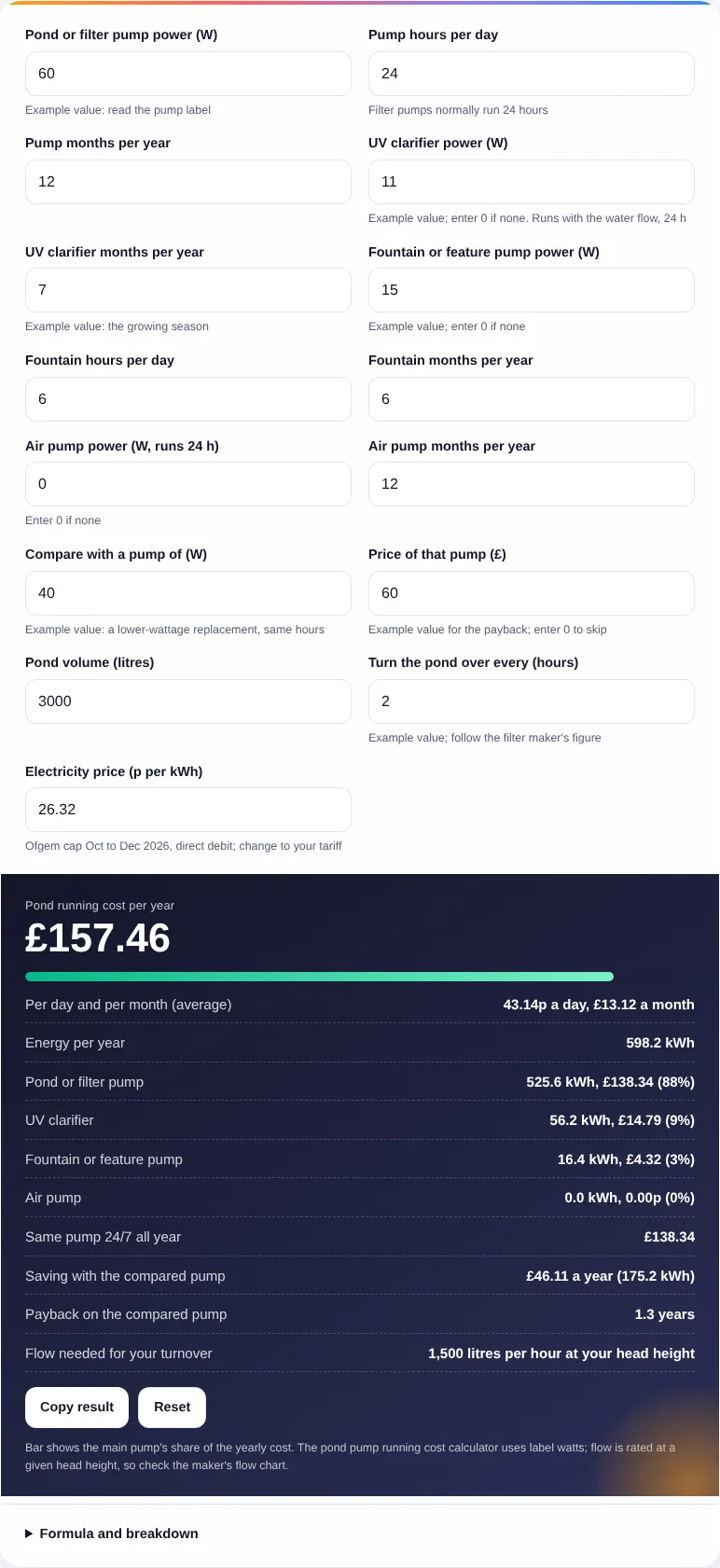
Bar shows the main pump’s share of the yearly cost. The pond pump running cost calculator uses label watts; flow is rated at a given head height, so check the maker’s flow chart.
Formula and breakdown
n/a
n/a
n/a
This pond pump running cost calculator works out what a garden pond costs to run per day, month and year, adding up the filter pump, UV clarifier, fountain pump and air pump with their own hours and months of use. It is set up for UK ponds at the current price cap, works anywhere in Europe with your own tariff, and compares your pump with a lower-wattage one to show the yearly saving and payback.
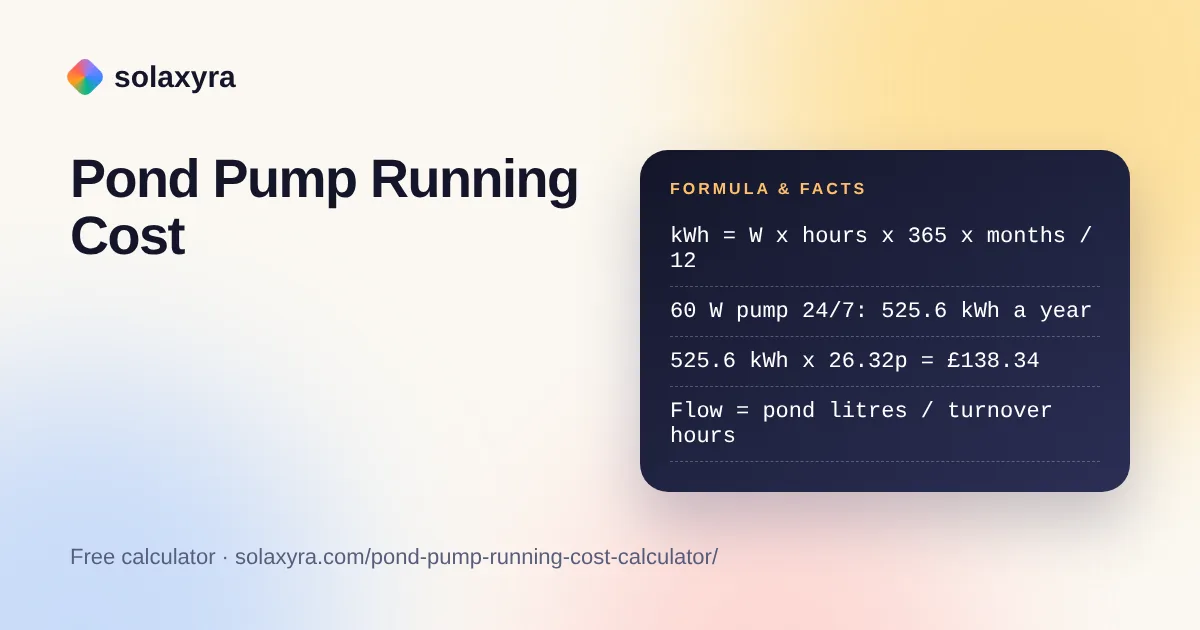
Quick answer: A pond pump running cost calculator multiplies each device’s watts by its hours and months of use, then by your unit price. A 60 W pond pump running 24 hours a day all year uses 525.6 kWh, which costs £138.34 at the Ofgem cap of 26.32p per kWh.
What Is a Pond Pump Running Cost Calculator?
A pond pump running cost calculator is a tool that turns the wattage and running time of pond equipment into kWh and money. In plain words: kWh per year = watts x hours per day x 365 x months used / 12 / 1,000, and the cost is that figure multiplied by your price per kWh.
Pond pumps are cheap per hour but run for a very long time. A filter pump that never stops runs 8,760 hours a year, so a few watts make a real difference. That is why the wattage on the label matters more than the flow figure on the box when you look at running costs, and why the calculator lets you compare two pumps side by side.
How Do You Use the Pond Pump Running Cost Calculator?
- Enter the power of your pond or filter pump from its label, with its hours a day and months a year.
- Add a UV clarifier, a fountain or feature pump and an air pump if you have them; enter 0 for anything you do not have.
- Enter the wattage and price of a pump you are thinking of buying to see the saving and payback.
- Enter your pond’s volume and a turnover time to see the flow you need.
- Enter your electricity price, or keep the October 2026 cap rate.
How Much Does a Pond Pump Cost to Run?
A pond pump running 24 hours a day costs about £2.31 a year for every watt at 26.32p per kWh, so a 60 W pump costs £138.34 a year and a 20 W pump £46.11. The Ofgem price cap announcement sets 26.32p per kWh as the average direct debit unit rate for 1 October to 31 December 2026, with VAT removed from electricity bills from 1 October 2026 to 31 March 2027.
| Pump power, running 24/7 | kWh per year | Cost per day | Cost per year |
|---|---|---|---|
| 20 W | 175.2 | 12.63p | £46.11 |
| 40 W | 350.4 | 25.27p | £92.23 |
| 60 W | 525.6 | 37.90p | £138.34 |
| 80 W | 700.8 | 50.53p | £184.45 |
| 100 W | 876.0 | 63.17p | £230.56 |
| 150 W | 1,314.0 | 94.75p | £345.84 |
Many UK articles on this topic still quote 16p, 28p or 30p per kWh from 2018 to 2023, so their yearly figures no longer match current bills. The pond pump running cost calculator uses the October 2026 cap by default, and you can enter your own tariff. For a single appliance on its own, the watts to kWh calculator does the same sum in one step.
Should You Run a Pond Pump 24 Hours a Day?
A pump that feeds a biological filter should normally run 24 hours a day, because the RHS guide to pond filters warns that the filter’s bacteria can die if it is switched off for 24 hours or more. A pump that only drives a fountain or waterfall can run on a timer for the hours you are in the garden.
| 60 W pump, 24 hours a day | kWh per year | Cost per year | Saving against all year |
|---|---|---|---|
| 12 months | 525.6 | £138.34 | £0.00 |
| 9 months | 394.2 | £103.75 | £34.59 |
| 6 months | 262.8 | £69.17 | £69.17 |
Whether a seasonal shutdown is right depends on your fish, your filter and the advice of the equipment maker, so treat the months as a cost check, not a recommendation. UV clarifiers are often used only in the growing season; the RHS explains that they make algae clump together so the filter can remove it.
Is a Lower-Wattage Pond Pump Worth It?
Usually yes for a pump that runs nonstop: replacing a 60 W pump with a 40 W pump saves 175.2 kWh, or £46.11 a year, at 26.32p per kWh. At an example price of £60, the new pump pays for itself in about 1.3 years.
Compare pumps at the flow you need, not the maximum flow on the box. A pump’s flow falls as the head height (the height the water is lifted) rises, so a smaller pump may not move enough water through a filter or up a waterfall. Use the maker’s flow chart at your head height, then put both wattages into the pond pump running cost calculator to see the saving.
What Size Pond Pump Do You Need?
Divide the pond volume by the turnover time your filter maker recommends: a 3,000 litre pond turned over every 2 hours needs about 1,500 litres per hour at your head height. The RHS advises choosing the filter by pond volume, and the pump must match the flow the filter is designed for.
The 2 hour turnover in the calculator is an example value; filter and pump makers publish their own figures, and fish ponds generally need more circulation than wildlife ponds. A bigger pump than you need costs more to run every hour of the year, so size it to the flow you need and no more. To see how much power an outdoor circuit carries, the watts to amps calculator converts the combined wattage to amps.
Ponds combine water and mains electricity outdoors. The RHS states that an electricity supply for pond filtration must be installed by a qualified electrician; in the UK the work must meet BS 7671, and outdoor sockets should be protected by a residual current device (RCD). Unplug equipment before handling it in the water.
Worked Example: A Garden Fish Pond
Example: a 3,000 litre fish pond has a 60 W filter pump running all year, an 11 W UV clarifier used for seven months, and a 15 W fountain pump on a timer for 6 hours a day over six months. The tariff is the Ofgem cap of 26.32p per kWh.
- Filter pump: 60 x 24 x 365 / 1,000 = 525.6 kWh, £138.34.
- UV clarifier: 11 x 24 x 365 x 7 / 12 / 1,000 = 56.2 kWh, £14.79.
- Fountain pump: 15 x 6 x 365 x 6 / 12 / 1,000 = 16.4 kWh, £4.32.
- Total: 598.2 kWh, £157.46 a year, which averages 43.14p a day or £13.12 a month.
- Swapping to a 40 W filter pump with enough flow at the same head saves £46.11 a year.
The filter pump is 88% of the bill, so it is the place to look first. Compare your own pump with a candidate replacement in the pond pump running cost calculator above, and add your other garden kit to the energy consumption calculator for a whole-home view.
Frequently Asked Questions
How much does a pond pump cost to run per year?
A 60 W pump running 24 hours a day all year uses 525.6 kWh, which costs £138.34 at the October to December 2026 cap of 26.32p per kWh. A 20 W pump costs about £46 and a 100 W pump about £231. Each 10 W of nonstop power adds about £23 a year.
Should I run my pond pump 24 hours a day?
A pump that feeds a biological filter should normally run all the time. The RHS warns that the filter’s bacteria can die if the filter is switched off for 24 hours or more. A fountain or waterfall pump that only serves a feature can run on a timer.
How much does a UV clarifier cost to run?
An 11 W UV clarifier running 24 hours a day for seven months uses 56.2 kWh, which costs £14.79 at 26.32p per kWh. Running it all year would cost about £25.36. Enter your lamp’s wattage and the months you use it in the pond pump running cost calculator.
Is it worth buying a more efficient pond pump?
Often, because the pump runs for thousands of hours a year. Swapping a 60 W pump for a 40 W pump on 24 hour running saves 175.2 kWh, or £46.11 a year at 26.32p per kWh, so a £60 pump pays back in about 1.3 years. Check its flow at your head height first.
What size pond pump do I need?
Start from the pond volume and the turnover time your filter maker recommends, then divide litres by hours. A 3,000 litre pond turned over every 2 hours needs 1,500 litres per hour at the height the water is lifted. Pump flow falls as head height rises, so check the flow chart.
Can I turn my pond pump off in winter?
That depends on the pond. A filter pump feeding a biological filter should not be off for more than a day without planning, because the bacteria can die. Some keepers run pumps for fewer months; the calculator’s months input shows what seasonal running saves.
Checked October 2026 by the Solaxyra Editorial Team. Sources: Ofgem: price cap 1 October to 31 December 2026, RHS: Choosing a pond filter.