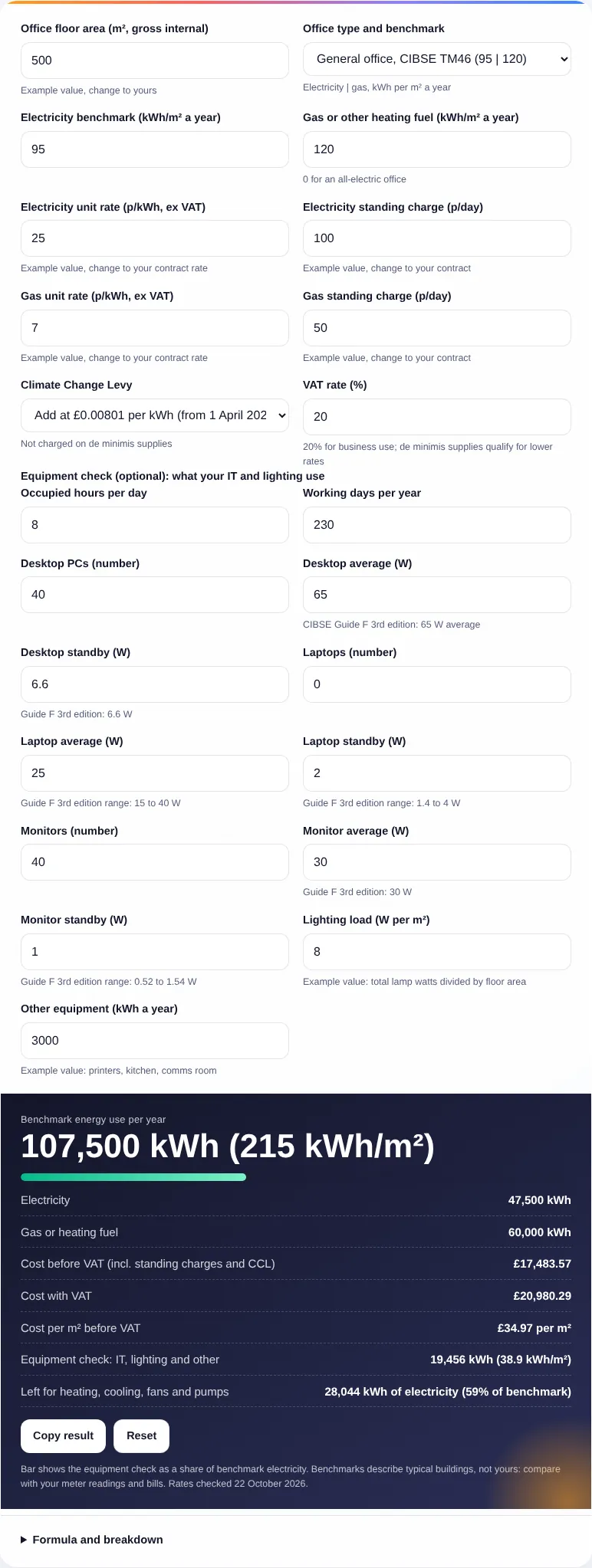
Bar shows the equipment check as a share of benchmark electricity. Benchmarks describe typical buildings, not yours: compare with your meter readings and bills. Rates checked 22 October 2026.
Formula and breakdown
n/a
n/a
n/a
n/a
This office energy usage calculator estimates how much electricity and gas a UK office uses in a year from its floor area and type, using published benchmarks in kWh per m², and turns that into a cost with standing charges, Climate Change Levy and VAT. An optional equipment check adds up what the computers, monitors, lighting and other kit use, so office managers, landlords and small firms can see how much is left for heating, cooling and ventilation.
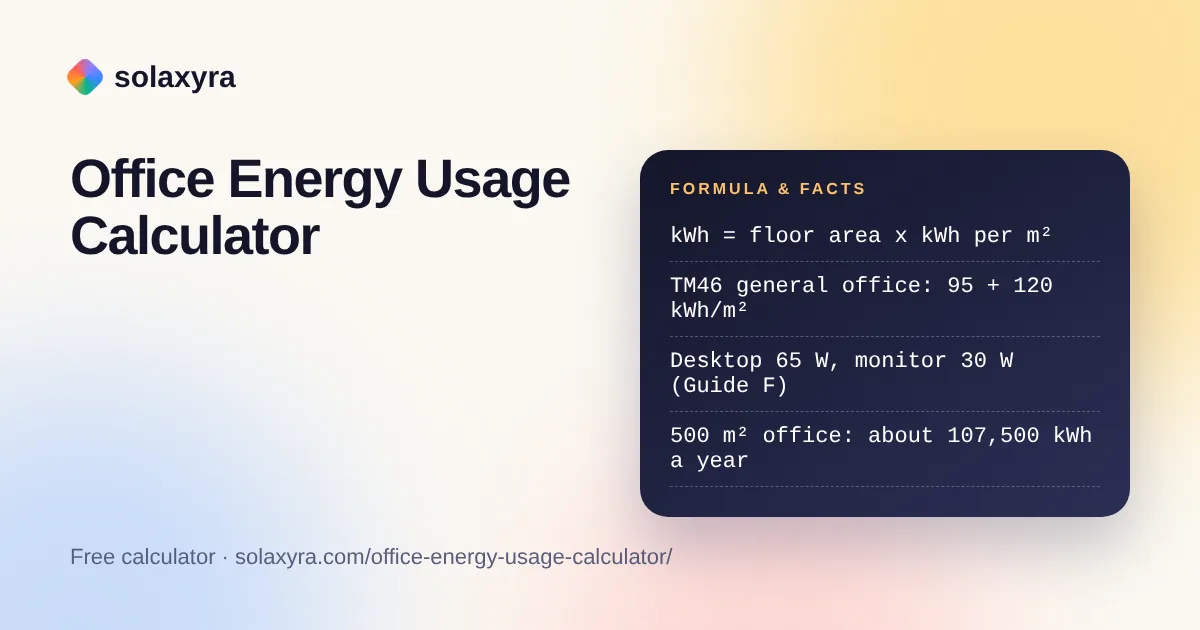
Quick answer: The CIBSE TM46 benchmark for a general office is 95 kWh of electricity and 120 kWh of heating fuel per m² a year. In the office energy usage calculator, a 500 m² office therefore uses about 47,500 kWh of electricity and 60,000 kWh of gas, around £17,500 a year before VAT at the example rates.
What Is an Office Energy Usage Calculator?
An office energy usage calculator is a tool that estimates a year of electricity and heating fuel for an office by multiplying its floor area by an energy benchmark for that type of building, then pricing the result. In plain words: kWh a year equals floor area in m² times kWh per m² for each fuel; cost equals kWh times the unit rate plus 365 days of standing charge, plus any levy and VAT.
Benchmarks are the usual starting point for an office energy usage calculator because most offices do not have sub-meters. CIBSE describes its TM46 energy benchmarks, published in October 2008, as an outline of building energy benchmarks, how they were developed and how to use them, including weather and occupancy adjustments. TM46 benchmarks are the ones used for Display Energy Certificates, and the older ECON 19 guide splits offices into four types with typical and good practice values.
How Do You Use the Office Energy Usage Calculator?
- Enter the office floor area in m². Benchmarks here are per m² of gross internal area, measured inside the external walls.
- Choose the office type. The TM46 general office suits most mixed offices; the ECON 19 types separate naturally ventilated and air conditioned buildings.
- Enter your contract unit rates and standing charges, excluding VAT. The defaults are examples, because business energy has no price cap.
- Leave the Climate Change Levy on unless your use falls within the de minimis limits, and check the VAT rate.
- For the equipment check, enter occupied hours, working days, the number of desktops, laptops and monitors, the lighting load and any other equipment.
- Compare the benchmark with your actual bills. If your meter readings are well above it, the equipment check and the breakdown show where to look.
How Much Energy Does an Office Use per m²?
A typical UK office uses roughly 100 to 500 kWh per m² a year, depending mainly on whether it is air conditioned. The benchmarks below are taken from Appendix C of the RIBA Publishing book What Colour is Your Building? (2013), which tabulates the ECON 19 values and CIBSE TM46 per m² of gross internal area; electricity is the sum of the tenant and landlord figures.
| Office type | Case | Electricity (kWh/m²) | Gas (kWh/m²) | Total (kWh/m²) |
|---|---|---|---|---|
| General office, CIBSE TM46 | Benchmark | 95 | 120 | 215 |
| Naturally ventilated cellular | Good practice | 32 | 75 | 107 |
| Naturally ventilated cellular | Typical | 52 | 143 | 195 |
| Naturally ventilated open plan | Good practice | 52 | 75 | 127 |
| Naturally ventilated open plan | Typical | 81 | 143 | 224 |
| Air conditioned standard | Good practice | 115 | 87 | 202 |
| Air conditioned standard | Typical | 203 | 160 | 363 |
| Air conditioned prestige | Good practice | 199 | 97 | 296 |
| Air conditioned prestige | Typical | 304 | 179 | 483 |
Totals in four rows differ by one from the appendix because its own columns are rounded. ECON 19 dates from 2003 and TM46 from 2008, and the authors of the appendix note they did not verify the figures, so treat them, and the office energy usage calculator built on them, as yardsticks rather than targets. A prestige air conditioned office typical of that era used more than twice the energy of a good naturally ventilated one.
How Much Electricity Do Office Computers and Lighting Use?
A desktop PC averages about 65 W in use and a monitor about 30 W, according to CIBSE Guide F (3rd edition) as reviewed in the Loughborough University paper Benchmarking small power energy consumption in UK office buildings. Guide F gives 15 to 40 W for a laptop and standby figures of 6.6 W for a desktop, 1.4 to 4 W for a laptop and about 0.5 to 1.5 W for a monitor.
The same paper found that monitored desktops often draw more than the Guide F figure, up to about three times as much for a high specification machine, while standby loads were overestimated. The office energy usage calculator therefore keeps every wattage editable. It counts in-use watts for the occupied hours and standby watts for the rest of the 8,760 hours in a year, so desktops left on standby overnight still add up. To size a single device, the watts to kWh calculator gives the same arithmetic for one item.
What Does Office Energy Cost per Year?
At the example rates of 25p per kWh for electricity and 7p for gas, the TM46 general office costs about £35 per m² a year before VAT. Business energy is not covered by Ofgem's price cap, so enter the unit rates and standing charges from your own contract in the office energy usage calculator; the electricity cost calculator is useful for checking individual appliances.
Two taxes sit on top. The Climate Change Levy is £0.00801 per kWh for both electricity and gas from 1 April 2026, according to HMRC's Climate Change Levy rates, unless the supply is within the de minimis limits of 1,000 kWh of electricity or 4,397 kWh of gas a month. VAT is charged at 20% on business fuel and power, and on the levy too. Our climate change levy calculator covers the reliefs in detail.
How Can an Office Cut Its Energy Use?
Start with the gap between the benchmark and the equipment check: in the default example, IT, lighting and other kit explain about 41% of the benchmark electricity, leaving 59% for heating controls, fans, pumps and any cooling. The office energy usage calculator makes that split visible, which points to the biggest savings.
- Switch desktops and monitors fully off out of hours; the standby hours are more than three times the occupied hours.
- Replace older lighting with LEDs and add occupancy controls, then cut the W per m² figure to match.
- Check heating and cooling time clocks against real occupied hours.
- Read the meters monthly and compare each fuel with the benchmark row for your office type.
Any new circuits, lighting or controls must be installed by a qualified electrician to BS 7671. Gas boilers serving the office must only be worked on by a Gas Safe registered engineer.
Worked Example: 500 m² Naturally Ventilated Office
Example: a 500 m² office floor in Bristol, heated by gas and without air conditioning, is assessed against the TM46 general office benchmark. It has 40 desktops and 40 monitors in use 8 hours a day on 230 working days, lighting of 8 W per m², and about 3,000 kWh a year of other equipment.
- Electricity: 500 x 95 = 47,500 kWh. Gas: 500 x 120 = 60,000 kWh.
- Energy cost: 47,500 x 25p + 365 x £1.00 = £12,240.00; 60,000 x 7p + 365 x £0.50 = £4,382.50.
- Climate Change Levy: 47,500 x £0.00801 = £380.48 and 60,000 x £0.00801 = £480.60, as both are above the de minimis limits.
- Total about £17,484 before VAT, or about £20,980 with 20% VAT, roughly £34.97 per m².
- Equipment check: occupied 1,840 hours, standby 6,920 hours. Desktops 40 x (65 x 1,840 + 6.6 x 6,920) / 1,000 = 6,611 kWh; monitors 2,485 kWh; lighting 500 x 8 x 1,840 / 1,000 = 7,360 kWh; other 3,000 kWh; total 19,456 kWh, 41% of the benchmark electricity.
If this office's bills showed 70,000 kWh of electricity, it would sit well above the general office benchmark, and the remaining 59% that the office energy usage calculator leaves for building services is where an energy survey should start.
Frequently Asked Questions
How much electricity does an office use per m²?
The CIBSE TM46 general office benchmark is 95 kWh of electricity per m² a year. Older ECON 19 figures range from 32 kWh per m² for a good practice naturally ventilated cellular office to 304 kWh per m² for a typical air conditioned prestige office.
How much gas does an office use per year?
The TM46 general office benchmark is 120 kWh of heating fuel per m² a year, so a 500 m² office would use about 60,000 kWh. ECON 19 gives 75 kWh per m² for good practice naturally ventilated offices and up to 179 kWh per m² for a typical prestige office.
What is CIBSE TM46?
TM46 is a CIBSE technical memorandum, published in October 2008, that sets energy benchmarks for many building types in kWh per m² a year, for electricity and for heating fuel. It is the basis of Display Energy Certificates and includes guidance on weather and occupancy adjustments.
How much power does an office computer use?
CIBSE Guide F (3rd edition) gives an average of about 65 W for a desktop PC, 15 to 40 W for a laptop and 30 W for a monitor, with standby of a few watts. Monitored studies found some desktops draw much more, so measure your own if you can.
Does the calculator include VAT and the Climate Change Levy?
Yes. It adds the Climate Change Levy at £0.00801 per kWh unless use is within the de minimis limits, and applies the VAT rate you enter, 20% by default for business use. Unit rates and standing charges should be entered excluding VAT, as shown on most business bills.
Why is my office using more than the benchmark?
Long opening hours, server rooms, air conditioning, poor heating controls and equipment left on overnight are common reasons. Benchmarks describe typical buildings, so compare like with like, then use the equipment check in the office energy usage calculator to see how much of your electricity is explained by IT and lighting.
Checked October 2026 by the Solaxyra Editorial Team. Sources: CIBSE: TM46 Energy Benchmarks, What Colour is Your Building? Appendix C: Energy consumption data (RIBA Publishing, 2013), Loughborough University: Benchmarking small power energy consumption in UK office buildings, Bordass et al.: Tailored energy benchmarks for offices and schools (CIBSE ASHRAE Symposium 2014), HMRC: Climate Change Levy rates, HMRC: VAT on fuel and power.