This guide explains the real difference between monocrystalline and polycrystalline solar panels for UK and European homeowners, and what it means in 2026, when one of the two has almost disappeared from sale. If you are comparing quotes, extending an older system or trying to identify the panels already on your roof, the monocrystalline vs polycrystalline question has a clearer answer than most comparison pages suggest.
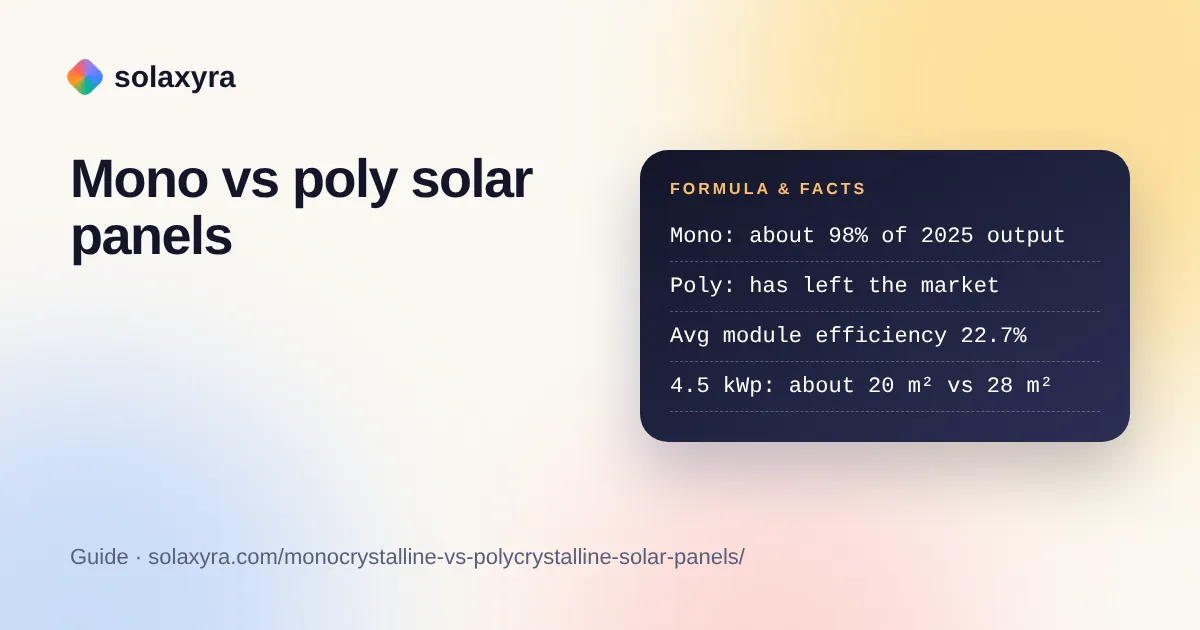
Quick answer: In monocrystalline vs polycrystalline, monocrystalline wins: single-crystal cells convert more light per square metre, so you need less roof for the same power. Polycrystalline (also called multicrystalline) panels have effectively left the market, and monocrystalline made up about 98% of world solar production in 2025. Today you choose between monocrystalline models.
Monocrystalline vs polycrystalline: what is the difference?
Monocrystalline cells are cut from a single, continuous silicon crystal, while polycrystalline cells are cut from silicon cast into blocks made of many smaller crystals. Single crystals are usually grown with the Czochralski method, in which a seed crystal is slowly pulled from molten silicon, according to the crystalline silicon reference. Polycrystalline silicon is made more simply, by letting molten silicon cool and solidify into a block instead of pulling one crystal.
The boundaries between the many crystals in a polycrystalline cell get in the way of the electrical charges the cell produces, so less of the light energy reaches the wires. That is the root of the monocrystalline vs polycrystalline efficiency gap. The two also look different:
- Monocrystalline: uniform dark or black cells, often with cut corners on older designs.
- Polycrystalline: blue cells with a speckled, flaky pattern where you can see the separate crystals.
Are polycrystalline solar panels still sold?
Hardly at all: the July 2026 Fraunhofer ISE Photovoltaics Report states that multicrystalline silicon technology has in practice disappeared from the market, with monocrystalline at about 98% of 2025 production and thin film making up most of the rest. Ten years earlier the monocrystalline vs polycrystalline picture was the other way round.
| Measure | Around 2013 | 2024 to 2025 |
|---|---|---|
| Share of world production, monocrystalline | 36% | about 98% |
| Share of world production, multicrystalline (poly) | 54% | effectively 0% |
| Best laboratory cell, monocrystalline | 25.6% | 28.1% (mono wafer based) |
| Best laboratory cell, multicrystalline | 20.4% | no longer reported |
| Average commercial crystalline module efficiency | about 16% (decade to 2014) | 22.7% weighted average, range 18.9% to 24.8% (Q4 2024) |
Sources: 2013 column from Wikipedia’s crystalline silicon article; 2024 to 2025 column from Fraunhofer ISE. Much of the monocrystalline vs polycrystalline advice still online, including price per watt comparisons that present polycrystalline as the budget choice, describes the older market.
Which is more efficient, and how much roof does that save?
Monocrystalline is more efficient, and today’s average module at 22.7% needs about 30% less roof area than a 16% module for the same power. Module efficiency is the share of the light hitting the panel’s surface that comes out as electricity at standard test conditions (1,000 W per square metre, 25 °C cells), so area needed is simply power ÷ (efficiency × 1,000 W per m²).
| Module efficiency | Where the figure comes from | Watts per m² at STC | Module area for 4.5 kWp |
|---|---|---|---|
| 16% | Typical commercial module around 2014 | 160 W | about 28.1 m² |
| 18.9% | Low end of 2024 commercial range | 189 W | about 23.8 m² |
| 22.7% | 2024 weighted average | 227 W | about 19.8 m² |
| 24.8% | High end of 2024 commercial range | 248 W | about 18.1 m² |
For comparison, the Energy Saving Trust says a typical 4.5 kWp home system needs 20 to 30 m² of roof, typically around 12 panels. The figures above are panel area only; real roofs also need gaps for edges, fixings and access. Check your own panel’s datasheet figure with the solar panel efficiency calculator, then see what fits with the solar panel roof area calculator.
Does efficiency change how much electricity you get per kWp?
No: a kWp is a kWp, so 4.5 kWp of efficient panels and 4.5 kWp of less efficient panels on the same roof produce broadly similar yearly kWh. Efficiency decides how many square metres that kWp occupies, not how much each kWp generates. Where efficiency matters is when roof space is the limit: more efficient panels let you fit more kWp, and therefore more kWh, on the same roof.
Example: a south-facing roof with 20 m² of usable space fits about 3.2 kWp of 16% modules (20 × 0.16) or about 4.5 kWp of 22.7% modules (20 × 0.227). At the same site, the second system would produce about 40% more each year simply because it is bigger.
How do heat and low light affect each type?
Both lose output as cells get hotter, and the size of that loss is set by the temperature coefficient of maximum power printed on each datasheet, so compare that number rather than relying on the panel type. The coefficient is given in per cent per °C above 25 °C. Example: a datasheet value of −0.30% per °C (example value, change to yours) means a cell at 45 °C loses about 6% of its rated power (20 °C × 0.30%).
In UK conditions cells rarely run very hot for long, so differences of a few hundredths of a per cent per °C have a modest effect on yearly output. The solar panel temperature loss calculator turns any datasheet coefficient and air temperature into a power loss. Low light behaviour also varies by model rather than by crystal type; read the datasheet’s low irradiance figure if it is given.
Do monocrystalline panels last longer than polycrystalline?
Lifespan is similar for both: the Energy Saving Trust gives one figure for solar panels in general, 25 years or more, and the NREL degradation studies include both crystal types in their crystalline silicon samples. Build quality, installation and warranty terms matter more than the monocrystalline vs polycrystalline choice. See our guide on how long solar panels last for degradation figures.
The environmental case for monocrystalline vs polycrystalline is also similar. Fraunhofer ISE estimates the energy payback time of a European-made crystalline silicon system in Northern Europe at about 1.1 years: the time it takes to generate the energy used to make it.
I already have polycrystalline panels: what should I do?
Keep them while they work: polycrystalline panels installed years ago still generate, and replacing healthy panels rarely pays back. The questions usually come up when a panel is damaged or when you want to add more.
- Check generation first. Compare yearly kWh per kWp with earlier years; a steady small decline is normal ageing.
- For a damaged panel, ask your installer for the closest electrical match. Exact polycrystalline replacements are now hard to find, so a monocrystalline panel with compatible voltage and current may be used.
- For an extension, new panels are usually best on their own inverter input, a separate inverter or microinverters, because mixing very different panels in one string limits the string to its weakest panel. The solar string size calculator shows the voltage limits an installer will check.
- Have all work done by an MCS certified installer; changes to the DC or AC wiring must be carried out by a competent person and comply with BS 7671.
What should you look for when choosing panels today?
Since nearly every panel on sale is monocrystalline, compare models on efficiency, temperature coefficient, warranty terms and price per kWp installed rather than on crystal type. Fraunhofer ISE notes that monocrystalline n-type TOPCon cells have become the dominant technology; other names you will see on datasheets include PERC and heterojunction, which are all monocrystalline cell designs.
- Efficiency: matters most when roof space is tight.
- Temperature coefficient: a smaller negative number loses less in heat.
- Product and performance warranty: length, end percentage and whether labour is covered.
- Appearance: all-black panels are common now if looks matter to you or your planning situation.
- Total installed price per kWp: the Energy Saving Trust gives about £7,600 for a typical 4.5 kWp system as a benchmark.
Frequently Asked Questions
Can I still buy polycrystalline solar panels?
Rarely. Fraunhofer ISE reports that multicrystalline silicon has in practice disappeared from the market, with monocrystalline making up about 98% of world production in 2025. You may find old stock or second-hand panels, but new installations are almost all monocrystalline.
How can I tell if my panels are monocrystalline or polycrystalline?
Look from the ground or at installation photos. Monocrystalline cells are a uniform dark colour, often black; polycrystalline cells are blue with a speckled, flaky pattern. The datasheet or MCS certificate will also name the panel model, which confirms the type.
Is monocrystalline worth the extra cost?
The question has largely gone away, because nearly all panels on sale are monocrystalline and prices are quoted per kWp. Compare installed price per kWp, efficiency and warranty between monocrystalline models rather than looking for a cheaper polycrystalline option.
Do polycrystalline panels work worse in the UK climate?
They produce less per square metre, but per kWp installed their yearly output is broadly similar in UK weather. The main penalty is roof space: a polycrystalline system of the same power takes up more of the roof than a modern monocrystalline one.
Can I mix monocrystalline and polycrystalline panels?
Only with care. Different panels in the same string limit the string to the weakest panel’s current. An installer will usually put new panels on a separate inverter input, a separate inverter or microinverters. Any wiring change must be done by a competent installer to BS 7671.
Checked October 2026 by the Solaxyra Editorial Team. Sources: Fraunhofer ISE: Photovoltaics Report, July 2026, Wikipedia: crystalline silicon, Energy Saving Trust: solar panels, Wikipedia: nominal power (photovoltaic).