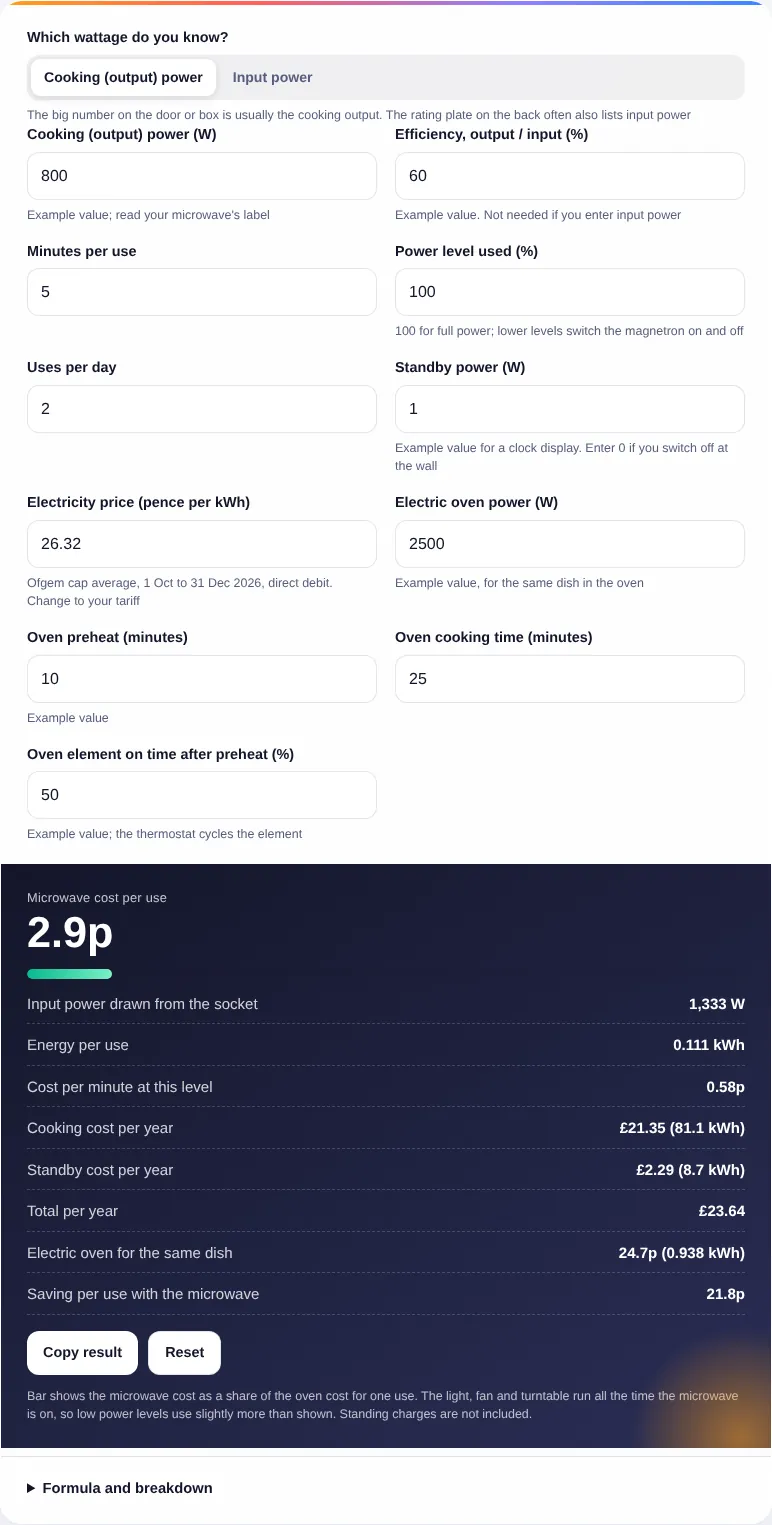
Bar shows the microwave cost as a share of the oven cost for one use. The light, fan and turntable run all the time the microwave is on, so low power levels use slightly more than shown. Standing charges are not included.
Formula and breakdown
n/a
n/a
n/a
This microwave running cost calculator works out what each use of a microwave costs in electricity, per minute and per year including standby, and compares it with cooking the same dish in an electric oven, for households in the UK, Ireland and the rest of Europe. It converts the cooking wattage printed on the door into the higher input power the microwave actually draws.
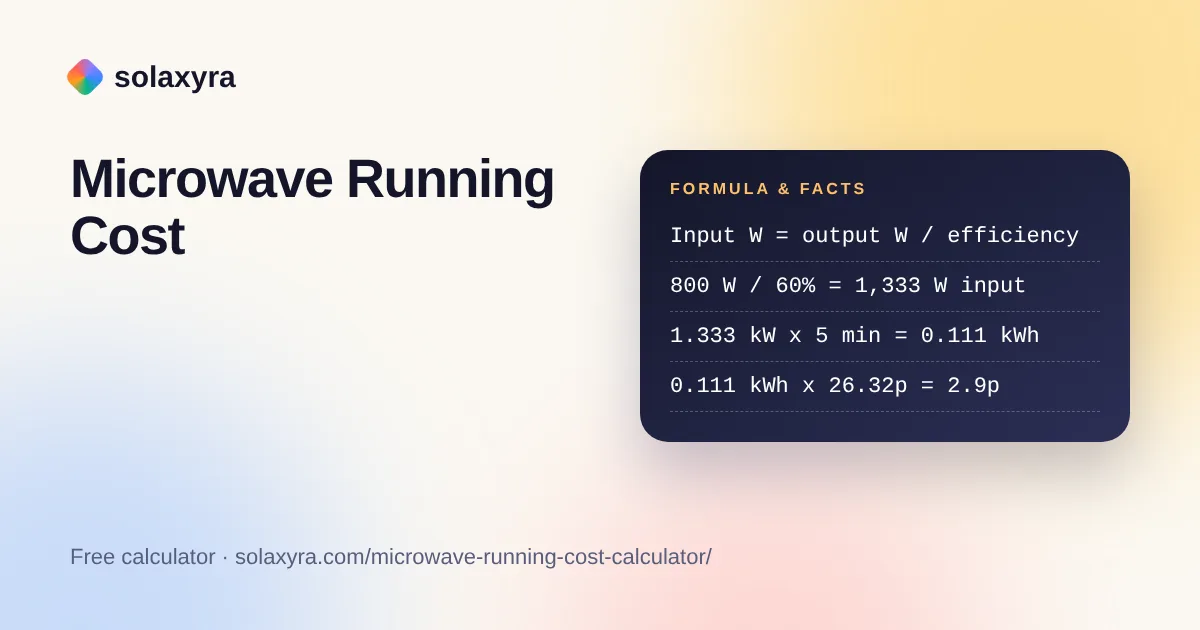
Quick answer: A microwave running cost calculator converts cooking power into input power, then multiplies kW by minutes and your unit price. An 800 W microwave that is 60% efficient draws about 1,333 W, so 5 minutes uses 0.111 kWh, about 2.9p at the 26.32p Ofgem cap rate.
What Is a Microwave Running Cost Calculator?
A microwave running cost calculator is a tool that turns a microwave’s power, cooking time and your electricity price into a cost per use and per year. In plain words: input power = cooking output power / efficiency; energy in kWh = input watts / 1,000 x minutes / 60 x the power level; cost = kWh x price per kWh. Standby is added for every hour of the year the microwave is not cooking.
The input and output distinction is what most cost guides miss. As the Wikipedia article on microwave ovens explains, the cooking or output wattage is lower than the input wattage, and conversion of electricity into microwaves can be as low as 50% efficient, with energy-efficient models exceeding 64%. Domestic models are usually marked with their IEC 60705 output rating, so the big number on the door understates the electricity used.
How Do You Use the Microwave Running Cost Calculator?
- Choose whether you know the cooking (output) power or the input power. The rating plate on the back often shows both.
- Enter the wattage. If you entered output power, set the efficiency; 60% is an example value.
- Enter the minutes per use and the power level. Full power is 100%.
- Enter uses per day and the standby power, or 0 if you switch off at the wall.
- Check the electricity price. The default is the Ofgem cap average for 1 October to 31 December 2026.
- Enter your oven’s power, preheat, cooking time and element on time to compare the same dish.
How Much Does It Cost to Run a Microwave per Minute?
A microwave costs its input power in kW / 60 x your unit price per minute: a microwave drawing 1,300 W costs 1.3 / 60 x 26.32p = 0.57p a minute at the October to December 2026 cap rate. The table below uses input power, because that is what the meter records.
| Input power | 1 minute | 2 minutes | 5 minutes | 10 minutes | 20 minutes |
|---|---|---|---|---|---|
| 1,000 W | 0.44p | 0.88p | 2.2p | 4.4p | 8.8p |
| 1,200 W | 0.53p | 1.05p | 2.6p | 5.3p | 10.5p |
| 1,300 W | 0.57p | 1.14p | 2.9p | 5.7p | 11.4p |
| 1,500 W | 0.66p | 1.32p | 3.3p | 6.6p | 13.2p |
| 1,800 W | 0.79p | 1.58p | 3.9p | 7.9p | 15.8p |
Figures use 26.32p per kWh at full power. If you only know the cooking output, divide it by the efficiency first; an 800 W output microwave at 60% efficiency draws about 1,333 W. The watts to kWh calculator converts any other power and time.
Is a Microwave Cheaper Than an Oven?
For heating single portions, yes: the Energy Saving Trust’s lab-tested cooking comparison puts a 400 g ready-made lasagne in a microwave at a typical £0.04 in Great Britain, and says microwaves are generally more efficient than ovens at heating food. With the defaults, the microwave running cost calculator shows 2.9p a use against 24.7p for an oven meal with preheat.
The gap narrows for large batches. A microwave heats the food, not a large cavity, but cooking time rises with the amount of food, while an oven can cook several dishes in one load. Compare the same dish both ways in the calculator, or use the electric oven running cost calculator and the air fryer cost calculator for the other appliances.
How Much Does a Microwave Cost per Year Including Standby?
With the default example, two 5 minute uses a day cost about £21.35 a year in cooking and £2.29 in standby at 1 W, about £23.64 in total at 26.32p per kWh. Standby is small but runs for about 8,700 hours a year. Wikipedia reports a Lawrence Berkeley National Laboratory study from 2000 finding an average of almost 3 W, and United States rules from 2016 requiring less than 1 W for most types.
Switching off at the wall removes standby entirely, though the clock will need resetting. To see the microwave alongside every other appliance, add it to the energy consumption calculator, which totals daily and yearly use.
Does a Lower Power Level Save Electricity?
A lower power level uses less electricity per minute but usually needs more minutes to heat the same food, so the saving per dish may be small. The light, fan and turntable keep running at every level, so the real saving per minute is also slightly smaller than the level suggests. Low levels are best kept for defrosting and even heating; to test the effect, change the power level and minutes in the microwave running cost calculator together.
What Electricity Price Should I Use?
Use the unit rate on your latest bill. On a default tariff in England, Scotland or Wales, Ofgem’s cap announcement gives an average of 26.32p per kWh for electricity paid by direct debit from 1 October to 31 December 2026, and says VAT is removed from electricity bills from 1 October 2026 to 31 March 2027. Standing charges are left out of the microwave running cost calculator because you pay them whatever you cook with.
Worked Example: Jacket Potato in the Microwave or the Oven?
Example: a household in Cardiff cooks one jacket potato three times a week. Its 900 W microwave lists 1,450 W input on the rating plate and takes 8 minutes at full power. The alternative is a 2,800 W oven with a 12 minute preheat and 60 minutes of cooking, element on about 55% of the time after preheat. The price is 26.32p per kWh. The cooking times and element share are example values.
- Microwave: 1.45 kW x 8/60 h = 0.193 kWh, or 5.1p.
- Oven: 2.8 kW x (0.2 h + 1 h x 55%) = 2.1 kWh, or 55.3p.
- Saving: 50.2p a potato, so the oven uses about 10.9 times the electricity here.
- Over a year of 156 potatoes the saving is about £78.29.
Choose Input power in the microwave running cost calculator and enter 1,450 W to reproduce these figures.
Frequently Asked Questions
How much does it cost to run a microwave for 5 minutes?
Use the input power, not the cooking wattage. A microwave drawing 1,333 W, typical of an 800 W output model at 60% efficiency, uses 0.111 kWh in 5 minutes, about 2.9p at 26.32p per kWh. A 1,000 W input model costs about 2.2p.
What is the difference between microwave input and output power?
Output power is the microwave energy delivered to the food, the figure usually printed on the door or box. Input power is what the appliance draws from the socket, which is higher because conversion is not 100% efficient. Running cost depends on input power.
Is it cheaper to use a microwave or an oven?
For single portions and reheating, a microwave is usually much cheaper because it heats the food rather than a large cavity and needs no preheat. The Energy Saving Trust’s tests put a microwave lasagne at about 4p in Great Britain. Large batches can narrow the gap.
How much does a microwave cost on standby?
At 1 W of standby, a microwave left plugged in for about 8,700 hours a year uses about 8.7 kWh, roughly £2.29 at 26.32p per kWh. Older models can draw more. Switching off at the wall avoids standby completely, but you will need to reset the clock.
Does a microwave use a lot of electricity?
Its power draw is high while running, about 1,333 W at the socket for an 800 W output model at 60% efficiency, but uses are short. Two 5 minute uses a day on a 1,333 W input model use about 81 kWh a year, around £21 at the current cap rate, plus a small standby amount.
Should I include the standing charge?
No. The standing charge is a fixed daily amount you pay whether or not you use the microwave, so it does not change with use. Only the unit rate affects the running cost of one appliance.
Checked October 2026 by the Solaxyra Editorial Team. Sources: Ofgem: Energy price cap 1 October to 31 December 2026, Energy Saving Trust: Air fryer vs oven, which is cheaper to run?, Wikipedia: Microwave oven.