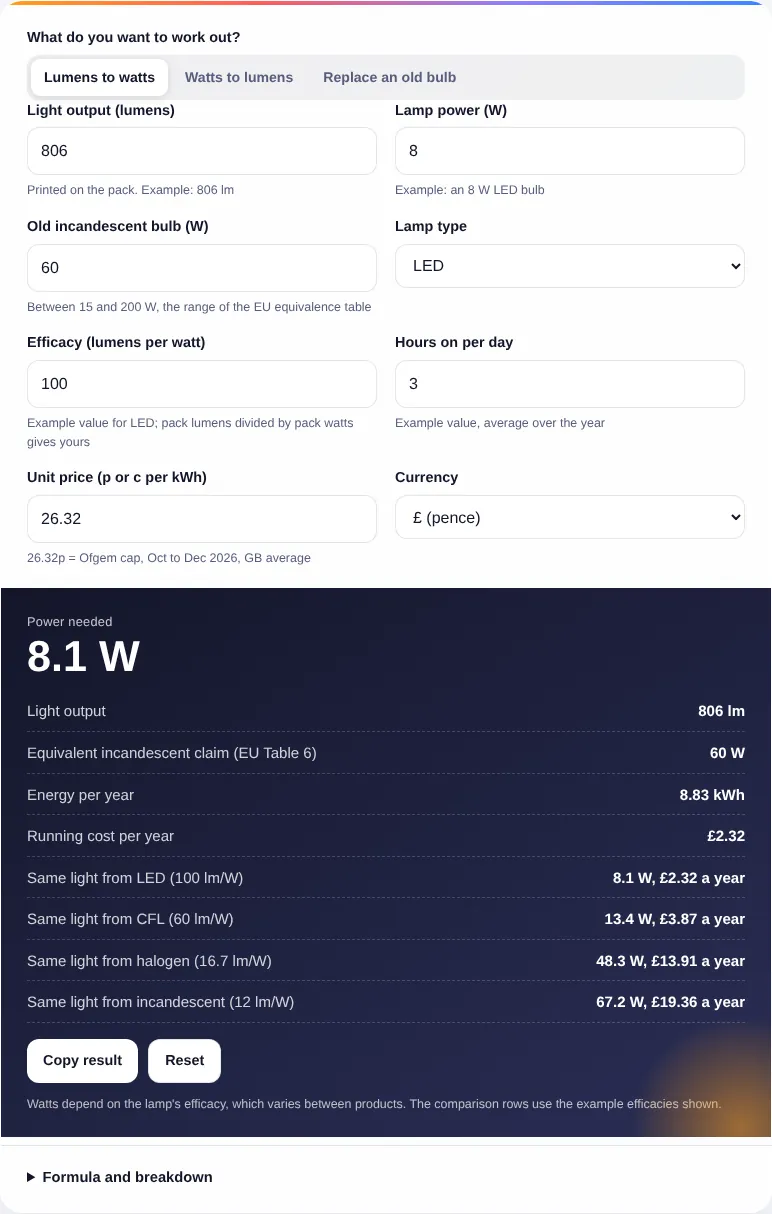
Watts depend on the lamp’s efficacy, which varies between products. The comparison rows use the example efficacies shown.
Formula and breakdown
n/a
n/a
n/a
This lumens to watts calculator works out how many watts a lamp needs to give a chosen brightness, or how bright a lamp of a given wattage will be, for LED, compact fluorescent, halogen and incandescent bulbs. It is set up for UK and European shoppers: it shows the equivalent incandescent wattage the way EU labelling rules define it and prices the running cost at the Ofgem cap.
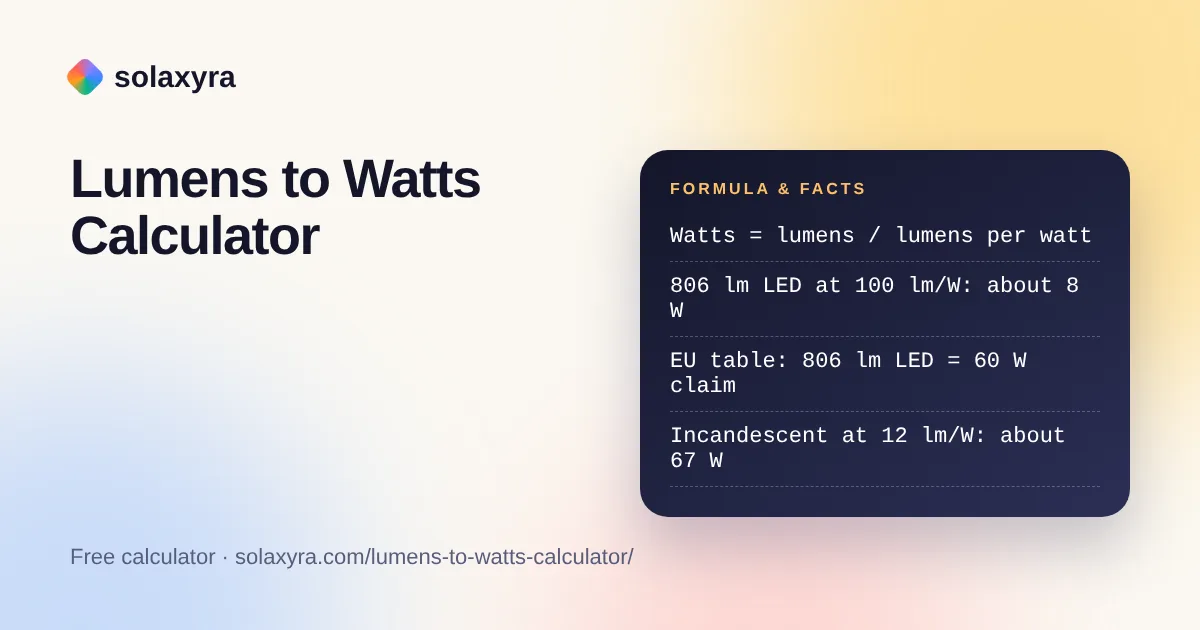
Quick answer: Watts equal lumens divided by the lamp's efficacy in lumens per watt. An 806 lumen LED at an example 100 lm/W draws about 8 W, while an incandescent bulb at 12 lm/W needs about 67 W for the same light. EU equivalence rules treat 806 lumens as a 60 W bulb.
What Is a Lumens to Watts Calculator?
A lumens to watts calculator is a tool that converts a light output in lumens into the electrical power a lamp of a given type needs to produce it. Lumens and watts measure different things, so there is no fixed conversion: the link between them is the lamp's luminous efficacy, the number of lumens it makes from each watt. Watts equal lumens divided by efficacy, and lumens equal watts times efficacy.
The lumen measures visible light weighted to the sensitivity of the human eye, while the watt measures electrical power drawn from the socket. The Wikipedia article on luminous efficacy sets the theoretical ceiling at 683 lm/W for green light at 555 nm; real white lamps reach a fraction of that.
How Do You Use the Lumens to Watts Calculator?
- Choose a mode: lumens to watts, watts to lumens, or replace an old bulb.
- Enter the lumens from the packaging, the lamp's wattage, or the wattage of the old incandescent bulb you are replacing.
- Pick the lamp type. The efficacy box fills with an example value; overwrite it with your own lamp's lumens divided by its watts for an exact answer.
- Set the hours the light is on each day and your unit price.
- Read the watts or lumens, the equivalent incandescent claim, the yearly energy and cost, and the same light from the other lamp types. Open the breakdown to see each step.
How Many Watts Is 800 Lumens?
800 lumens takes about 8 W from an LED at 100 lm/W, about 13 W from a CFL at 60 lm/W, about 48 W from a mains halogen and about 67 W from a classic incandescent bulb. The exact LED figure depends on the product, which is why the efficacy input is editable.
The table below uses the example efficacies in the calculator and 3 hours of use a day at 26.32p per kWh, the Ofgem price cap unit rate for 1 October to 31 December 2026.
| Lumens | EU equivalent claim | LED (100 lm/W) | CFL (60 lm/W) | Halogen (16.7 lm/W) | Incandescent (12 lm/W) |
|---|---|---|---|---|---|
| 470 lm | 40 W | 4.7 W, £1.35 a year | 7.8 W, £2.26 | 28.1 W, £8.11 | 39.2 W, £11.29 |
| 806 lm | 60 W | 8.1 W, £2.32 a year | 13.4 W, £3.87 | 48.3 W, £13.91 | 67.2 W, £19.36 |
| 1,521 lm | 100 W | 15.2 W, £4.38 a year | 25.4 W, £7.31 | 91.1 W, £26.25 | 126.8 W, £36.53 |
The incandescent column at 12 lm/W is an example inside the range Wikipedia gives for 230 V tungsten lamps (10.4 lm/W for 40 W, 13.8 lm/W for 100 W). At that example efficacy a 60 W incandescent bulb gives about 720 lumens, a little under the 806 lm the LED column links to 60 W.
What Is the Lumens Per Watt of LED, CFL, Halogen and Incandescent Bulbs?
Typical efficacy runs from about 10 to 14 lm/W for 230 V incandescent bulbs to 75 to 217 lm/W for 5 to 16 W LED lamps on 230 V, according to the tables in the Wikipedia luminous efficacy article. Compact fluorescent lamps of 9 to 32 W sit at 46 to 75 lm/W including the ballast, and 230 V tungsten halogen lamps at 16.7 lm/W for 100 W.
- LED: the widest spread, so check the pack. Divide lumens by watts and type the result into the lumens to watts calculator.
- CFL: the calculator uses 60 lm/W as an example within the 46 to 75 range.
- Halogen: 16.7 lm/W, the figure listed for a 100 W, 230 V halogen lamp.
- Incandescent: 12 lm/W as an example between the 40 W and 100 W figures.
What Does the 60 W Equivalent Label on an LED Bulb Mean?
A "60 W equivalent" label means the lamp gives at least the lumens that EU rules matched to a 60 W incandescent bulb: 806 lm for LED, 741 lm for CFL and 702 lm for halogen. Those figures come from Table 6 of Regulation (EC) No 244/2009, Annex II, the ecodesign rule for household lamps, which also says values between rows are found by linear interpolation.
| Claimed incandescent equivalent | LED and other lamps | CFL | Halogen |
|---|---|---|---|
| 15 W | 136 lm | 125 lm | 119 lm |
| 25 W | 249 lm | 229 lm | 217 lm |
| 40 W | 470 lm | 432 lm | 410 lm |
| 60 W | 806 lm | 741 lm | 702 lm |
| 75 W | 1,055 lm | 970 lm | 920 lm |
| 100 W | 1,521 lm | 1,398 lm | 1,326 lm |
| 150 W | 2,452 lm | 2,253 lm | 2,137 lm |
| 200 W | 3,452 lm | 3,172 lm | 3,009 lm |
The "Replace an old bulb" mode uses this table directly: enter 75 W and it returns 1,055 lm, then divides by your LED's efficacy to give the wattage. The later Regulation (EU) 2019/2020 also requires packaging to show the useful luminous flux in a font at least twice the size of the power figure, so lumens are the number to read first.
How Much Does It Cost to Run a Bulb for a Year?
Yearly cost equals watts times hours a day times 365, divided by 1,000, times your unit price. An 8.1 W LED used 3 hours a day uses 8.83 kWh, about £2.32 a year at 26.32p per kWh; the same light from a 67 W incandescent costs about £19.36.
The lumens to watts calculator shows this yearly figure for the lamp you enter. For a whole house of lamps, the electricity cost calculator handles any wattage, and our LED bulb savings calculator adds bulb prices and payback. To total every appliance as well, use the energy consumption calculator.
Swapping a bulb is simple, but changing a light fitting, adding a circuit or fitting a dimmer is electrical work. In the UK it must meet BS 7671 and is best done by a registered electrician.
Worked Example: Replacing a 100 W Bulb in a Living Room
Example: a household in Bristol replaces an old 100 W incandescent bulb in a living room light used 3 hours a day. The LED on the shelf lists 1,521 lm and 15 W.
- Light needed: Table 6 matches 100 W with 1,521 lm for LED lamps, so this LED meets the claim.
- Efficacy of the LED: 1,521 / 15 = 101.4 lm/W.
- Energy per year: 15 W x 3 h x 365 / 1,000 = 16.43 kWh, about £4.32 at 26.32p.
- Old bulb: 100 W x 3 x 365 / 1,000 = 109.5 kWh, about £28.82.
- Saving: 93.08 kWh and about £24.50 a year from one lamp, for the same rated light.
Running the lumens to watts calculator in "Replace an old bulb" mode with 100 W, LED and 101.4 lm/W gives the same 15 W answer.
Frequently Asked Questions
How do you convert lumens to watts?
Divide the lumens by the lamp's efficacy in lumens per watt. For example, 806 lumens from an LED rated at 100 lm/W needs 8.06 W. There is no single conversion factor, because efficacy differs between LED, CFL, halogen and incandescent lamps and between products of the same type.
How many lumens is a 60 W bulb?
EU equivalence rules match a 60 W incandescent bulb with 806 lumens for an LED, 741 lumens for a CFL and 702 lumens for a halogen lamp. These are the minimum outputs a replacement must give before its packaging can claim to equal a 60 W bulb.
How many watts is 1,000 lumens?
About 10 W from an LED at 100 lm/W, about 17 W from a CFL at 60 lm/W, about 60 W from a mains halogen and about 83 W from an incandescent bulb at 12 lm/W. Check the LED pack, since many LEDs are more or less efficient than 100 lm/W.
Are lumens and watts the same thing?
No. Lumens measure the visible light a lamp gives out, weighted to how sensitive the eye is to each colour. Watts measure the electrical power the lamp draws. A lumens to watts calculator links them through efficacy, which tells you how many lumens each watt produces.
How do I find the efficacy of my LED bulb?
Divide the lumens printed on the pack by the watts printed on the pack. A 1,521 lm, 15 W lamp gives 101.4 lm/W. EU and UK labels show lumens prominently, so both numbers are usually on the box or in the product's online listing.
Is this lumens to watts calculator accurate for any bulb?
It is exact for the efficacy you enter. With the built-in example values it gives a typical figure, but real lamps vary, so use the pack's lumens and watts. The yearly cost assumes the bulb draws its rated power every hour it is on.
Checked October 2026 by the Solaxyra Editorial Team. Sources: Regulation (EC) No 244/2009 Annex II, Table 6 (legislation.gov.uk), Regulation (EU) 2019/2020 Annex II (legislation.gov.uk), Wikipedia: Luminous efficacy, Ofgem: Energy price cap 1 October to 31 December 2026.