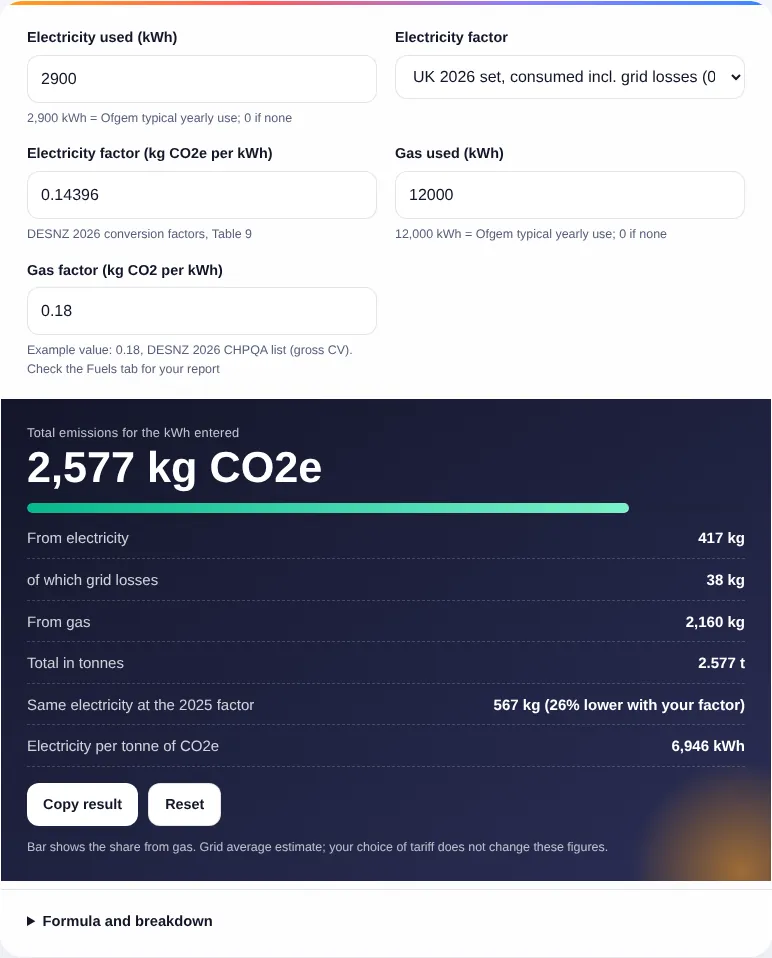
Bar shows the share from gas. Grid average estimate; your choice of tariff does not change these figures.
Formula and breakdown
n/a
n/a
n/a
This kWh to CO2 calculator turns the kilowatt hours on an electricity or gas bill into kilograms and tonnes of carbon dioxide equivalent, for households, landlords and small businesses in the UK, with a custom factor for anyone elsewhere in Europe. It uses the UK government’s 2026 greenhouse gas conversion factors, splits out grid losses and shows how much the 2026 factor changed from 2025.
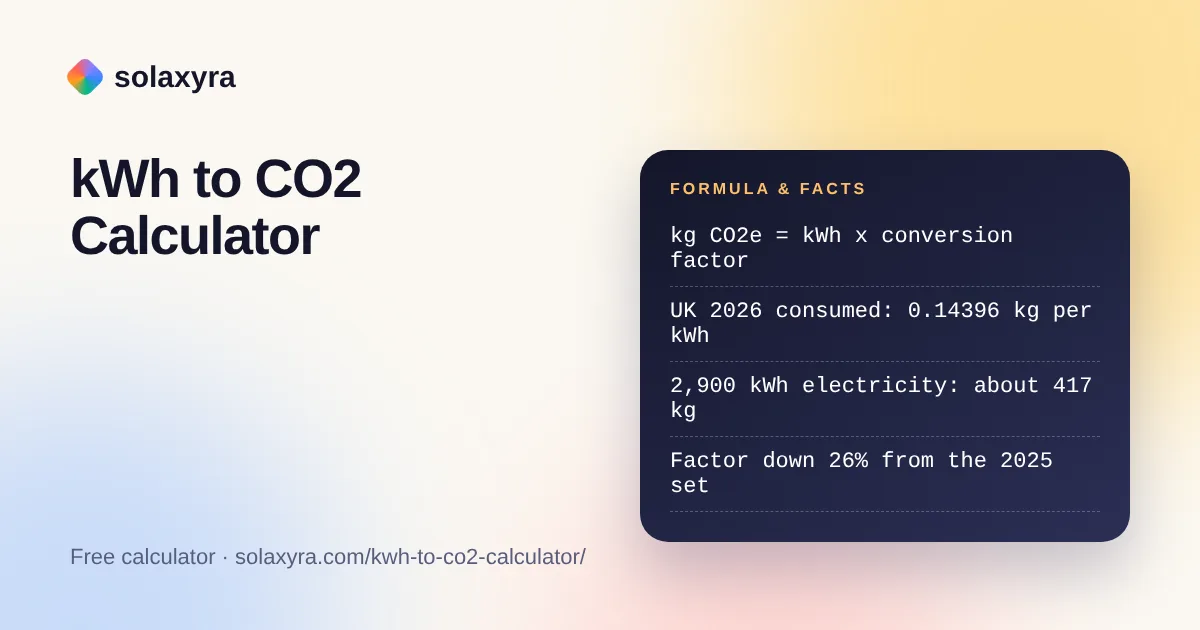
Quick answer: Multiply kWh by an emission factor. With the UK government 2026 factor for electricity consumed, 0.14396 kg CO2e per kWh, a typical 2,900 kWh a year gives about 417 kg CO2e. Gas at an example 0.18 kg per kWh adds about 2,160 kg for 12,000 kWh.
What Is a kWh to CO2 Calculator?
A kWh to CO2 calculator is a tool that converts an amount of energy used into the greenhouse gas emissions linked to it, by multiplying kilowatt hours by a conversion factor in kilograms of CO2 equivalent per kWh. The factor depends on the fuel and, for electricity, on how the grid generated power in the data year.
CO2e, or carbon dioxide equivalent, adds methane and nitrous oxide to carbon dioxide, weighted by their warming effect, so different gases can be reported as one number. The UK factor for electricity in the 2026 set is 0.12943 kg of CO2 plus small amounts of methane and nitrous oxide, giving 0.13096 kg CO2e per kWh generated.
How Do You Use the kWh to CO2 Calculator?
- Enter the electricity kWh from your bill or meter readings for the period you want, or keep the Ofgem typical yearly figure.
- Pick an electricity factor. For a home or office that buys from the grid, the 2026 “consumed” factor is the usual choice because it includes the power lost in the wires.
- Enter your gas kWh, or 0 if you do not use gas. The gas factor is an example value you can change.
- Outside the UK, choose “Custom” and type your country or supplier factor in kg per kWh.
- Read the total, the split between electricity, grid losses and gas, the total in tonnes and the change from the 2025 factor.
What Is the UK Carbon Factor for Electricity in 2026?
For UK grid electricity in 2026 the government factor is 0.13096 kg CO2e per kWh generated, plus 0.01299 kg for transmission and distribution losses, giving 0.14396 kg CO2e per kWh consumed. These figures are in Table 9 of the 2026 methodology paper published by the Department for Energy Security and Net Zero (DESNZ) with the greenhouse gas reporting conversion factors 2026, released on 11 June 2026.
| Factor set | kg CO2e per kWh | Per 1,000 kWh | For 2,900 kWh |
|---|---|---|---|
| UK 2026, generated | 0.13096 | 130.96 kg | 380 kg |
| UK 2026, grid losses | 0.01299 | 12.99 kg | 38 kg |
| UK 2026, consumed (generated plus losses) | 0.14396 | 143.96 kg | 417 kg |
| UK 2025 set, generated | 0.17700 | 177.00 kg | 513 kg |
| UK 2025 set, consumed | 0.19553 | 195.53 kg | 567 kg |
| Natural gas, example (DESNZ CHPQA list, gross CV) | 0.18 | 180 kg | Not used for electricity |
The 2026 factors include imported electricity, which made up 15.5% of supply in the data year. DESNZ’s major changes report puts the fall in the electricity factor at 26%. The 2026 set is based on 2025 data, while the 2025 set used 2023 data, so the newer factor reflects two more years of change on the grid.
How Much CO2 Does 1 kWh of Gas Produce?
Burning natural gas produces roughly 0.18 kg of CO2 per kWh on a gross calorific value basis, the figure listed for natural gas in the CHPQA fuel table (Table 10) of the DESNZ 2026 methodology paper. That table is given for information, so the kWh to CO2 calculator treats 0.18 as an editable example.
For company reporting, use the exact natural gas factor in kWh (gross CV) from the Fuels tab of the official 2026 spreadsheet, since gas bills in the UK are normally stated in gross kWh. We could not read that spreadsheet’s cells when checking this page, which is why the gas figure is not presented as the official reporting factor.
Should I Use the Generated or Consumed Electricity Factor?
Use the consumed factor, 0.14396 kg CO2e per kWh, for electricity bought from the grid, because some power is lost as heat in cables and transformers before it reaches you. Use the generated factor, 0.13096, only when you report losses separately or when you are estimating electricity fed into the grid.
Both are grid average factors: they describe the whole UK grid, not your tariff, so this kWh to CO2 calculator gives the same answer whichever supplier you use. To see how much grid carbon solar panels avoid, use the solar panel savings calculator with our solar carbon savings calculator.
How Do I Convert kWh to CO2 for Other European Countries?
Choose “Custom” and enter your country’s factor in kg per kWh; a figure published in grams per kWh is divided by 1,000. The European Environment Agency indicator gives the greenhouse gas intensity of gross electricity generation in gCO2e per kWh by country, with an early estimate for 2024.
The EEA figures cover generation only, not grid losses, and its country values sit in an interactive chart rather than in text, so this page does not repeat them. Your supplier’s fuel mix disclosure is another source, but it may be market-based.
Worked Example: A Monthly Bill
Example: a two-bedroom flat in Leeds has a monthly bill showing 250 kWh of electricity and 900 kWh of gas.
- Electricity: 250 x 0.14396 = 35.99 kg CO2e, of which 250 x 0.01299 = 3.25 kg is grid losses.
- Gas: 900 x 0.18 (example factor) = 162 kg CO2.
- Total: 35.99 + 162 = 197.99 kg, about 0.198 tonnes for the month.
- At the 2025 consumed factor the electricity would have been 250 x 0.19553 = 48.88 kg, so the same use now counts 26% lower.
Gas makes up over 80% of this flat’s figure. Cutting heat demand, or comparing a heat pump with our heat pump running cost calculator, usually matters more than small electricity savings. The electricity cost calculator prices the same kWh.
Frequently Asked Questions
How much CO2 is 1 kWh of electricity in the UK?
Using the UK government 2026 conversion factors, 1 kWh of grid electricity consumed is 0.14396 kg CO2e, made up of 0.13096 kg for generation and 0.01299 kg for transmission and distribution losses. That is about 144 grams, down from 196 grams in the 2025 set.
How do I convert kWh to kg of CO2?
Multiply the kWh by the emission factor in kg CO2e per kWh. For example, 2,900 kWh of UK electricity times 0.14396 equals 417 kg CO2e. Divide by 1,000 to get tonnes. Use the factor for the right fuel, country and year.
Why did the UK electricity carbon factor fall so much in 2026?
The DESNZ major changes report gives a 26% fall. The 2026 factors are based on 2025 grid data, while the 2025 set used 2023 data, so they capture two more years of change on the grid. Comparisons between years should use the same factor set for both.
Does a green electricity tariff make my emissions zero?
Not with the grid average factors used here, which describe the whole UK grid whoever your supplier is. A tariff-specific figure depends on your supplier’s own evidence for the power it buys, so the kWh to CO2 calculator does not attempt it.
What factor should I use for gas?
For a quick estimate, about 0.18 kg CO2 per kWh, the natural gas figure in the DESNZ 2026 CHPQA table, on a gross calorific value basis. For formal reporting, take the exact gross kWh factor from the Fuels tab of the government’s 2026 conversion factor spreadsheet.
Can I use the kWh to CO2 calculator for a business report?
It is useful for checking figures, but formal company reports should use the official spreadsheet factors for the reporting year and document the method. The electricity factors here match the 2026 methodology paper; the gas factor is an example to replace.
Checked October 2026 by the Solaxyra Editorial Team. Sources: DESNZ: Greenhouse gas reporting conversion factors 2026, DESNZ: 2026 conversion factors methodology paper (Tables 9 and 10), DESNZ: 2026 major changes report, EEA: Greenhouse gas emission intensity of electricity generation, Ofgem: Average gas and electricity use explained.