This guide answers is plug-in solar safe for UK households. It explains the safety rules that took effect on 27 August 2026, the protections built into compliant devices, the checks to make on your sockets and wiring, and how to mount panels securely.
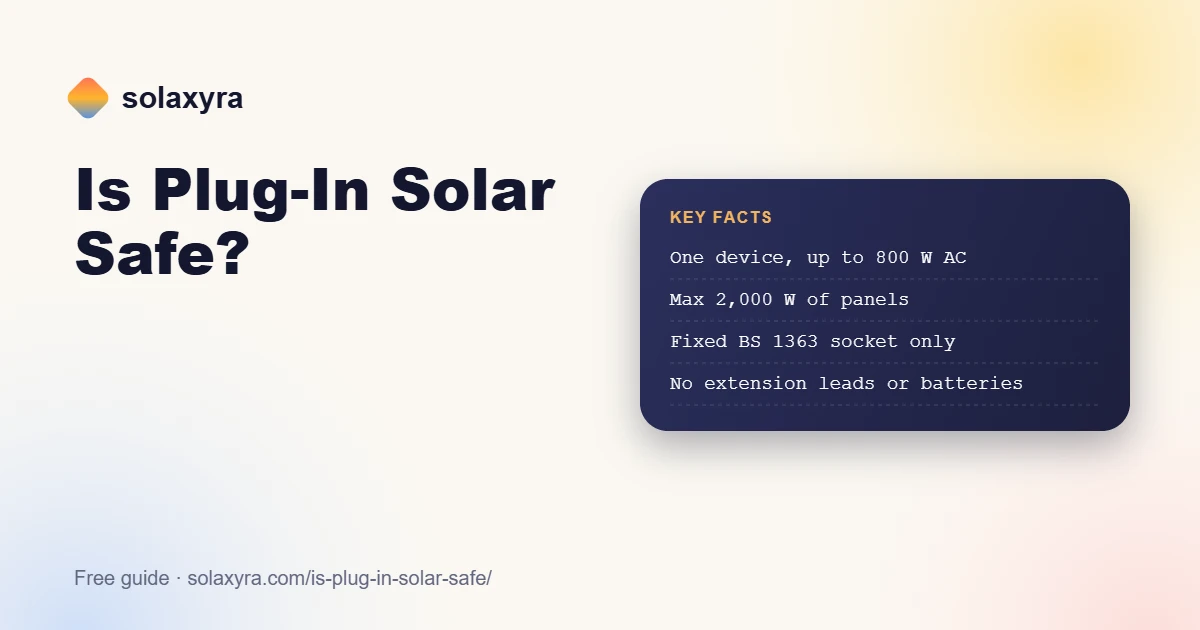
Quick answer: Plug-in solar is designed to be safe when you use a compliant system within the UK rules: one ENA-registered device of up to 800 W AC, with no more than 2,000 W of panels, plugged into a fixed BS 1363 socket and registered online. Its inverter must stop exporting instantly when unplugged, and it must never be used with an extension lead or a battery.
What makes plug-in solar safe?
A compliant plug-in solar device includes a microinverter that only produces power when it detects the grid. If you unplug it, or the grid fails, it shuts down within a fraction of a second, so the plug pins do not become live. Keeping the output at or below 800 W limits the extra current a socket circuit can carry.
The UK rules in brief
From 27 August 2026, households in Great Britain may use one plug-in solar device of up to 800 W AC, with no more than 2,000 W of panels, plugged into a fixed BS 1363 socket. The device must be registered with the Energy Networks Association and registered online, and it must not be used with a battery. Our guide to plug-in solar rules in the UK has the full details.
Safety checks before you plug in
- Use a fixed wall socket. Never use an extension lead, adaptor or multi-way block.
- Check the circuit. The socket should be on a circuit in good condition with RCD protection. If your wiring is old or you are unsure, ask an electrician to check it.
- Avoid heavy loads on the same socket. Do not plug the device into a socket you also use for heaters or other large appliances.
- Use the supplied cable. Keep it away from sharp edges, doors and windows that could trap it.
- Keep connectors dry. Outdoor connections should be weatherproof and off the ground.
Mounting the panels safely
- Use the mounting kit designed for your balcony, wall or ground setup.
- Check balcony rails and walls can take the weight and wind load, and get permission from your landlord or freeholder if needed.
- Make sure panels cannot fall onto people below.
- Avoid shading by railings where possible; it reduces output but is not a safety issue.
What to avoid
- Devices that are not on the approved list or exceed 800 W.
- Connecting more than one device.
- DIY wiring or cutting plugs.
- Using plug-in solar with a home battery.
Is it worth it?
An 800 W system on a good balcony in southern England might produce around 500 to 700 kWh a year. If most of that replaces electricity you would buy at the October to December 2026 cap of 26.32p per kWh, it could save roughly £130 to £180 a year.
Frequently Asked Questions
Is plug-in solar legal in the UK?
Yes, in Great Britain since 27 August 2026, within the rules on power, registration and connection.
Can plug-in solar overload a socket?
At up to 800 W on a fixed socket in good condition, the risk is low; never use an extension lead.
Does plug-in solar need an electrician?
Not to plug in, but an electrician should check old or doubtful wiring.
What happens if I unplug plug-in solar?
A compliant inverter stops output immediately, so the plug pins are not live.
Checked November 2026 by the Solaxyra Editorial Team. Sources: Energy Networks Association, Electrical Safety First, Ofgem: Energy price cap, 1 October to 31 December 2026.