This guide covers how to reduce your electricity bill with changes that make a measurable difference, ranked roughly by how much they can save. Every figure uses the October to December 2026 cap of 26.32p per kWh, so you can see the value in pounds rather than percentages.
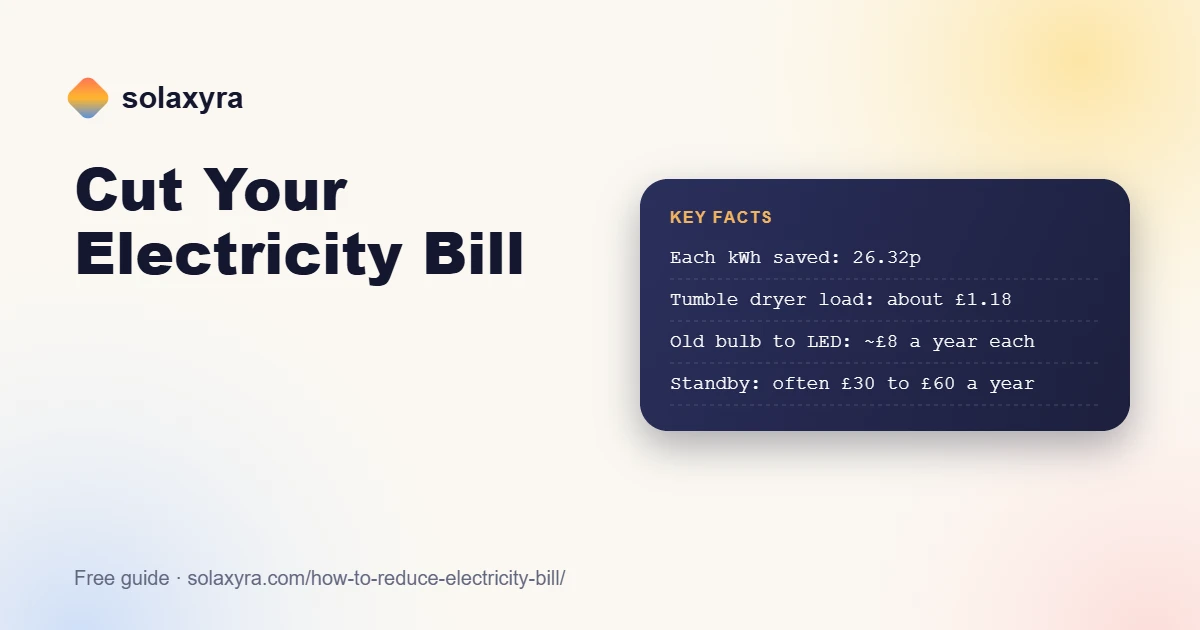
Quick answer: Start with the biggest users: heating, hot water, tumble drying and cooking. Then check your tariff, shift flexible use to cheaper times if you have a time-of-use tariff, cut standby waste and swap remaining old bulbs for LEDs. Each kWh you avoid saves 26.32p at the current cap.
Where does the electricity go?
In a home without electric heating, the biggest users are usually the fridge and freezer, cooking, laundry and drying, lighting, and the TV and computer equipment. In homes with electric heating or an electric shower, heating and hot water dwarf everything else. Our guide to what uses the most electricity at home has the breakdown.
15 ways to cut your electricity bill
- Check your tariff. A fixed deal below the cap or a time-of-use tariff can cut costs if your usage suits it.
- Use off-peak hours. On an Economy 7 or smart tariff, run the dishwasher, washing machine and EV charging at cheap times.
- Dry clothes outdoors or on an airer. A vented tumble dryer can use around 4.5 kWh a load, about £1.18.
- Wash at 30°C. Most of a washing machine’s energy goes on heating water.
- Fill the dishwasher and use eco mode. Eco programmes run longer but heat less water.
- Boil only the water you need. A full 1.7-litre kettle uses about 0.2 kWh, around 5p.
- Use smaller appliances for cooking. An air fryer or microwave usually uses far less than the oven for small meals.
- Swap to LED bulbs. A 60 W old bulb used 3 hours a day costs about £17 a year; an 8 W LED costs about £2.30.
- Switch off standby. Consoles, TVs, set-top boxes and chargers left on standby can add £30 to £60 a year.
- Defrost the freezer and check door seals. Ice and poor seals make the compressor work harder.
- Turn down the electric shower time. A 9.5 kW shower for 8 minutes uses about 1.27 kWh, about 33p.
- Heat one room, not the house. If you use electric heaters, heat the room you are in and close the door.
- Replace a very old fridge or freezer. An old model can use twice the energy of a new one.
- Consider solar panels. Solar output used at home avoids buying that kWh at 26.32p.
- Get a smart meter. It shows usage in near real time and enables cheaper smart tariffs.
How much can you save?
The table shows typical savings at 26.32p per kWh. Your figures depend on how you use each appliance.
| Change | Typical energy saved per year | Saving |
|---|---|---|
| Air dry 3 loads a week instead of a vented dryer | about 700 kWh | about £184 |
| Wash at 30°C instead of 40°C | about 50 kWh | about £13 |
| Replace 8 old 60 W bulbs with LEDs, used 1.5 hours a day | about 230 kWh | about £60 |
| Cut 25 W of standby | about 220 kWh | about £58 |
| Shorten 2 electric showers a day by 2 minutes | about 230 kWh | about £61 |
Should you switch supplier?
When the price cap applies, standard variable tariffs are priced at or below the cap, so the gains come from fixed deals priced below it or tariffs that reward flexible use. Compare the unit rate and standing charge, and work out the yearly cost using your own usage. Our standing charge calculator shows the true price per kWh once standing charges are included.
Don’t forget the standing charge
At the October to December 2026 cap the electricity standing charge is 54.83p a day, about £200 a year. You pay it regardless of use, so cutting kWh lowers the variable part of your bill only.
Frequently Asked Questions
What uses the most electricity in a home?
Electric heating and hot water where they exist; otherwise tumble dryers, cooking, fridges and freezers.
Does switching things off at the wall save money?
Yes, for devices with high standby use, such as older TVs, consoles and set-top boxes.
Is it cheaper to run appliances at night?
Only on a time-of-use tariff with a cheaper night rate.
How can I see what my home uses?
A smart meter display, your supplier’s app or a plug-in energy monitor.
Checked November 2026 by the Solaxyra Editorial Team. Sources: Ofgem: Energy price cap, 1 October to 31 December 2026, Energy Saving Trust: Quick tips to save energy.