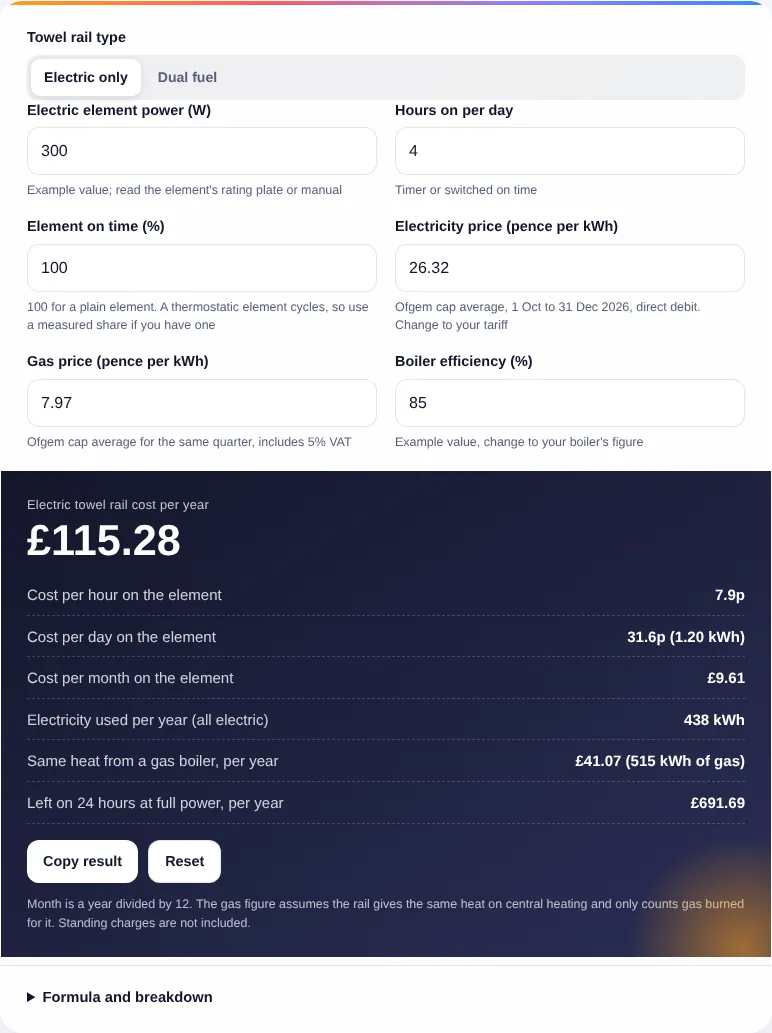
Month is a year divided by 12. The gas figure assumes the rail gives the same heat on central heating and only counts gas burned for it. Standing charges are not included.
Formula and breakdown
n/a
n/a
n/a
This heated towel rail running cost calculator works out what an electric or dual fuel towel rail costs to run per hour, day, month and year, and compares it with getting the same heat from a gas boiler, for households in the UK, Ireland and the rest of Europe. It also shows how much a timer saves compared with leaving the rail on all day.
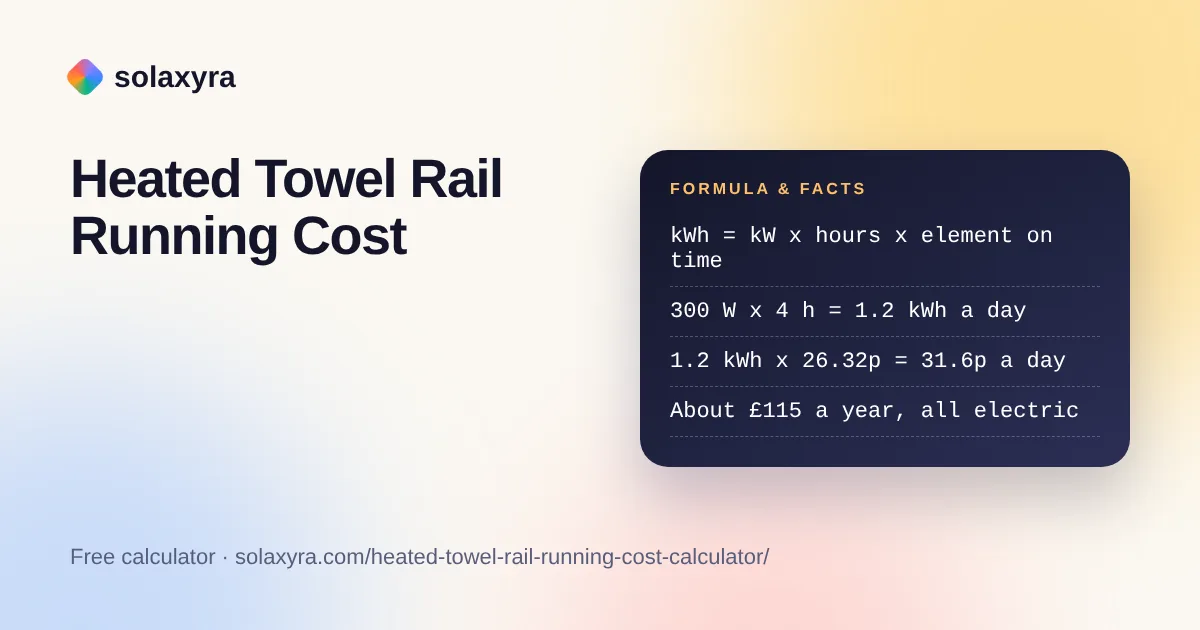
Quick answer: A heated towel rail running cost calculator multiplies the element power in kW by hours on, the share of time the element heats and your unit price. A 300 W electric rail on for 4 hours a day uses 1.2 kWh, about 31.6p a day or £115.28 a year at the 26.32p Ofgem cap rate.
What Is a Heated Towel Rail Running Cost Calculator?
A heated towel rail running cost calculator is a tool that turns a towel rail's element wattage and daily hours into kilowatt-hours and then into money at your electricity price. In plain words: energy per day in kWh = watts / 1,000 x hours on x the share of time the element is heating, and cost = kWh x price per kWh. A year is the daily cost times 365, and a month is that year divided by 12.
The element-on share matters because only some elements cycle. A plain element heats for the whole time it is switched on, so 100% is right. A thermostatic element switches off when the fluid inside the rail reaches its set temperature, so it draws full power for only part of each hour. If you have measured the rail with a plug-in energy monitor, enter the share it shows.
How Do You Use the Heated Towel Rail Running Cost Calculator?
- Choose Electric only, or Dual fuel if the rail is plumbed into central heating and also has an electric element for summer use.
- Enter the element power in watts from its rating plate, box or manual.
- Enter how many hours a day it is switched on, for example by a timer or a fused spur switch.
- Leave the element on time at 100% for a plain element, or lower it for a thermostatic one you have measured.
- Check the electricity and gas prices. The defaults are the Ofgem cap averages for 1 October to 31 December 2026.
- Enter your boiler efficiency, and for dual fuel the number of months a year the rail runs on its electric element.
How Much Does a Heated Towel Rail Cost to Run per Hour?
An electric towel rail at full power costs its wattage in kW times your unit price per hour: a 300 W element costs 0.3 x 26.32p = 7.9p an hour at the October to December 2026 cap rate. A thermostatic element that heats half the time costs half that. The table shows full-power costs for common element sizes, and the heated towel rail running cost calculator above handles any other rating.
| Element power | Per hour | 2 hours a day | 4 hours a day | Per year at 4 hours a day | Per year left on 24 hours |
|---|---|---|---|---|---|
| 100 W | 2.6p | 5.3p | 10.5p | £38.43 | £230.56 |
| 150 W | 3.9p | 7.9p | 15.8p | £57.64 | £345.84 |
| 200 W | 5.3p | 10.5p | 21.1p | £76.85 | £461.13 |
| 300 W | 7.9p | 15.8p | 31.6p | £115.28 | £691.69 |
| 400 W | 10.5p | 21.1p | 42.1p | £153.71 | £922.25 |
| 600 W | 15.8p | 31.6p | 63.2p | £230.56 | £1,383.38 |
| 800 W | 21.1p | 42.1p | 84.2p | £307.42 | £1,844.51 |
Figures use 26.32p per kWh with the element heating 100% of the time. The last column shows why a timer matters: a 300 W rail left on all day at full power costs six times as much as the same rail on for 4 hours. For any other appliance with a fixed wattage, the electricity cost calculator applies the same method.
Is It Cheaper to Run a Towel Rail on Central Heating or Electric?
On the October to December 2026 cap prices, central heating is usually cheaper per unit of heat: gas at 7.97p per kWh burned in a boiler that is 85% efficient costs about 9.4p per kWh of heat, against 26.32p for the electric element. With the default inputs the heated towel rail running cost calculator shows £115.28 a year on electricity and about £41.07 for the same heat from gas.
The comparison has limits. A plumbed rail only warms when the boiler is heating, so in summer it is cold unless you fire the whole system. The boiler efficiency here is an example value; use your boiler's own figure. Gas under the cap includes 5% VAT, while Ofgem's cap announcement says VAT is removed from electricity bills from 1 October 2026 to 31 March 2027, which narrows the gap slightly. If you heat with a heat pump instead of gas, the heat pump running cost calculator gives a fairer comparison.
How Does a Dual Fuel Towel Rail Work and What Does It Cost?
A dual fuel towel rail is plumbed into the central heating like a radiator and also has an electric element, so it can warm towels from the boiler in winter and from electricity in summer. The towel warmer article on Wikipedia describes this combined arrangement, with hot water heating the rail in winter and electricity in summer.
The heated towel rail running cost calculator splits the year: months on the element are charged at the electric rate, and the rest at the gas cost of the same heat. With 5 summer months on a 300 W element and 7 months on central heating, both for 4 hours a day, the yearly cost is about £71.99. Change the months to match how you really use it.
How Much Does a Timer Save on a Heated Towel Rail?
A timer saves the full cost of every hour the rail would otherwise run: cutting a 300 W rail from 24 hours to 4 hours a day saves about £576 a year at 26.32p per kWh. The breakdown under the heated towel rail running cost calculator shows this saving for your own inputs whenever Electric only is selected.
Try two hours after a morning shower and two in the evening, then adjust the hours in the heated towel rail running cost calculator to match what dries your towels. A thermostatic element reduces cost further when the rail is already warm. To see the rail alongside your other appliances, add it to the household energy consumption calculator, and for a portable room heater use the electric heater cost calculator.
Who Can Install an Electric Towel Rail in a Bathroom?
A hard-wired electric or dual fuel towel rail must be connected by a qualified electrician, and in the UK the work must meet BS 7671. In England, Approved Document P makes a new circuit notifiable, and also any addition or alteration to existing circuits in the special location around a bath or shower: up to 2.25 m high and 0.6 m from the edge of the bath or shower tray. A registered electrician can self-certify and notify the work for you.
The plumbing side of a dual fuel rail, such as fitting the T-piece that lets the element and the water connection share the rail, should be done by a competent plumber. Never fit a plain electric element into a rail that is not designed or approved for one by its manufacturer.
Worked Example: Electric or Dual Fuel for a Family Bathroom?
Example: a household in Manchester compares a 400 W electric-only rail with a dual fuel rail of similar output. The rail runs 3 hours a day. The electricity price is 26.32p, gas 7.97p, and the boiler efficiency of 88% is an example value. The dual fuel rail uses its element for 4 months a year. Entering these values in the heated towel rail running cost calculator gives the same results.
- Electricity per day: 0.4 kW x 3 h = 1.2 kWh, which is 31.6p a day.
- Electric only for a year: 31.584p x 365 = £115.28.
- Gas for the same heat: 1.2 kWh / 0.88 = 1.364 kWh a day x 7.97p x 365 = £39.67 a year.
- Dual fuel: £115.28 x 4/12 + £39.67 x 8/12 = £38.43 + £26.45 = £64.87 a year.
- Difference: the dual fuel rail costs about £50.41 a year less than electric only with these inputs.
Frequently Asked Questions
How much does it cost to run a heated towel rail for an hour?
Multiply the element power in kW by your unit price. At 26.32p per kWh a 100 W element costs about 2.6p an hour, a 300 W element 7.9p and a 600 W element 15.8p at full power. A thermostatic element that cycles off costs less than these figures.
Is it expensive to leave a heated towel rail on all the time?
It can be. A 300 W rail left on 24 hours a day at full power uses 7.2 kWh a day, about £691.69 a year at 26.32p per kWh. Running the same rail for 4 hours a day costs about £115.28. A timer or a thermostatic element cuts the cost sharply.
Is a dual fuel towel rail cheaper to run?
Usually, when it runs on gas central heating for most of the year. At current cap prices, boiler heat costs roughly a third of electric heat per kWh. The saving depends on how many months you use the electric element and on your boiler's efficiency, which the calculator lets you change.
Does a thermostatic element save money?
It can, because it switches off once the rail reaches its set temperature, so it does not draw full power for the whole time it is on. The saving depends on the room and the setting. Measure the rail with a plug-in energy monitor and enter the share of time it actually heats.
Should I include the standing charge?
No. The standing charge is a fixed daily amount you pay whether or not the towel rail is on, so it does not change with use. Only the unit rate affects the running cost of one appliance, which is why the calculator leaves standing charges out.
Do I need an electrician to fit an electric towel rail?
Yes for a hard-wired rail. Fixed wiring in a bathroom must meet BS 7671, and in England work on circuits close to a bath or shower is notifiable under Part P of the Building Regulations. A registered electrician can do the work and notify it for you.
Checked October 2026 by the Solaxyra Editorial Team. Sources: Ofgem: Energy price cap 1 October to 31 December 2026, GOV.UK: Approved Document P, Electrical safety, dwellings, Wikipedia: Towel warmer.