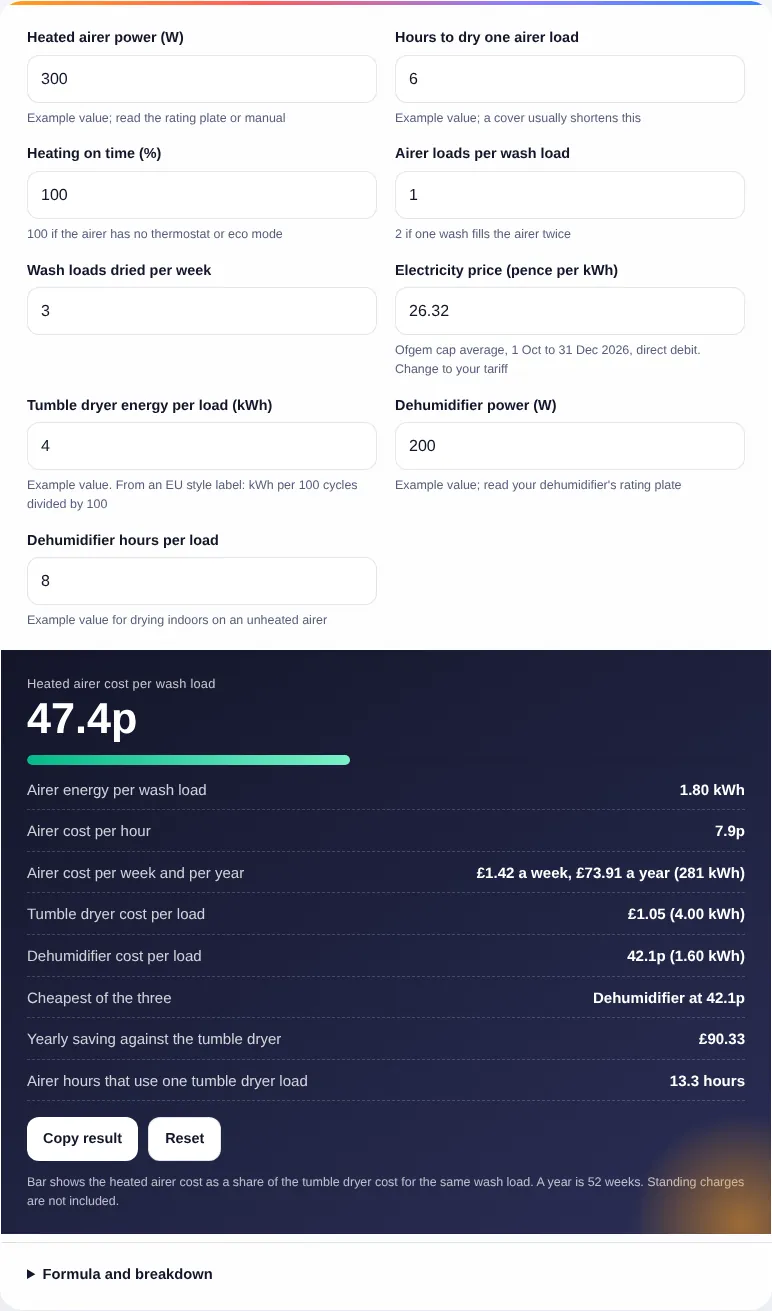
Bar shows the heated airer cost as a share of the tumble dryer cost for the same wash load. A year is 52 weeks. Standing charges are not included.
Formula and breakdown
n/a
n/a
n/a
This heated airer running cost calculator works out what a heated clothes airer costs to run per hour, per wash load, per week and per year, and compares it with a tumble dryer and a dehumidifier drying the same load, for households in the UK, Ireland and the rest of Europe. It uses your airer’s wattage, drying time and electricity price.
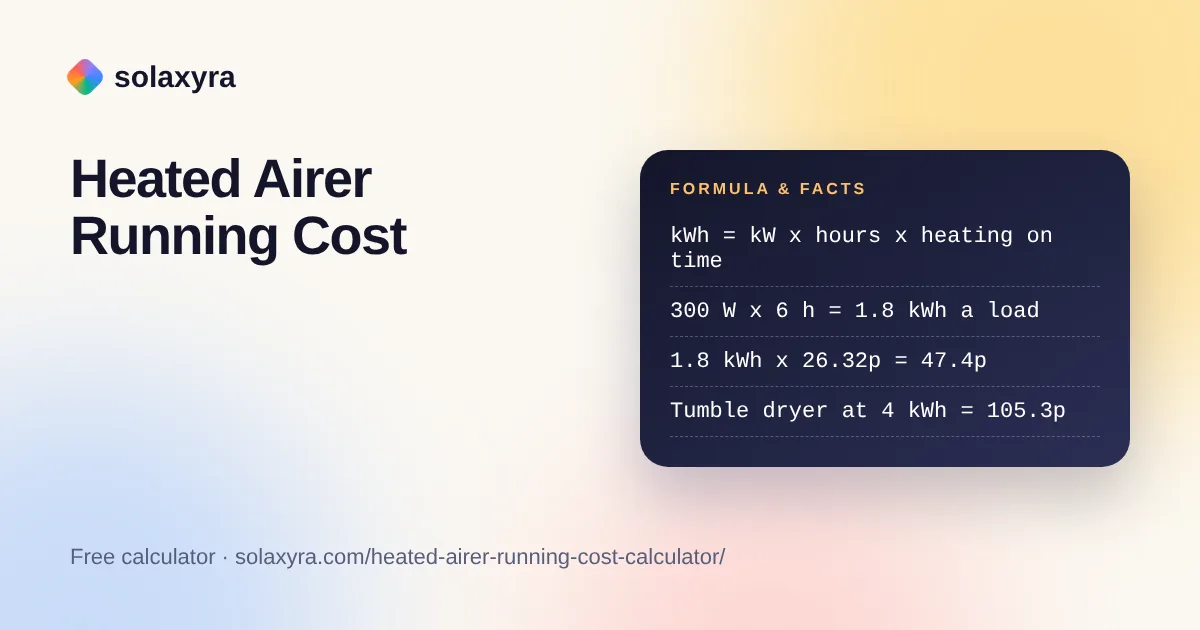
Quick answer: A heated airer running cost calculator multiplies the airer’s power in kW by drying hours and your unit price. A 300 W heated airer running 6 hours uses 1.8 kWh, about 47.4p a load at the 26.32p Ofgem cap rate, against 105.3p for a tumble dryer using 4 kWh per load.
What Is a Heated Airer Running Cost Calculator?
A heated airer running cost calculator is a tool that converts a heated clothes airer’s power rating and drying time into kilowatt-hours and then into money at your electricity price. In plain words: energy per wash load in kWh = watts / 1,000 x hours x the share of time the heating is on x the number of airer loads per wash, and cost = kWh x price per kWh.
Most simple heated airers have no thermostat, so they heat for the whole time they are switched on and the share is 100%. Some models have an eco or timer setting; if yours does, measure it with a plug-in energy monitor and enter the share it reports. If one wash fills the airer twice, set airer loads per wash to 2 so the cost compares fairly with one tumble dryer load.
How Do You Use the Heated Airer Running Cost Calculator?
- Enter the airer’s power in watts from its rating plate, box or manual.
- Enter how many hours it takes to dry one airer load in your home.
- Leave heating on time at 100% unless you have measured a lower figure.
- Enter how many airer loads one wash needs and how many washes a week you dry this way.
- Check the electricity price. The default is the Ofgem cap average for 1 October to 31 December 2026.
- Enter your tumble dryer’s energy per load and your dehumidifier’s power and hours to compare all three methods.
How Much Does a Heated Airer Cost to Run per Hour?
A heated airer costs its wattage in kW times your unit price per hour: a 300 W airer costs 0.3 x 26.32p = 7.9p an hour at the October to December 2026 cap rate, and a 230 W model about 6.1p. Drying time drives the total, so a load that takes 8 hours costs more than double one that takes 3. The table shows typical combinations.
| Airer power | Per hour | 4 hour load | 6 hour load | 8 hour load | Per year, 3 loads a week of 8 hours |
|---|---|---|---|---|---|
| 150 W | 3.9p | 15.8p | 23.7p | 31.6p | £49.27 |
| 200 W | 5.3p | 21.1p | 31.6p | 42.1p | £65.69 |
| 230 W | 6.1p | 24.2p | 36.3p | 48.4p | £75.55 |
| 300 W | 7.9p | 31.6p | 47.4p | 63.2p | £98.54 |
| 400 W | 10.5p | 42.1p | 63.2p | 84.2p | £131.39 |
| 1,000 W drying pod | 26.3p | 105.3p | 157.9p | 210.6p | £328.47 |
Figures use 26.32p per kWh with the heating on all the time. The wattages are examples to compare against; your airer’s rating plate gives the real figure. The watts to kWh calculator converts any other rating and time.
Is a Heated Airer Cheaper Than a Tumble Dryer?
Usually yes against a vented or condenser dryer, but not always against a heat pump dryer. With the defaults, the heated airer running cost calculator shows 47.4p a load against 105.3p for a dryer using 4 kWh, a saving of about £90.33 a year at three loads a week. The break-even row shows how many airer hours use the same electricity as one dryer load: 13.3 hours here.
To find your dryer’s energy per load, use its energy label or product information sheet. Under EU Regulation 2023/2534, which applies from 1 July 2025, the tumble dryer label shows weighted energy consumption per 100 drying cycles in kWh; divide by 100 for one load. The Energy Saving Trust notes these labels came into use in Northern Ireland on that date and that heat pump dryers are much cheaper to run than condenser models. For a full dryer comparison, the tumble dryer running cost calculator covers vented, condenser and heat pump types.
Is a Heated Airer or a Dehumidifier Cheaper for Drying Clothes?
It depends on wattage and hours: a 200 W dehumidifier running 8 hours uses 1.6 kWh, about 42.1p, which is slightly less than the 47.4p default airer load. The heated airer running cost calculator puts both side by side and names the cheapest of the three methods for your inputs.
A dehumidifier also removes the moisture from the room, while a heated airer adds warmth but leaves the water vapour in the air, so ventilate the room or open a window when using one. Many households combine an unheated airer with a dehumidifier. The dehumidifier running cost calculator shows compressor and desiccant models in more detail.
How Much Does a Heated Airer Cost per Year?
With the default example in the heated airer running cost calculator, three wash loads a week on a 300 W airer for 6 hours each cost about £73.91 a year and use 281 kWh at 26.32p per kWh. A cover that traps the warm air can shorten drying time, and every hour saved removes 7.9p from each load on a 300 W model. Spin clothes at the highest speed the fabric allows before drying, so there is less water to remove.
To see the airer alongside the kettle, fridge and other appliances in one total, add it to the energy consumption calculator. The yearly saving only applies to loads you would otherwise have tumble dried; loads that would have dried outside cost nothing to dry.
What Electricity Price Should I Use?
Use the unit rate on your latest bill. On a default tariff in England, Scotland or Wales, Ofgem’s cap announcement gives an average of 26.32p per kWh for electricity paid by direct debit from 1 October to 31 December 2026, and says VAT is removed from electricity bills from 1 October 2026 to 31 March 2027. If you are on a time of use tariff, enter the rate for the hours the airer runs into the heated airer running cost calculator. Standing charges are left out because you pay them whichever way you dry.
Worked Example: Heated Airer, Heat Pump Dryer or Dehumidifier?
Example: a household in Glasgow dries four wash loads a week. It compares a 230 W heated airer taking 7 hours per load, a heat pump tumble dryer using 1.5 kWh per load, and a 160 W dehumidifier running 10 hours with an unheated airer. The price is 26.32p per kWh. The dryer energy, drying times and dehumidifier figures are example values.
- Heated airer: 0.23 kW x 7 h = 1.61 kWh, or 42.4p a load.
- Heat pump dryer: 1.5 kWh x 26.32p = 39.5p a load.
- Dehumidifier: 0.16 kW x 10 h = 1.6 kWh, or 42.1p a load.
- Break-even: 1.5 / 0.23 = 6.5 airer hours, so the airer is cheaper only if loads dry in under about 6.5 hours.
- Over a year of 208 loads, the heat pump dryer costs about £82.12 and the heated airer about £88.14, so the dryer is about £6.02 a year cheaper with these inputs.
The heated airer running cost calculator reproduces this result: enter the same figures and the yearly saving row reports that the tumble dryer is cheaper.
Frequently Asked Questions
How much does a heated airer cost to run per hour?
Multiply its wattage in kW by your unit price. At 26.32p per kWh a 230 W heated airer costs about 6.1p an hour and a 300 W model about 7.9p. A 1,000 W drying pod costs about 26.3p an hour. Check the rating plate for your model’s wattage.
Is a heated airer cheaper than a tumble dryer?
Against a vented or condenser dryer, usually yes. Against an efficient heat pump dryer the gap is small and can reverse when drying takes many hours. Divide the dryer’s energy per load by the airer’s power in kW to find the break-even number of drying hours.
How many hours does a heated airer take to dry clothes?
It varies with the load, fabric, room temperature and whether you use a cover, so the calculator treats drying time as your input. Time a typical load once, then use that figure. Fewer hours per load lowers the cost in direct proportion.
Can I leave a heated airer on overnight?
Follow the manufacturer’s instructions for your model, as some include a timer or recommend limits. Never cover the airer with anything the manual does not allow, keep it away from water and plug it directly into a wall socket rather than an overloaded extension lead.
Does a heated airer cause damp?
It can add moisture to the room, because the water in the clothes evaporates into the air. Open a window, use an extractor fan or run a dehumidifier in the same room. Drying in a small closed room without ventilation increases condensation risk.
Should I include the standing charge?
No. The standing charge is a fixed daily amount you pay whether or not you dry clothes, so it does not change with the airer’s use. Only the unit rate matters when comparing the running cost of drying methods.
Checked October 2026 by the Solaxyra Editorial Team. Sources: Ofgem: Energy price cap 1 October to 31 December 2026, EUR-Lex: Commission Delegated Regulation (EU) 2023/2534, Energy Saving Trust: Heat pump tumble dryers and the new energy labels.