Night costs assume the full heat loss for every hour, so they are an upper limit; milder nights cost less with a thermostat. Paraffin and gas heaters need ventilation.
Formula and breakdown
n/a
n/a
n/a
n/a
This greenhouse heater calculator works out the heater output, in watts, that a garden greenhouse needs to stay frost free or warm on the coldest night, for growers in the UK and Europe. It measures the glazed area from the length, width, eaves and ridge heights in feet or metres, applies a U-value for glass, bubble wrap or twinwall polycarbonate, and compares the cost of a night’s heating with electric, paraffin and propane heaters.
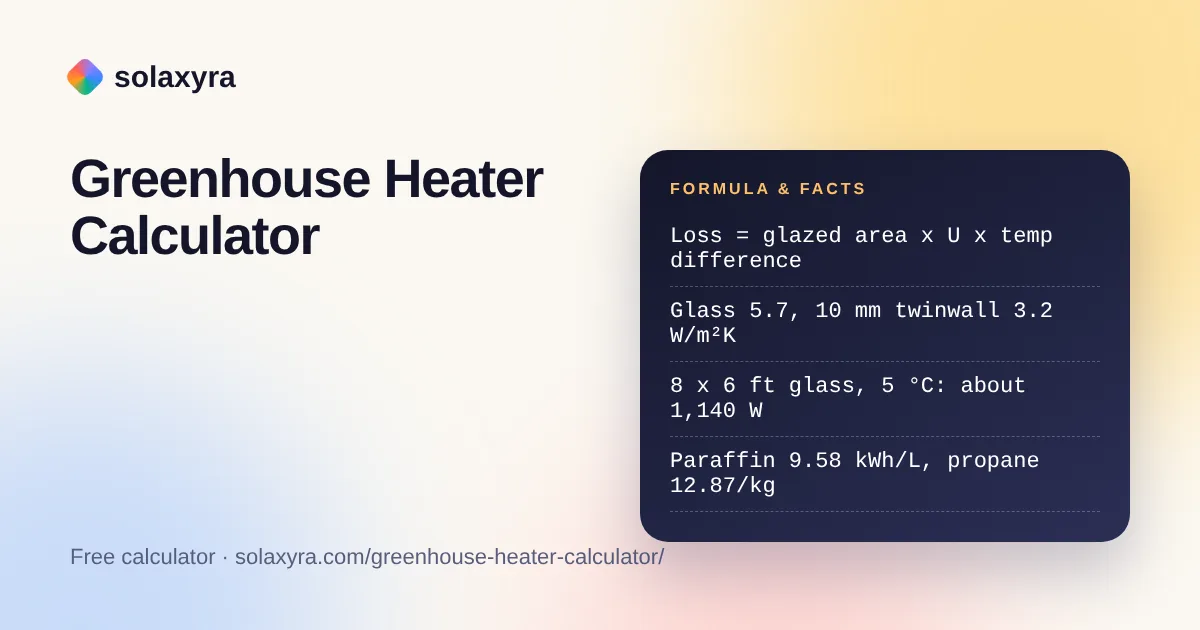
Quick answer: A greenhouse heater calculator multiplies the glazed area by the glazing U-value and the inside to outside temperature difference, then adds air leakage. An 8 x 6 ft single-glass greenhouse kept at 5 °C on a minus 5 °C night loses about 1,140 W, so a 1.4 kW heater with a 20% margin suits it.
What Is a Greenhouse Heater Calculator?
A greenhouse heater calculator is a tool that estimates the heat a greenhouse loses on a cold night so you can choose a heater large enough to replace it. In plain words: glazing loss equals glazed area times U-value times the difference between the minimum inside temperature and the coldest outside temperature; air leakage adds 0.33 times air changes per hour times the greenhouse volume times the same difference; the heater should match the total plus a safety margin.
In a greenhouse heater calculator, almost all of the loss is through the glass or plastic, because thin glazing insulates poorly. The Wikipedia article on thermal transmittance gives single glazing a U-value of 5.7 W/m²K, which means each square metre loses 5.7 W for every degree of difference. A floor of soil is left out of the sum, since the ground under a greenhouse is usually warmer than the night air.
How Do You Use the Greenhouse Heater Calculator?
- Choose feet or metres, then enter the length, width, eaves height and ridge height of the greenhouse.
- Pick the glazing: single glass, glass lined with bubble wrap, or twinwall polycarbonate, or type your own U-value.
- Choose frost protection, a cool or a warm greenhouse, or enter your own minimum temperature.
- Enter the coldest night you want to cover, the air change rate and a safety margin.
- Set the hours of heating per night and your electricity, paraffin and propane prices.
- Read the heater size, the heat loss split and the cost of a cold night for each fuel.
What Size Heater Do I Need for My Greenhouse?
An 8 x 6 ft single-glass greenhouse needs about 1.4 kW to stay at 5 °C on a minus 5 °C night, falling to about 0.8 kW once it is lined with bubble wrap or glazed with 10 mm twinwall polycarbonate. Keeping the same greenhouse at 10 °C needs about 2.1 kW. The greenhouse heater calculator rows below all use 1 air change per hour, a 20% margin and a 12-hour night at the full cold-night loss.
| Example greenhouse | Glazing U-value | Inside / outside | Heat loss | Heater size | Electric per cold night |
|---|---|---|---|---|---|
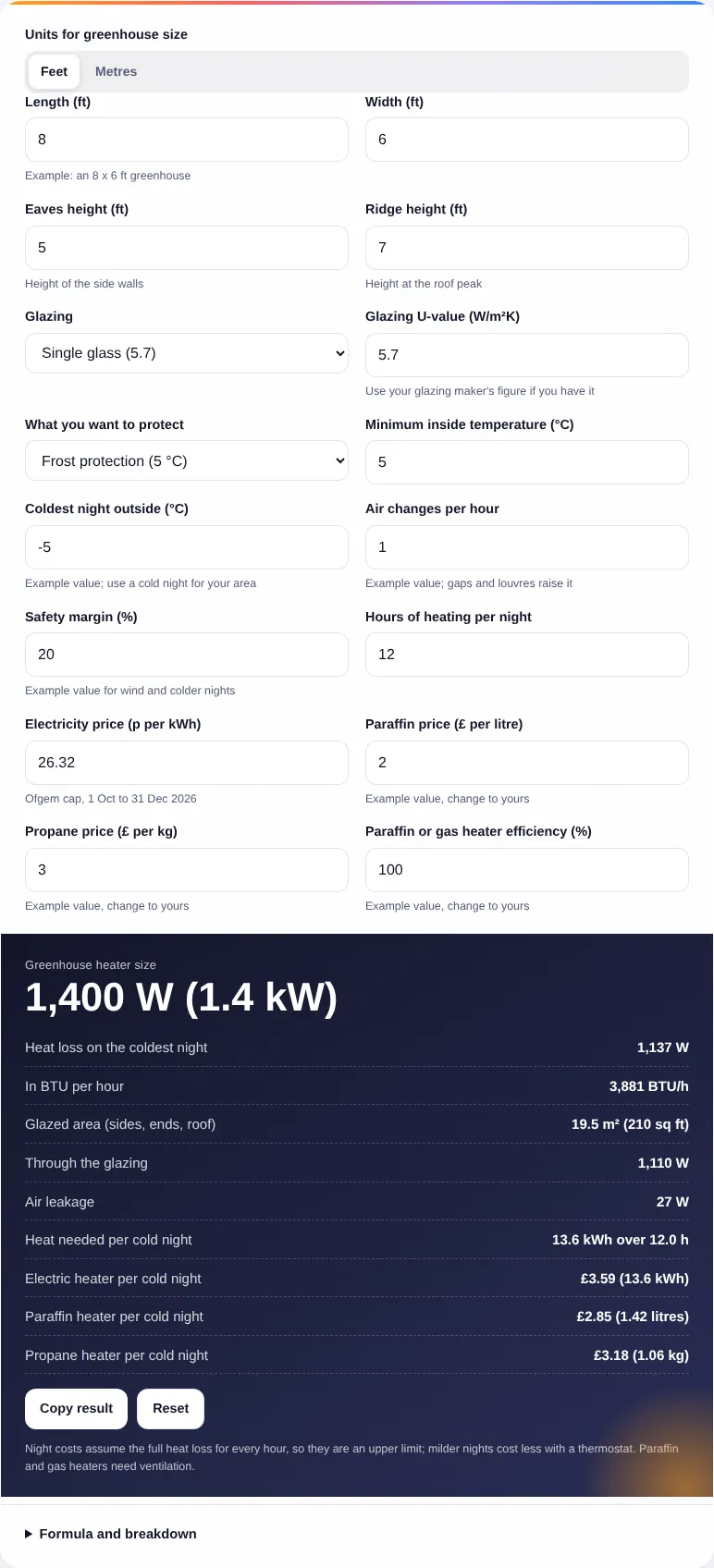
| 8 x 6 ft, single glass (default) | 5.7 | 5 °C / minus 5 °C | 1,137 W | 1,400 W | £3.59 |
| 8 x 6 ft, glass lined with bubble wrap | 3.1 (example) | 5 °C / minus 5 °C | 631 W | 800 W | £1.99 |
| 8 x 6 ft, 4 mm twinwall polycarbonate | 3.9 | 5 °C / minus 5 °C | 787 W | 1,000 W | £2.48 |
| 8 x 6 ft, 10 mm twinwall polycarbonate | 3.2 | 5 °C / minus 5 °C | 650 W | 800 W | £2.05 |
| 8 x 6 ft, single glass, cool house | 5.7 | 10 °C / minus 5 °C | 1,706 W | 2,100 W | £5.39 |
| 10 x 8 ft, single glass, 5.5 ft eaves, 8 ft ridge | 5.7 | 5 °C / minus 5 °C | 1,704 W | 2,100 W | £5.38 |
The 8 x 6 ft examples assume 5 ft eaves and a 7 ft ridge, which gives about 19.5 m² of glazing. A night at the full loss for 12 hours is an upper limit: with a thermostat, the heater only runs as hard as the night requires.
What U-Value Should I Use for Glass, Polycarbonate and Bubble Wrap?
Use 5.7 W/m²K for single glass, 3.9 W/m²K for 4 mm twinwall polycarbonate and 3.2 W/m²K for 10 mm twinwall, taken from Wikipedia and Storm Building Products’ data sheets. The 4 mm PC4 sheet is listed at 3.9 W/m²K with 85% light transmission for the clear version, and the 10 mm PC10 sheet at 3.2 W/m²K.
No primary source publishes a U-value for horticultural bubble wrap, so the 3.1 W/m²K preset is an example value. It comes from greenhouse maker Hartley Botanic, whose heating calculator uses a heat loss factor of 1.1 for single glass and 0.6 for a bubble wrap lined glasshouse; applying that ratio to 5.7 gives 3.1. Treat it as a starting point, and check the greenhouse heater calculator result against how your heater copes on a frosty night.
How Much Does It Cost to Heat a Greenhouse Overnight?
Heating the default 8 x 6 ft glass greenhouse through a 12-hour, minus 5 °C night takes about 13.6 kWh, which costs about £3.59 with electricity at 26.32p per kWh, the Ofgem price cap rate from 1 October to 31 December 2026. With the example fuel prices, the same heat costs about £2.85 from paraffin (1.42 litres) and £3.18 from propane (1.06 kg).
Paraffin, called kerosene outside the UK, holds about 9.58 kWh per litre: the Wikipedia kerosene article gives a lower heating value of 43.1 MJ/kg and a density of about 0.80 kg per litre. Propane gives about 12.87 kWh per kg, from the lower heating value of 2,043 kJ per mole in Wikipedia’s propane article. In the greenhouse heater calculator, change the example prices to what you pay; paraffin and bottled gas prices vary widely by retailer and bottle size. For electric heaters, our electric heater running cost calculator shows the effect of a thermostat duty cycle.
Is an Electric, Paraffin or Gas Greenhouse Heater Best?
An electric heater with a thermostat is the easiest to control and adds no fumes or water vapour, while paraffin and propane heaters suit greenhouses with no power supply but need ventilation. Burning propane produces carbon dioxide and water vapour, and without enough oxygen it also forms carbon monoxide and soot, as the propane article explains. The NHS lists gas and paraffin heaters among sources of carbon monoxide, so never sit or sleep in a greenhouse or shed with one burning.
Power for an electric heater must be safe outdoors. A permanent supply to a greenhouse needs a suitable outdoor circuit designed and installed by a qualified electrician to BS 7671; do not run an indoor extension lead down the garden. Our watts to amps calculator shows the current a heater draws, and the greenhouse heater calculator result tells you the wattage to look for.
How Much Does Insulating a Greenhouse Save?
Lining the default glass greenhouse with bubble wrap cuts its frost protection heat loss from about 1,137 W to 631 W in the greenhouse heater calculator, a reduction of about 45%, which halves the size of heater needed and saves about £1.60 on a cold night of electric heating. Twinwall polycarbonate gives a similar result from the start.
Check that any lining still lets enough light reach your plants. Reducing draughts helps too: louvres and gaps around doors raise the air change rate, although in a small greenhouse leakage is a small share of the total compared with the glazing. Use the electricity cost calculator to compare a season of heating before and after insulating.
Worked Example: 8 x 6 ft Glass Greenhouse Kept Frost Free
Example: a single-glass 8 x 6 ft greenhouse in Norfolk with 5 ft eaves and a 7 ft ridge must stay at 5 °C on a minus 5 °C night, with 1 air change per hour, heated for 12 hours.
- Convert to metres: 2.44 x 1.83 m, eaves 1.52 m, ridge 2.13 m, so the roof rises 0.61 m.
- Glazed area: sides 2 x 2.44 x 1.52 = 7.43 m²; ends with gables 6.69 m²; roof slopes 5.36 m²; total 19.48 m².
- Glazing loss: 19.48 x 5.7 x 10 K = 1,110 W. Air leakage: volume 8.16 m³; 0.33 x 1 x 8.16 x 10 = 27 W.
- Total 1,137 W (3,881 BTU/h). Add 20%: 1,365 W, rounded up to a 1,400 W heater.
- A full cold night: 1.137 kW x 12 h = 13.6 kWh, about £3.59 of electricity at the cap rate.
Frequently Asked Questions
What size heater do I need for an 8 x 6 greenhouse?
A single-glass 8 x 6 ft greenhouse needs about 1,140 W to stay at 5 °C on a minus 5 °C night, so a heater of about 1.4 kW with a margin suits it. Lined with bubble wrap, or glazed with 10 mm twinwall polycarbonate, it needs about 800 W.
How many BTU do I need to heat a greenhouse?
Multiply the heat loss in watts by 3.412 to get BTU per hour. The default 8 x 6 ft glass greenhouse loses 1,137 W, about 3,880 BTU/h, for frost protection, and about 5,820 BTU/h to stay at 10 °C. Larger houses and colder nights raise this in proportion.
Is a paraffin heater cheaper than electric for a greenhouse?
It depends on your prices. Paraffin holds about 9.58 kWh per litre, so at the example price of £2 a litre each kWh of heat costs about 21p, against 26.32p for capped electricity. Electric heaters are easier to control with a thermostat, which often removes the difference.
Does bubble wrap really keep a greenhouse warmer?
Yes. Hartley Botanic’s heat loss factors suggest a bubble wrap lined glasshouse loses about 45% less heat than single glass. In this calculator that cuts the default greenhouse from about 1,137 W to 631 W, so a smaller heater can hold the same temperature.
What temperature should a greenhouse heater be set to?
Set the thermostat to the minimum your plants need rather than a comfortable room temperature. Frost protection means keeping the air above 0 °C, and the 5 °C preset leaves a margin; tender plants may need 10 °C or more. Each extra degree raises the heat loss by the same amount, so warm settings cost far more.
How accurate is this greenhouse heater calculator?
It is a planning estimate for a simple gable greenhouse. Wind, gaps, a cold base wall and clear skies can raise the real loss, which is why a margin is added. The bubble wrap U-value, air change rate and fuel prices are example values to replace with your own.
Checked October 2026 by the Solaxyra Editorial Team. Sources: Wikipedia: Thermal transmittance, Storm Building Products PC4 4 mm twinwall data sheet, Storm Building Products PC10 10 mm twinwall data sheet, Hartley Botanic greenhouse heating calculator, Wikipedia: Kerosene, Wikipedia: Propane, NHS: Carbon monoxide poisoning, Ofgem price cap, 1 October to 31 December 2026.