Assumes one motor starts at a time. Run generators outdoors only, away from doors and windows (carbon monoxide). Connecting to house wiring needs a changeover switch fitted by a qualified electrician.
Formula and breakdown
n/a
n/a
n/a
This generator size calculator adds up the running watts of everything you want to power, allows for the extra current motors draw when they start, applies headroom and any derating, and gives the minimum generator rating in kVA and kW, for homeowners planning for power cuts, tradespeople, event organisers and off-grid users in the UK, Ireland and Europe. Build your own load list from common items, change every figure, and see which load decides the size.
Quick answer: A generator size calculator totals the running watts, adds the extra starting load of the largest motor, compares that peak with the running total plus about 20% headroom, and divides the larger figure by the power factor (usually 0.8) to get kVA. Example: 2,950 W running needs about 3.54 kW, a 4.43 kVA generator.
What Is a Generator Size Calculator?
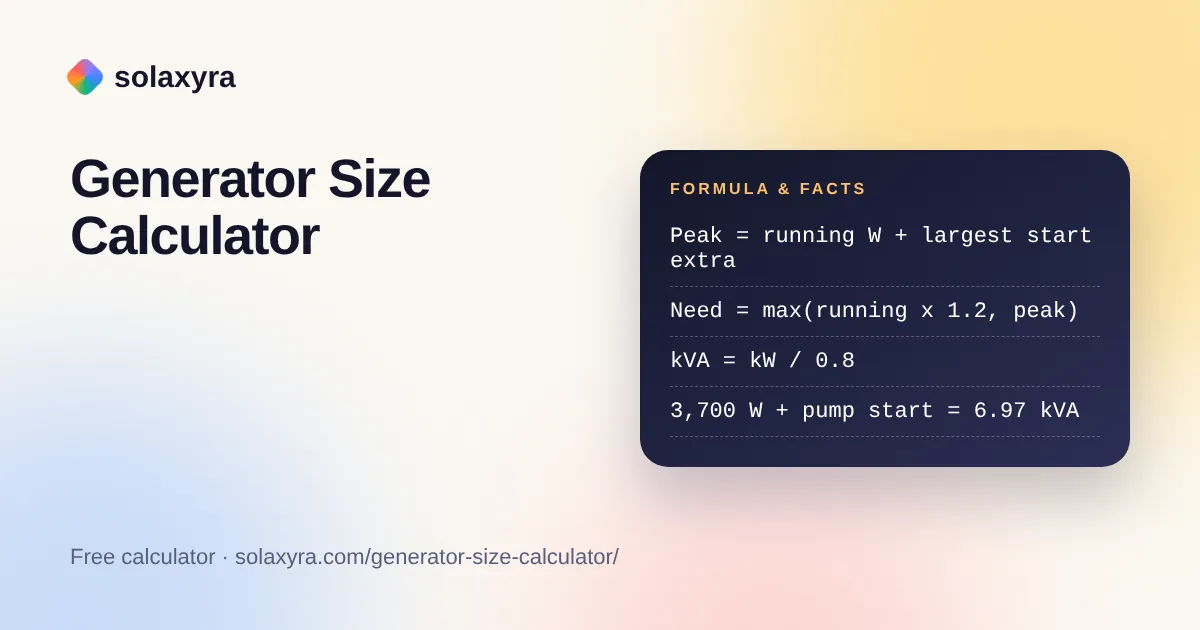
A generator size calculator is a tool that estimates the smallest continuous generator rating that can run a set of loads at the same time, including the brief surge when motors start. Generators are usually rated in kVA as well as kW, so the result is given in both. In plain words: required kW is the larger of running load plus headroom, or running load plus the largest starting surge; kVA equals that kW divided by the power factor.
The 0.8 power factor is the convention generator makers use when they quote kVA; one manufacturer selection guide converts with kW divided by 0.8 to give kVA, and also advises allowing 20% extra on the total power requirement so the generator does not run flat out all the time. Both are editable in the generator size calculator.
How Do You Use the Generator Size Calculator?
- Start from the example list or clear it with the Remove buttons.
- Add loads from the drop-down or as custom items, and type the running watts from each rating plate.
- Set the starting multiple: 1 for heaters, kettles, lights and electronics; about 1.2 for brush motors in power tools; about 3 to 3.5 for induction motors in fridges, pumps and compressors, unless the maker gives a figure.
- Set the quantity of each item running at the same time.
- Adjust headroom, power factor and any derating the manufacturer specifies for heat or altitude.
- Read the minimum kVA and kW, the peak load, and whether the running load or a motor start decides the size.

What Is the Difference Between Running Watts and Starting Watts?
Running watts are what an appliance draws once it is going; starting watts are the short peak when an electric motor gets up to speed, which can be several times higher. A manufacturer guide gives induction motors such as fridges, sump pumps and compressors a starting factor of 3 to 3.5 times running power, and brush motors in tools such as angle grinders about 1.2 times. The Wikipedia article on induction motors puts locked-rotor current for standard motors at about 6 to 7 times rated current, so some pumps and compressors need even more.
| Load type | Examples | Starting multiple used here |
|---|---|---|
| Resistive | Kettle, heater, toaster, incandescent lamp | 1 |
| Electronics and LED | Router, laptop, TV, LED lights | 1 |
| Brush (universal) motor | Angle grinder, drill, many vacuum cleaners | About 1.2 |
| Induction motor | Fridge, freezer, sump pump, air compressor | About 3 to 3.5, more if the maker says so |
| Large direct-on-line motor | Borehole pump, workshop machinery | Use the maker’s starting current; often 6 or more |
The generator size calculator assumes only one motor starts at a time, which is why it adds the largest single starting surge rather than all of them. If two motors can start together, enter the second one’s extra in the first one’s multiple, or stagger them.
What Size Generator Do I Need for a House?
For essential loads in a home during a power cut, such as a fridge-freezer, lights, router and a kettle, the example list in the generator size calculator needs about 4.4 kVA; adding high-power items such as an electric shower, oven or heaters can multiply that. The exact figure depends on what you run at the same time, so list your actual loads.
The table shows what common sizes deliver at a 0.8 power factor and the largest running load each can carry while keeping 20% headroom.
| Generator (kVA) | kW at PF 0.8 | Running load with 20% headroom |
|---|---|---|
| 2 | 1.6 kW | 1,333 W |
| 3 | 2.4 kW | 2,000 W |
| 5 | 4.0 kW | 3,333 W |
| 7.5 | 6.0 kW | 5,000 W |
| 10 | 8.0 kW | 6,667 W |
| 15 | 12.0 kW | 10,000 W |
| 20 | 16.0 kW | 13,333 W |
For unit conversions on their own, the kW to kVA calculator and the kVA to kW calculator show the power factor step in detail.
Why Are Generators Rated in kVA Instead of kW?
A generator’s alternator is limited by the current it can carry, whatever the power factor of the load, so its electrical rating is given as apparent power in kVA; the engine sets the kW it can deliver. Multiplying kVA by the power factor gives kW: a 10 kVA generator at 0.8 delivers 8 kW. Small portable sets for home use are often quoted in watts only, so check whether the figure is continuous (rated) or maximum (peak) power and size against the continuous figure.
Can a Portable Generator Power My Whole House?
Only through a properly installed changeover (transfer) switch; never by plugging the generator into a socket. The Wikipedia article on transfer switches explains that the switch isolates the generator from the grid, preventing backfeed into the network that can endanger line workers who expect cables to be dead. In the UK the switch and any connection to fixed wiring must be installed by a qualified electrician and meet BS 7671; elsewhere, follow local wiring rules.
Without a changeover switch, run appliances from the generator’s own outlets with suitably rated extension leads. A 13 A socket can supply about 2,990 W at 230 V, so the calculator warns when one item exceeds that.
Where Is It Safe to Run a Generator?
Outdoors only, well away from doors, windows and vents. The NHS lists portable generators among the sources of carbon monoxide, a gas you cannot see or smell that can kill, and advises never running engines in garages or other enclosed spaces and fitting a carbon monoxide alarm. Never refuel a hot or running generator, keep fuel stored safely, and keep the unit dry. If you would rather avoid fuel and fumes for small loads, compare the power station runtime calculator.
Worked Example: Backup Power for Essentials and a Sump Pump
Example: a home in Somerset wants to run a fridge-freezer (150 W), LED lights (200 W), router and laptop (100 W), a kettle (2,500 W) and a 750 W sump pump during a flood-season power cut, using example ratings with a starting multiple of 3.5 for both motors.
- Running load: 150 + 200 + 100 + 2,500 + 750 = 3,700 W.
- Largest starting extra: sump pump 750 x (3.5 minus 1) = 1,875 W, more than the fridge’s 375 W.
- Peak: 3,700 + 1,875 = 5,575 W.
- Running plus 20% headroom: 3,700 x 1.2 = 4,440 W, lower than the peak, so the motor start decides the size.
- Minimum rating: 5,575 W / 0.8 = 6.97 kVA, so a 7.5 kVA generator. Without the pump the same list needs only 4.43 kVA.
Frequently Asked Questions
How do I calculate what size generator I need?
Add the running watts of everything that will run together. Add the extra starting watts of the largest motor to find the peak, and compare it with the running total plus about 20%. Take the larger figure, divide by 0.8 and by 1,000, and choose a generator with at least that continuous kVA rating.
How many kW is a 5 kVA generator?
At the usual power factor of 0.8, a 5 kVA generator delivers 4 kW. Keeping 20% headroom, plan for a running load of about 3,300 W. Some small generators quote kW at a power factor of 1, so check the specification sheet for the continuous rating.
What size generator do I need to run a fridge-freezer?
A fridge-freezer running at around 150 W needs far more for a moment when its compressor starts, often 3 to 3.5 times its running power. On its own that is about 525 W peak, so a small 1 kVA generator is usually enough; check the appliance’s rating plate.
Should I size a generator on peak or continuous power?
Size on the continuous (rated) power. The peak or maximum rating can only be sustained briefly, which is enough for motor starts but not for steady loads. Your running load plus headroom must fit the continuous rating, and the starting peak should fit within it too.
Can I plug a generator into a wall socket to power my house?
No. Backfeeding through a socket can make the house wiring and the street supply live, endangering you, neighbours and network workers, and can damage the generator. Connection to house wiring needs a changeover switch installed by a qualified electrician to BS 7671 in the UK.
Is an inverter generator better for electronics?
Inverter generators electronically regulate their output, which makers promote for laptops, TVs and boiler controls. Size them the same way as any generator, using the continuous rating, and check the maker’s figures for motor starting, because small inverter units can have limited surge capacity.
Checked October 2026 by the Solaxyra Editorial Team. Sources: SDMO: Which generator? (manufacturer selection guide), Wikipedia: Induction motor, Wikipedia: Transfer switch, NHS: Carbon monoxide poisoning, IET: BS 7671.