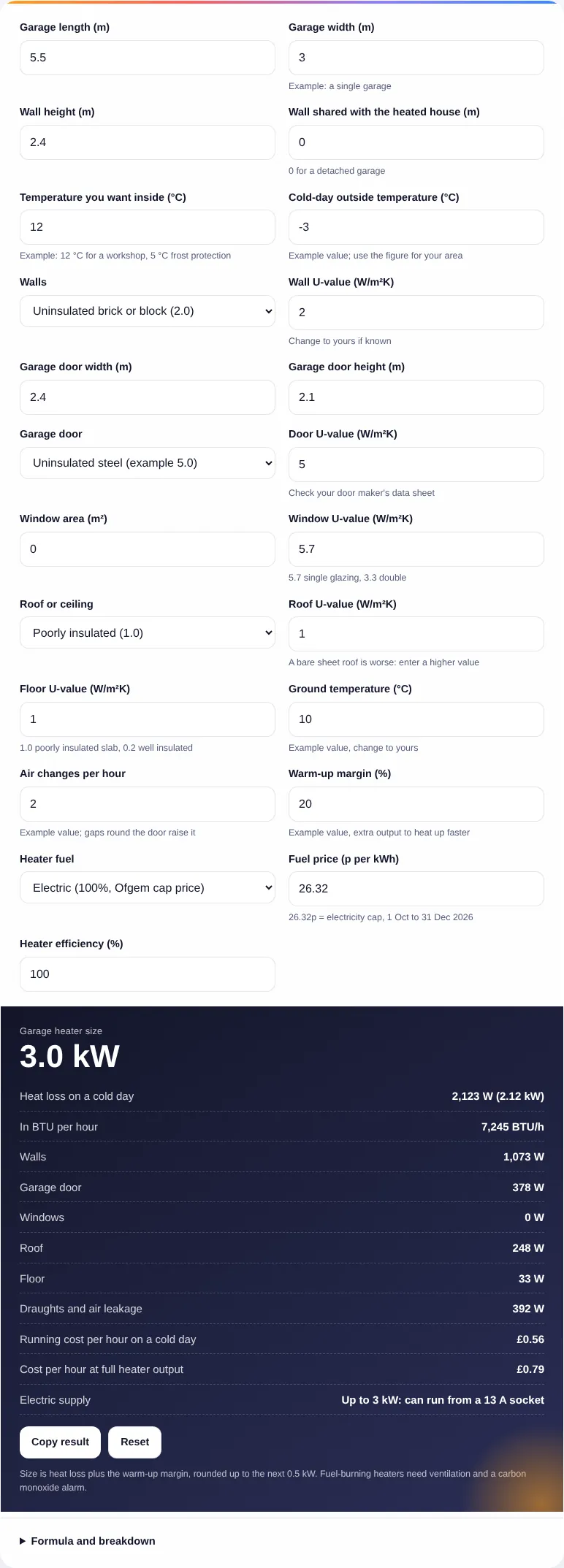
Size is heat loss plus the warm-up margin, rounded up to the next 0.5 kW. Fuel-burning heaters need ventilation and a carbon monoxide alarm.
Formula and breakdown
n/a
n/a
n/a
n/a
This garage heater size calculator works out how many kilowatts of heat a garage or workshop needs on a cold day, for UK and European owners choosing between an electric heater, a fixed unit or a fuel-burning heater. It adds up the heat lost through the walls, garage door, windows, roof, floor and draughts, adds a warm-up margin and shows the running cost per hour.
Quick answer: A garage heater size calculator adds the heat lost through each surface (area x U-value x temperature difference) to the heat carried off by draughts. A detached, uninsulated 5.5 x 3 m single garage held at 12 °C with minus 3 °C outside loses about 2.1 kW, so a 3 kW heater fits.
What Is a Garage Heater Size Calculator?
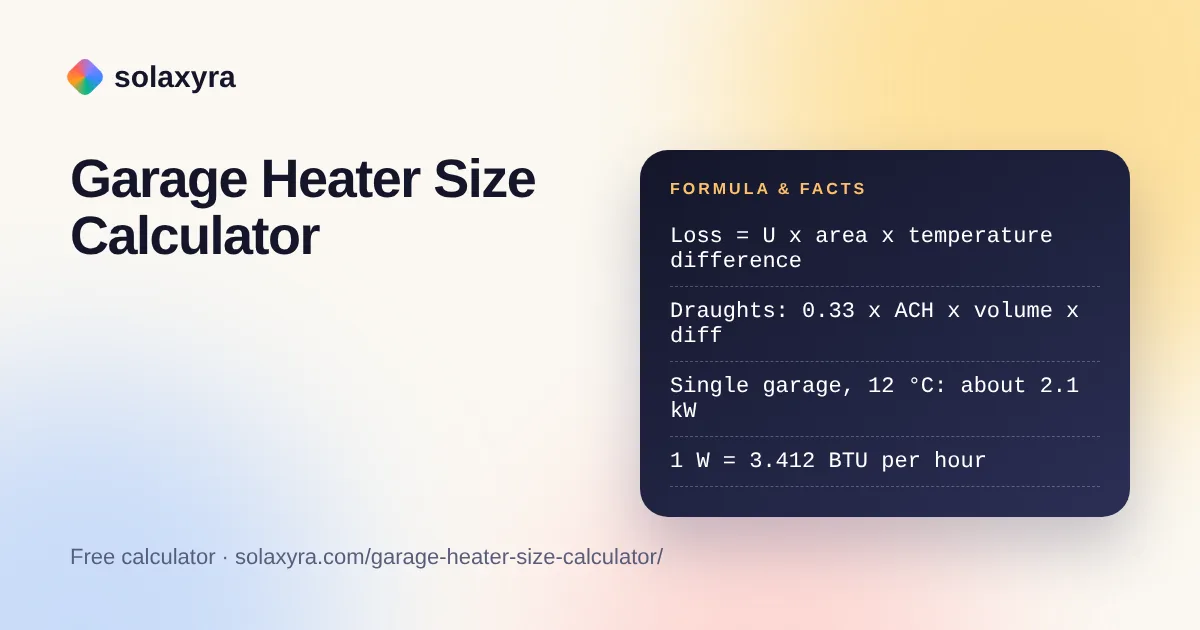
A garage heater size calculator is a tool that estimates the heat output a heater must deliver to hold a garage or workshop at a chosen temperature when it is cold outside. In plain words: for the walls, door, windows, roof and floor, heat loss equals area times U-value times the inside to outside temperature difference; draughts add 0.33 times air changes per hour times the garage volume times the same difference; the heater should match that total plus a margin for warming up.
The U-value is the heat in watts that passes through one square metre of a material for each degree of temperature difference. The Wikipedia article on thermal transmittance gives the heat flow formula used here and typical values such as 2.0 W/m²K for a poorly insulated wall and 0.15 W/m²K for a well insulated one.
How Do You Use the Garage Heater Size Calculator?
- Enter the garage length, width and wall height, and the length of any wall shared with the heated house.
- Set the temperature you want inside and a cold-day outside temperature for your area.
- Choose the wall, garage door and roof types, or type U-values from your own data sheets.
- Enter the door size, any window area and the floor U-value.
- Set the air changes per hour and the warm-up margin, then pick electric or enter another fuel’s price and efficiency.
- Read the heater size, the split of heat loss by surface and the running cost per hour; the garage heater size calculator updates as you type.
What Size Heater Do I Need for a Garage?
An uninsulated single garage usually needs about 2.5 to 3 kW to reach 12 °C on a cold day, an insulated one about 1 kW, and an uninsulated double garage kept at 18 °C about 6 kW. The table runs the garage heater size calculator for common cases; every row uses minus 3 °C outside and a 20% warm-up margin unless stated.
| Example garage | Changes from default | Heat loss | BTU/h | Heater size | Electric cost per hour |
|---|---|---|---|---|---|
| Single, detached, uninsulated, 12 °C (default) | None | 2,123 W | 7,245 | 3.0 kW | £0.56 |
| Same, frost protection only | 5 °C inside | 1,115 W | 3,804 | 1.5 kW | £0.29 |
| Same, attached on one long side | 5.5 m shared wall | 1,727 W | 5,894 | 2.5 kW | £0.45 |
| Same, insulated sectional door | Door U 1.35 | 1,847 W | 6,304 | 2.5 kW | £0.49 |
| Partly insulated, insulated door and roof | Walls 0.6, door 1.35, roof 0.10, 1 air change | 678 W | 2,312 | 1.0 kW | £0.18 |
| Well insulated throughout | Walls 0.15, door 0.4, roof 0.10, floor 0.2, 0.5 air changes | 240 W | 819 | 0.5 kW | £0.06 |
| Double garage, 6 x 6 m, uninsulated | 18 °C inside | 4,978 W | 16,986 | 6.0 kW | £1.31 |
| Workshop, 8 x 6 x 3 m, draughty | 18 °C inside, minus 10 °C outside, 3 air changes | 10,847 W | 37,012 | 13.5 kW | £2.85 |
Cost per hour is the heat loss at 26.32p per kWh, the Ofgem price cap electricity rate from 1 October to 31 December 2026. On milder days a thermostat cuts the heater back, so the real hourly cost is usually lower.
How Much Heat Does a Garage Door Lose?
An uninsulated steel garage door can lose more heat than all the walls of a well insulated garage combined: with the example value of 5.0 W/m²K, a 2.4 x 2.1 m door loses about 378 W at a 15 degree difference. Swapping to a 40 mm insulated sectional door rated at 1.35 W/m²K cuts that to about 102 W.
Door makers publish U-values. The Gliderol insulated sectional door with 40 mm panels is listed at 1.35 W/m²K, and ASSA ABLOY quotes 1.0 W/m²K for its standard Crawford OH1042P sectional door and 0.4 W/m²K for the OH1082P with 82 mm of insulation. In the garage heater size calculator, the 5.0 figure for an uninsulated steel door is an example value, so replace it with your door maker’s figure if you have one.
Why Do Draughts Matter So Much in a Garage?
Air leakage takes about 392 W of the 2,123 W in the default garage, and in a draughty workshop with three air changes an hour it becomes the largest single loss. Each air change replaces the whole volume of warm air with cold air, and warming one cubic metre of air by one degree takes about 0.33 Wh.
Gaps round an up-and-over door, unsealed eaves and air bricks all raise the rate. Brush or rubber seals round the door are among the cheapest upgrades, and you can test the effect by lowering the air changes in this garage heater size calculator. The 2 air changes default is an example value, not a measurement.
Should a Garage Heater Be Electric, Gas or Paraffin?
An electric heater is the simplest and safest choice for an enclosed garage, because it produces no fumes, while gas, paraffin and diesel heaters need ventilation and a carbon monoxide alarm. The NHS page on carbon monoxide poisoning lists gas and paraffin heaters as sources, warns that the gas has no colour or smell, and advises a CO alarm in every room with a fuel-burning appliance.
Never run a car or petrol engine in a closed garage. Any fixed gas heater must be installed by a Gas Safe registered engineer, and a flued appliance is safer than a flueless one in a small space. For a fuel heater, choose “Other fuel” in the garage heater size calculator and enter its price per kWh and efficiency to compare the hourly cost with electric.
Can a Garage Heater Plug Into a 13 A Socket?
A heater up to 3 kW can run from a standard 13 A socket, because 13 A x 230 V is 2,990 W, but anything larger needs its own circuit. Our watts to amps calculator shows the current any heater draws; a 3 kW unit pulls about 13 A, which is the full rating of the plug, so avoid extension leads and multi-way adaptors.
A fixed heater, a new socket in a garage or a supply cable from the house to a detached garage must be installed by a qualified electrician to BS 7671. In England and Wales this work falls under Part P of the Building Regulations; Approved Document P explains when it must be notified, so use a registered electrician who can certify it.
How Much Does It Cost to Heat a Garage?
At the October 2026 cap rate, holding the default uninsulated single garage at 12 °C on a minus 3 °C day costs about 56p an hour with electric heat. Run for four hours a day, five days a week on such days, that is about £11 a week. The electric heater running cost calculator works out costs for different heater types and thermostat settings, and the electricity cost calculator handles any other tool in the workshop.
Insulation pays back quickly in a garage that is heated often. In the garage heater size calculator table, insulating the walls, door and roof cuts the cold-day heat loss from 2,123 W to 678 W, roughly a two-thirds reduction in running cost.
Worked Example: Detached Single Garage Used as a Workshop
Example: a detached 5.5 x 3 m brick garage in Sheffield with 2.4 m walls, an uninsulated steel door 2.4 m wide and 2.1 m high, a poorly insulated roof and a concrete floor is heated to 12 °C for woodwork when it is minus 3 °C outside.
- Temperature difference: 12 minus (minus 3) = 15 K. Perimeter 17 m; wall area 17 x 2.4 = 40.8 m², minus the 5.04 m² door = 35.76 m².
- Walls: 35.76 x 2.0 x 15 = 1,073 W. Door: 5.04 x 5.0 x 15 = 378 W.
- Roof: 16.5 m² x 1.0 x 15 = 248 W. Floor: 16.5 x 1.0 x (12 minus 10) = 33 W.
- Draughts: volume 39.6 m³; 0.33 x 2 x 39.6 x 15 = 392 W.
- Total 2,123 W (7,245 BTU/h). Add 20%: 2,548 W, rounded up to a 3 kW heater, costing about 56p an hour at the heat loss rate.
Frequently Asked Questions
What size heater do I need for a single garage?
An uninsulated detached single garage of about 5.5 x 3 m needs about 2.1 kW to stay at 12 °C when it is minus 3 °C outside, so a 3 kW heater with a warm-up margin suits it. Insulating the door, walls and roof can bring the need down to about 1 kW.
How many BTU do I need to heat a garage?
Multiply the heat loss in watts by 3.412 to get BTU per hour. The default single garage loses 2,123 W, about 7,245 BTU/h, while an uninsulated 6 x 6 m double garage at 18 °C needs about 17,000 BTU/h. The calculator shows BTU/h alongside watts for every result.
Is a 2 kW heater enough for a garage?
A 2 kW heater is enough for frost protection in an uninsulated single garage, which needs about 1.1 kW to stay at 5 °C on a minus 3 °C day. For a 12 °C workshop it falls short in cold weather unless the door and roof are insulated and draughts are sealed.
Is it safe to use a gas or paraffin heater in a garage?
Only with good ventilation and a working carbon monoxide alarm, because these heaters can produce carbon monoxide, which has no colour or smell. Fixed gas heaters must be installed by a Gas Safe registered engineer. An electric heater avoids fumes altogether and is the simpler choice for a closed garage.
Does insulating a garage door make a difference?
Yes. In the default garage, an uninsulated steel door at an example 5.0 W/m²K loses about 378 W, while a 40 mm insulated sectional door at 1.35 W/m²K loses about 102 W, cutting total heat loss by about 13% on its own.
How accurate is this garage heater size calculator?
It is a planning estimate. The U-values, air change rate, ground temperature and outside temperature are example values unless you enter your own, and real garages often have gaps and thin roofs that raise the loss. Choose the next size up if the garage is draughty or rarely heated.
Checked October 2026 by the Solaxyra Editorial Team. Sources: Wikipedia: Thermal transmittance, Gliderol insulated sectional door specification, ASSA ABLOY insulated overhead sectional doors, NHS: Carbon monoxide poisoning, HSE: Domestic gas safety FAQs, GOV.UK: Approved Document P, Wikipedia: Table of specific heat capacities, Ofgem price cap, 1 October to 31 December 2026.