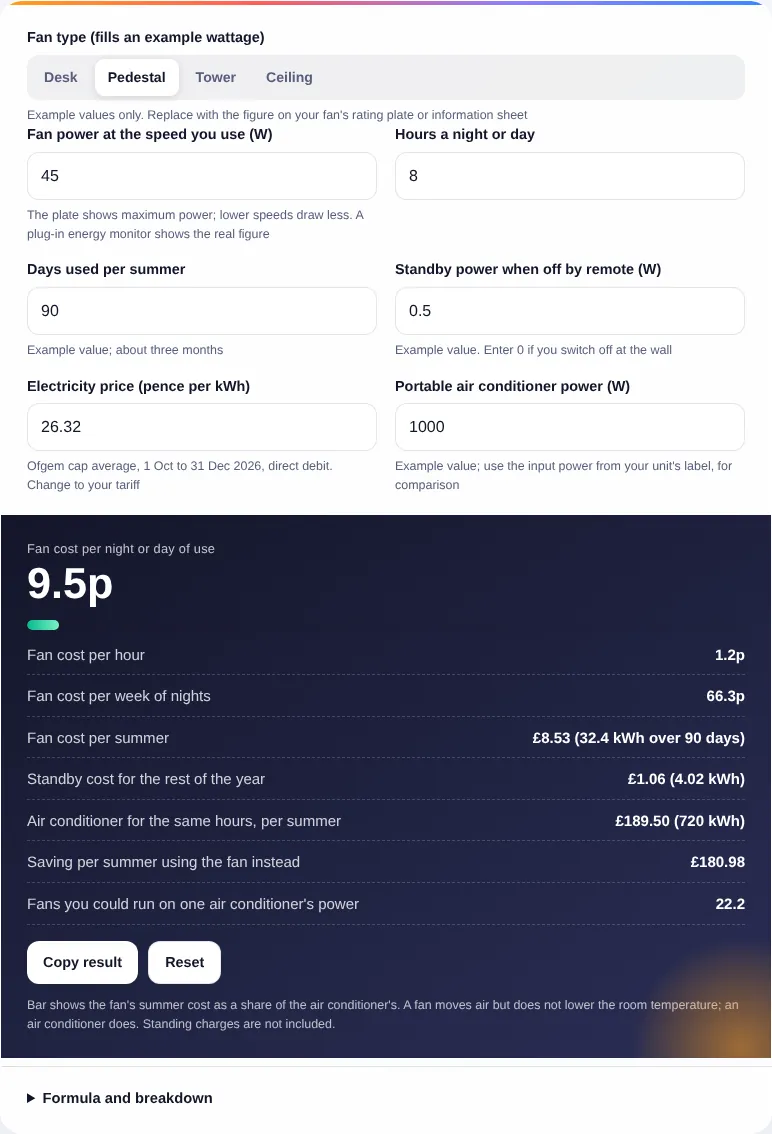
Bar shows the fan’s summer cost as a share of the air conditioner’s. A fan moves air but does not lower the room temperature; an air conditioner does. Standing charges are not included.
Formula and breakdown
n/a
n/a
n/a
This fan running cost calculator works out what a desk, pedestal, tower or ceiling fan costs to run per hour, per night and per summer, including standby, and compares it with a portable air conditioner used for the same hours, for households in the UK, Ireland and the rest of Europe.
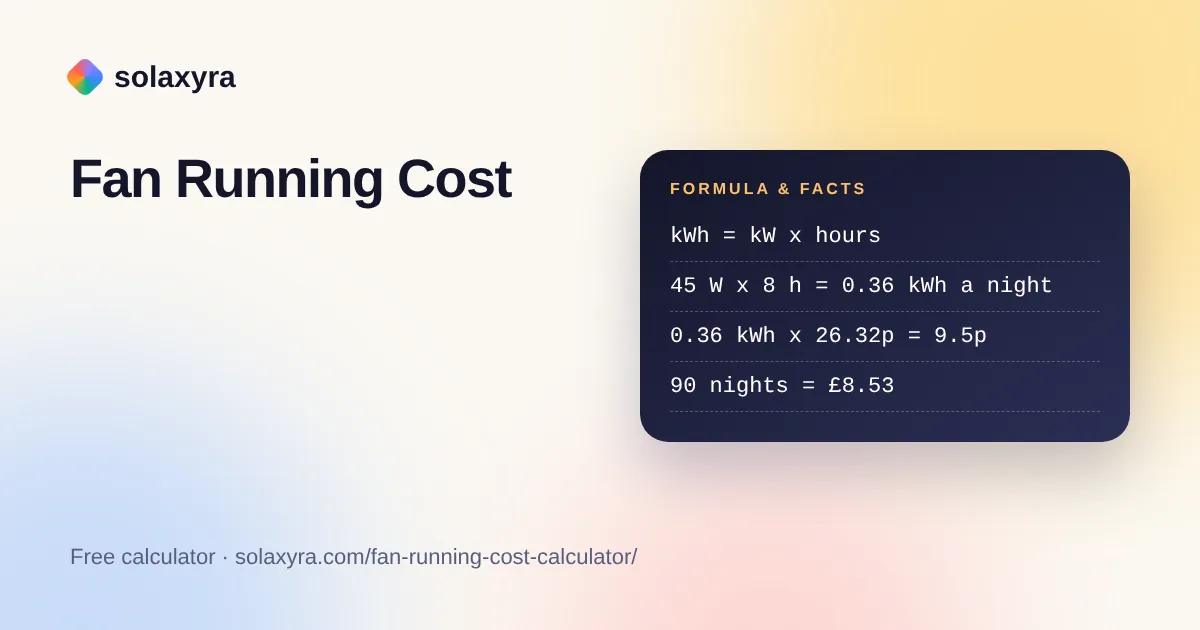
Quick answer: A fan running cost calculator multiplies the fan’s power in kW by hours of use and your unit price. A 45 W pedestal fan running 8 hours a night uses 0.36 kWh, about 9.5p a night, or £8.53 over a 90 night summer at the 26.32p Ofgem cap rate.
What Is a Fan Running Cost Calculator?
A fan running cost calculator is a tool that converts a fan’s electrical power and hours of use into kilowatt-hours and then into money at your electricity price. In plain words: energy in kWh = watts / 1,000 x hours, and cost = kWh x price per kWh. A summer is the nightly cost times the number of days you use it.
Standby is the part most cost guides miss. A fan with a remote control keeps a receiver powered when it is switched off, so it draws a small amount all year. This fan running cost calculator charges standby for every hour of the year the fan is not running. Enter 0 if you switch off at the wall socket.
How Do You Use the Fan Running Cost Calculator?
- Pick the fan type to load an example wattage, then replace it with your fan’s own figure.
- Enter the power at the speed you actually use; the rating plate shows the maximum.
- Enter hours a night or day and how many days you use it each summer.
- Enter the standby power, or 0 if you unplug or switch off at the socket.
- Check the electricity price. The default is the Ofgem cap average for 1 October to 31 December 2026.
- Enter a portable air conditioner’s input power to compare the cost of cooling the same hours.
How Much Does It Cost to Run a Fan per Hour?
A fan costs its wattage in kW times your unit price per hour: a 45 W fan costs 0.045 x 26.32p = 1.2p an hour at the October to December 2026 cap rate, and a 25 W desk fan about 0.66p. Even a 125 W fan, the upper limit of the EU ecodesign rules for comfort fans, costs about 3.3p an hour. The table shows typical figures.
| Fan power | Per hour | Per 8 hour night | Per 90 nights of 8 hours | Left on 24 hours, per day |
|---|---|---|---|---|
| 5 W (USB fan) | 0.13p | 1.1p | £0.95 | 3.2p |
| 15 W | 0.39p | 3.2p | £2.84 | 9.5p |
| 25 W | 0.66p | 5.3p | £4.74 | 15.8p |
| 40 W | 1.05p | 8.4p | £7.58 | 25.3p |
| 50 W | 1.32p | 10.5p | £9.48 | 31.6p |
| 75 W | 1.97p | 15.8p | £14.21 | 47.4p |
| 100 W | 2.63p | 21.1p | £18.95 | 63.2p |
| 125 W | 3.29p | 26.3p | £23.69 | 79.0p |
Figures use 26.32p per kWh. The wattages are examples spanning small USB fans to large pedestal and ceiling models; use your own fan’s figure for a real cost. The electricity cost calculator works the same way for any appliance.
How Much Does It Cost to Run a Fan All Night?
An 8 hour night costs the fan’s wattage x 8 / 1,000 x your unit price: about 9.5p for a 45 W fan and 5.3p for a 25 W fan at 26.32p per kWh. Over a 90 night summer the 45 W fan costs about £8.53 and uses 32.4 kWh. A fan’s speed setting makes a real difference, because the low setting draws less than the maximum on the plate.
Standby adds a little: a fan drawing 0.5 W on standby for the remaining 8,040 hours of the year uses about 4 kWh, roughly £1.06. Fans plugged into a smart plug or a socket switched off at the wall avoid this. If you want to check other devices left on standby, the energy consumption calculator totals several appliances at once.
Is a Fan Cheaper to Run Than an Air Conditioner?
Yes, by a wide margin: with the defaults, a 1,000 W portable air conditioner used for the same 8 hours on 90 nights costs about £189.50, against £8.53 for the 45 W fan, because it draws about 22 times as much power. The fan running cost calculator shows the saving and the power ratio for your own inputs.
The two do different jobs. As the ceiling fan article on Wikipedia explains, fans cool people by increasing air speed and helping sweat evaporate, but do not reduce air temperature or humidity; an air conditioner removes heat from the room. In very hot weather a fan may not be enough. For the air conditioner side, use its input power from the label rather than its cooling capacity, or see the air conditioner running cost calculator for a full model.
Which Type of Fan Is Cheapest to Run?
The cheapest fan to run is the one with the lowest power at the airflow you need, whatever its shape. In the EU, Ecodesign Regulation (EU) No 206/2012 covers comfort fans with an electric power input up to 125 W and requires manufacturers to publish the maximum air flow rate in m³/min, the fan power input in W, the service value (air flow per watt), standby power and sound power level.
Compare service values when choosing: a higher figure means more air for each watt. The example wattages in the calculator for desk, pedestal, tower and ceiling fans are only starting points; product information sheets and rating plates vary widely within each type. A ceiling fan is fixed wiring and must be installed by a qualified electrician; in the UK the work must meet BS 7671.
What Electricity Price Should I Use?
Use the unit rate on your latest bill. On a default tariff in England, Scotland or Wales, Ofgem’s cap announcement gives an average of 26.32p per kWh for electricity paid by direct debit from 1 October to 31 December 2026. Summer prices will follow whichever cap period applies then, so update the price in the fan running cost calculator when it changes. On a time of use tariff, use the night rate for overnight running. Standing charges are left out because you pay them whether or not the fan runs.
Worked Example: Tower Fan or Portable Air Conditioner for a Bedroom?
Example: a household in London cools a bedroom for 9 hours a night on 75 summer nights. It compares a 35 W tower fan with 1 W standby and a 900 W portable air conditioner. The price is 26.32p per kWh. The wattages and standby figure are example values, and the fan running cost calculator gives the same results for these inputs.
- Fan per night: 0.035 kW x 9 h = 0.315 kWh, or 8.3p.
- Fan per summer: 8.29p x 75 = £6.22, using 23.6 kWh.
- Standby: 8,760 minus 675 hours in use = 8,085 hours x 1 W = 8.1 kWh, or £2.13 a year.
- Air conditioner: 0.9 kW x 9 h x 75 = 607.5 kWh, or £159.89 per summer.
- Saving with the fan: about £153.68 per summer; the air conditioner draws about 25.7 times the fan’s power.
Frequently Asked Questions
How much does it cost to run a fan for an hour?
Multiply the fan’s power in kW by your unit price. At 26.32p per kWh a 25 W desk fan costs about 0.66p an hour, a 45 W pedestal fan 1.2p and a 100 W fan 2.6p. Lower speed settings draw less power than the maximum shown on the rating plate.
How much does it cost to run a fan all night?
For an 8 hour night, a 45 W fan uses 0.36 kWh, about 9.5p at 26.32p per kWh. A 25 W fan costs about 5.3p. Over 90 nights the 45 W fan costs about £8.53. Enter your own wattage, hours and price for an exact figure.
Do fans use a lot of electricity?
No. Most household fans draw tens of watts, compared with 1,000 W for the example portable air conditioner in the calculator. EU ecodesign rules for comfort fans cover models of up to 125 W input. Over a whole summer a typical fan uses a few tens of kWh.
Is it cheaper to run a fan or an air conditioner?
A fan is far cheaper. With the default inputs, a 45 W fan costs about £8.53 over 90 eight hour nights, against about £189.50 for a 1,000 W portable air conditioner. The air conditioner cools the room, while a fan only moves air, so the choice depends on how hot it gets.
Does a fan use electricity when switched off?
A fan with a remote control or electronic controls can draw a small standby power while off, because the receiver stays powered. A fan with a mechanical switch usually draws nothing. Switching off at the wall socket stops any standby use completely.
How do I find my fan’s wattage?
Look at the rating plate on the base or motor housing, or in the manual. In the EU the product information for comfort fans must state the fan power input in watts. A plug-in energy monitor shows the real draw at each speed setting.
Checked October 2026 by the Solaxyra Editorial Team. Sources: Ofgem: Energy price cap 1 October to 31 December 2026, EUR-Lex: Commission Regulation (EU) No 206/2012, Wikipedia: Ceiling fan.